Close

Archive for category: Solutions For Living

by

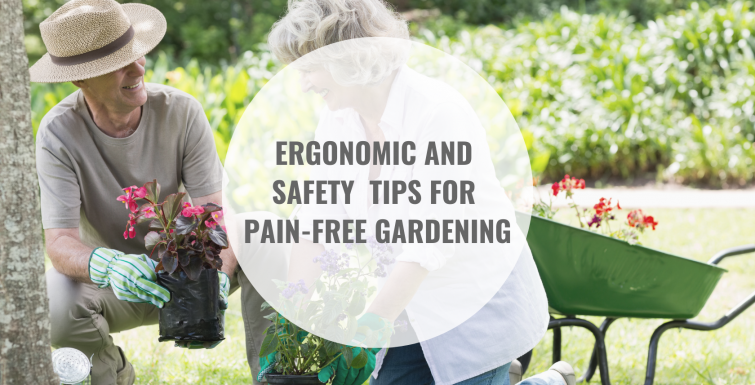
Ergonomic and Safety Tips for Pain-Free Gardening

Do you have, or are aspiring to have, a “green thumb?”  Or do you simply enjoy beautifying your home or spending time connecting with nature?  Whether you garden for pleasure or purpose you may be reaping many of the health benefits, however, you may also from time to time suffer from a sore back and achy muscles brought on by the hard work and bending involved.  Take a look at the following article from Sunnybrook which discusses simple ways to prevent aches, pains, and injury when gardening so you can enjoy your garden all season long. 

Sunnybrook– Your Health Matters:    How to avoid pain or injury while gardening

by

Brain Injury Recovery O-Tip of the Week: There’s an App for That!

Our O-Tip of the week series we will be providing valuable “OT-Approved Life Hacks” to provide you with simple and helpful solutions for living. 

June is Brain Injury Awareness Month.  Occupational Therapists are a vital part of a team of professionals that assist with the rehabilitation from brain injury.  Therefore, for the month of June, our series will be providing solutions to assist with some of the common cognitive deficits that can result from brain injury.

Remember the old Apple commercials… “There’s an app for that!”  Well, isn’t that the truth.  You can find apps for just about anything, and in fact, there are some great apps that can assist with memory and cognition for those who are recovering from a brain injury.  Some of these apps are summarized below:

by

LGBTQ+: Three Strategies to Make Your Business More Inclusive

Julie Entwistle, MBA, BHSc (OT), BSc (Health / Gerontology)
Co-written by Jacquelyn Bonneville, Occupational Therapist and proud member of the LGBTQ+ community

Have you ever been on vacation to Jamaica, Dominica, or St. Lucia? Have you ever Googled pictures of the beautiful Maldives? Did you know that all of these countries, and some 70 others, have anti-homosexuality laws punishable by fine, imprisonment, or death? Globally we still have a long way to go, but like all progress, we must remain proud of the steps forward we are taking in regards for Lesbian, Gay, Bisexual, Transgender, and Queer (LGBTQ+) awareness and rights.

Pride month is celebrated in June in every year in honour of the 1969 Stonewall riots in Manhattan, USA; a turning point for LGBTQ+ activism. If you don’t identify with this culture you may not feel that pride month is relevant to you, however, the spirit of pride month is to embrace diversity and peace, which all of us should celebrate, especially as proud Canadians.  This point, and the concept of peace, is even more prominent today considering the 2016 events in Orlando that resulted in the senseless killing of 49 innocent people as they attended a nightclub frequented by the LGBTQ+ community.

In honour of pride month, we’d like to offer 3 simple ways you can make your business more LGBTQ+ friendly:

 1.  Challenge Your Assumptions

It can be easy to assume that everyone is straight; when you ask a man if he has a wife, or a woman if she has a husband, you could be unintentionally making an awkward scenario for a non-straight person. If you have an intake form that only has two gender options (male or female), you could be instantly excluding someone or causing them to feel uncomfortable about your services.

As therapists, we are often in a position of asking about our client’s social supports. Instead of making assumptions, ask more open-ended questions such as “Are you in relationship with someone right now”, “who is your main source of support”, or “do you have a significant other?” Have an “other” option for gender on intake forms, or include sex as well as gender if someone’s sexual organs are relevant to your medical field. Consider expanding “married” on your intake process to include “common law” and “long term relationship”.  You’ll still get the information you need, but in a more inclusive way.

2.  Don’t be Afraid You’ll Use the Wrong Terminology

My husband’s name is Kelly.  Many times people have assumed he would be female:  he has been put on the girls’ draw in tennis tournaments, rendered us to win the prize for the “ladies best foursome” in a golf event, and often our mail and solicitation calls are directed to Mrs. Kelly. We’ve all called someone by the wrong name/gender accidentally before. It’s embarrassing – usually, they correct us, we apologize, and chances are you’ll never forget their name again. It happens, but in the grand scheme of things, it isn’t a big deal.

Gay, lesbian, queer, bisexual, bigender, cisgender, gender fluid, asexual, feminine/masculine of center, intersex, MSM/WSM, pansexual, trans*, two-spirit, ze – what does it all mean? If you are not part of any particular minority group, it can be difficult to know if you’re wording something ‘correctly’ and it may make you uncomfortable. You may even be afraid to offend someone – isn’t ‘queer’ an offensive term? It all comes down to individual preference – and you won’t know until you ask.

Instead of assuming a person is Sir or Ma’am, Mr. or Mrs. based on your assumption of their gender, get used to asking more inclusive, generalized questions as part of your daily routine. There is nothing wrong with asking a client/patient, “What’s your preferred name?” or “How should I address you?” And if you slip and use the wrong pronoun or term in addressing them, simply apologize, correct yourself, and move on. Besides, a good businessperson should have a healthy dose of humility – your clients will respect you more for trying to use their preferred terminology, even if you make a mistake. Don’t worry.

3.  Understand Some of the Systemic Barriers LGBTQ+ Persons may Face in Your System 


Knowledge of some of the challenges in your own business that directly affects persons of various sexual orientations and genders will only make your business more inclusive. Some questions that may be relevant to health care professions include:

  • Can a bisexual person donate blood in your city?
  • Is a transperson legally able to give emergency medical consent if their loved one is unconscious?

Will a queer person be safe in a shared hospital room if their partner comes to visit them?

Health care isn’t as easily accessible as you may think. It can be very challenging to find competent medical and rehabilitation practitioners that are educated on health factors more common in certain minority populations, and so not all people feel they can be open with their family doctor or access health care without judgment. Knowledge is power – keep an eye out for changing laws, trends, or factors affecting the LGBTQ+ population in your area.

In the end, consider adopting some of these strategies into your everyday life, and you’ll be making maximum impact with minimal effort. To quote a Futurama cartoon episode:  “When you do things right, people won’t be sure you’ve done anything at all.”

No one may notice you changed your language, or thank you for making the change – but to that client who needs to know that they’re safe with you, I guarantee you that your choice of inclusive words will make all the difference.

As Occupational Therapists we are lucky to be able to assess our clients holistically and to consider all of the factors that may be affecting their occupational performance including sexual orientation, gender, sex, and social support networks. We can constantly challenge our assumptions to help develop into even better practitioners.

Happy Pride Month!

Originally posted June 2016
 

by

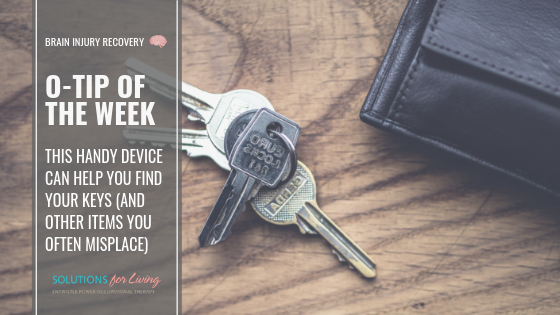
Brain Injury Recovery O-Tip of the Week: This Handy Device Can Help You Find Your Keys

Our O-Tip of the week series we will be providing valuable “OT-Approved Life Hacks” to provide you with simple and helpful solutions for living. 

June is Brain Injury Awareness Month.  Occupational Therapists are a vital part of a team of professionals that assist with the rehabilitation from brain injury.  Therefore, for the month of June, our series will be providing solutions to assist with some of the common cognitive deficits that can result from brain injury. 

This tip definitely does not only apply to those recovering from brain injury… If you’re someone who is always misplacing your keys and/or wallet (or other items) this helpful piece of technology is for you!  Tile is a small Bluetooth tracking device you can attach to a keychain, slip into your wallet or attach to anything you frequently have to search for.  This device syncs with an app on your smartphone that will allow you to easily locate your items when in need – saving you a lot of time, effort and frustration!

Learn more here: https://www.thetileapp.com/en-us/how-it-works


by

The Importance of Hope

Julie Entwistle, MBA, BHSc (OT), BSc (Health / Gerontology)

June is Brain Injury Awareness Month.  For many who suffer a brain injury the road to recovery is long and filled with many twists and turns along the way.  I wanted to post this popular blog post as a reminder to not give up hope, no matter how difficult the journey may be.

A friend asked me to visit a colleague of his who was in the hospital following a spinal infection.  The spinal infection and resulting surgery caused paralysis and the gentleman was told he will not walk again.  During our visit we spoke of the non-profit organization “Spinal Cord Injury Ontario” and the client’s wife told me the story of their first meeting with a Peer Support volunteer.  She recalled that the volunteer (a paraplegic) entered their room and introduced himself.  The wife politely thanked him for coming but told him they would not need his services as they strongly believe that her husband will walk again.   The volunteer’s answer was brilliant – he told them that even though it has been years since his own accident, he too has not given up hope that one day there will be a cure for paralysis.  He explained that he keeps himself in great shape as to always be prepared for that day.  He told my friend’s colleague to never give up hope.

This conversation reminded me that hope is essential.  As a health professional, I realized early that one of the key roles I play in the lives of my clients is to foster hope.  Hope for a better future, for a solution to their current problems, and for a better way to manage.  Even just discussing problems and brainstorming solutions elicits hope.  Health professionals should never undervalue the importance of fostering hope – even if that is in the face of one huge challenge after another.  Where hope becomes dangerous is when people are so busy waiting for “the cure” that they forget to manage in the meantime.  Hope, like goals, is essential to survival, but so is survival in between.  To forgo opportunities, solutions and help in the hopes of a future “fix” will only cause secondary problems that may be larger than the initial problem in the first place.

This philosophy is supported by most Chronic Pain Programs – they will not admit people to participate if that person is banking on a surgery, medication, or other therapy to “fix” them.  Some problems are chronic, and learning to manage with the trials of life despite the problem is the only therapy.  This should not squish hope – but rather should allow hope to live and breathe among optimal function.  

I always try to remain hopeful.  Hopeful for a better world for my children, for resolution of pain and suffering for my clients, for the health of others, and for my industry to remain a place where injured people can be adequately supported during their recovery.  But I recognize that it is not always easy to feel hopeful.  So, if you ever find yourself running on empty in the hope tank, try calling a supportive friend or family member, looking online (or on this blog) for inspiration, watching a funny or uplifting movie, getting some exercise, changing your scenery, or seeking support from a health professional.  We are here for hope and help. 


Previously posted July 2013

by

The Need for Occupational Therapy in Non-Traditional Roles

The following, written by an OT student whose placements included a homeless shelter and working with troubled youth, discusses the need for occupational therapy in these non-traditional settings.  Learn more about this particular OT’s experiences in the following care of The Guardian.

The Guardian:  There’s a place for occupational therapy beyond councils and the NHS

by

O-Tip of the Week: Simple Solution to Steady a Cutting Board

Our O-Tip of the week series we will be providing valuable “OT-Approved Life Hacks” to provide you with simple and helpful solutions for living. 

For the month of May, our O-Tip series will showcase some creative solutions using a commonly found household item – rubber bands.

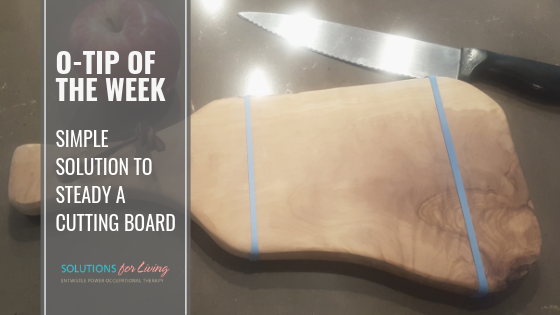
Stop a cutting board from sliding by wrapping thick elastic bands around it.  The rubber bands create a non-slip board allowing you to work safely.

by

Don’t Multi-Task, Multi-Purpose – It’s Better for You

Julie Entwistle, MBA, BHSc (OT), BSc (Health / Gerontology)

Like the word “busy”, the words “multi-task” had a few years of being “cool”.  People thought that “multi-tasking” was accomplishing more, being super-hero productive, and showing superior intellectual capacity.  But research into multi-tasking has proven the opposite and in fact, our brains are not able to multi-task at all.  In fact, trying to do two things at once is reducing our capability to manage either effectively. 

In the article “12 Reasons to Stop Multi-Tasking Now” it is highlighted that society has moved towards the implication that if you are not doing two things at once, you are wasting time.  It mentions the reasons to stop multi-tasking, including some important points like: “Moving back and forth between several tasks actually wastes productivity…because your attention is expended on the act of switching gears—plus, you never get fully “in the zone” for either activity”.  This causes activities to take “more time” so instead of both taking say 10 minutes each, together they take you 25.  Further, we miss things by trying to do too much.  Our skills become careless, or it reduces our ability to enjoy moments if we are texting and walking or emailing while also trying to watch the ballet recital.  Attending to two things at once actually drains our “working memory” which kills our creativity.  There is just not an upside.

My solution is something I call “multi-purpose”.  It is the way I try to spend my time when it makes sense to fit in multiple things.  But I apply this to chores and tasks at home, more than work.  For example, if I am out to get X, I will also survey my home and “to do list” to see if I can also do Y in the same errand.  Our orthodontist is beside the bike shop and seamstress, so every trip to get braces tightened also means pants with holes or bikes with slow leaks are also addressed.  The pet store is beside the Goodwill, so when the cats need food the donation bag in the garage is dropped off.  The grocery store is beside my favorite gas station, so stopping for one usually means stopping for the other.  With work, I, of course, try to book client visits that are nearby, and if I have time in between I want to know that I can stop at a coffee shop with my laptop for some charting (means I need to plan for this and bring my laptop with me).  I also bring a lunch, as stopping to eat (in my opinion) doesn’t benefit my time, wallet or waistband. I may or may not return calls in the car (hands-free of course) – it depends on whether my brain (or heart) just needs to “reflect and drive” or the urgency of the call.  Bottom line is that I don’t tend to go places without thinking “what else can I accomplish during this outing and how can my time be best spent?”  The things that fill my day tend to serve many purposes, but they are still done separately.  That is the art of multi-purpose without the troubles and inefficiencies of the misleading concept of “multi-tasking”.

by

Reap What you Sow: Healthy Benefits of Gardening

If you haven’t planted your garden already, now is the time!  In recent years there has been a rise in the number of people growing vegetables and fruits in their backyards, patios and even on rooftops.  Why?  From health benefits to financial savings, there are many benefits of growing your own food and working in the garden.

Check out the following article from Reader’s Digest to learn about the ways gardening can benefit your health and get growing today!

Reader’s Digest:  10 Surprising Ways Gardening Is One of the Healthiest Things You Can Do


by

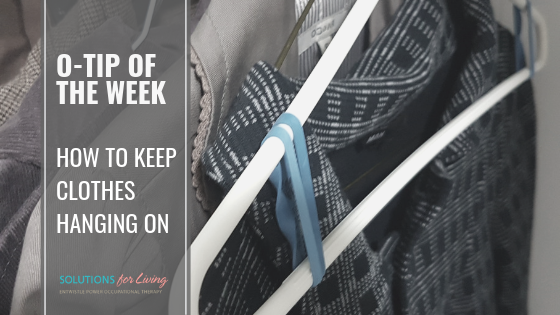
O-Tip of the Week: How to Keep Clothes Hanging On

Our O-Tip of the week series we will be providing valuable “OT-Approved Life Hacks” to provide you with simple and helpful solutions for living. 

For the month of May, our O-Tip series will showcase some creative solutions using a commonly found household item – rubber bands.

Attaching rubber bands to the end of your hangers will ensure your clothes never slip off when you’re searching through to find the perfect outfit!