Close

Archive for category: Solutions For Living

by

Washroom Safety and Independence: OT Can Help!

Julie Entwistle, MBA, BHSc (OT), BSc (Health / Gerontology)

For some people, the simple task of going to the bathroom can be a challenge.  This may be due to a recent surgery, mobility impairment or another medical issue that impacts the bladder or bowels.

In an episode from our OT-V series, we talk about some of the tools and methods Occupational Therapists will recommend when providing solutions for safe and effective washroom usage.

Watch the video below to learn more about how an Occupational Therapist can help an individual facing challenges in the washroom to ensure their safety, comfort and optimal independence.  


If you enjoyed this episode of OT-V please visit our YouTube Channel to see more informative videos about Occupational Therapy and the Solutions for Living OTs provide!

by

O-Tip of the Week: Open Jars with Ease

Our O-Tip of the week series we will be providing valuable “OT-Approved Life Hacks” to provide you with simple and helpful solutions for living. 

For the month of May, our O-Tip series will showcase some creative solutions using a commonly found household item – rubber bands.

Are you always struggling to open stubborn lids on jars?  No need to struggle anymore!  Simply wrap a thick elastic band around the lid and twist.  No need to purchase fancy gadgets with these free helpful tools in your kitchen drawer.


by

Getting around: Transportation Made Easier

Julie Entwistle, MBA, BHSc (OT), BSc (Health / Gerontology)

Have you ever wondered why the design of the objects we use and spaces around us are getting better and seem to relate to our bodies or the way we do things in a much more obvious way than ever before?

Barrier-Free Design allows the greatest majority of people equal access to the private and public spaces of our built environment. The aim is to minimize or eliminate physical, cognitive, and sensory barriers in our homes, businesses, and public spaces and even our streets.  

Consider the front entrance of a building. Sidewalk curbs, uneven walkways, multiple stairs, heavy doors, and lack of handrails. All these can prevent access because they can create barriers for individuals.

Universal design methods such as curb cuts, level and slip-resistant walkway surfaces, properly designed ramps, accessible washrooms, automatic doors, lifts, and colour-contrasted handrails are all examples of ways to support increased and barrier-free access not just for folks with a physical disability but for all of us, including children, the elderly, parents with strollers and many others.

Occupational Therapy promotes a wide range of barrier-free design and universal design principles that have helped to make better buildings and spaces in our communities.

There is a greater awareness in society that our buildings and spaces must be more accessible to the greatest majority of people. There are far more products and methods for creating barrier-free environments today than ever before which can be great for finding the right product or design solution for an individual. On the other hand, the vast and ever-growing range of products and design solutions can also be confusing, making choosing the right product a difficult one.  Occupational Therapists have the knowledge and experience to help facilitate the right approach by drawing on current research and best practices for creating barrier-free spaces.

Occupational Therapists provide helpful information and design advice to architects, designers, and contractors when it comes to creating barrier-free spaces inside homes, businesses, gardens, and even public spaces. And since there is a wide range of barriers that can contribute to preventing an individual from completing an activity such as reaching or bending, OTs help by determining what the barriers are for an individual and facilitating products and design strategies that can help surmount these barriers.

As OTs, we have the privilege to serve the needs of many people in the community and using our skills and practices to help people meet their individual needs of daily living and have productive and rewarding life experiences. For many, this may only be accomplished by implementing a barrier-free experience in their homes, businesses, and places they like to visit.

For example:

  • For individuals with visual impairments, spaces should have adequate lighting, colour contrasting surfaces where appropriate, tactile cueing and signage as well as audible alarm systems. For individuals with auditory impairments, visual signage and alarm systems (for example, flashing lights) are necessary.
  • For someone in a wheelchair, a barrier-free experience may include modifications to their workplace kitchens and washrooms. Fixtures such as light switches, sinks, paper towel dispensers, toilet paper dispensers and grab bars must be installed at a height that can be reached from a seated position.

Ultimately, the goal of barrier-free design is to promote equal access and participation for everyone. There have been many steps taken toward ensuring this type of design prevails in our communities. There are new laws supporting improved accessibility within Ontario as of January of 2015.  Is your building up to code? Consulting an occupational therapist can help to ensure your space meets the new criteria.

 

by

Do You Listen to Music While You Work?

Music at work… a distraction or a helpful part of your working environment?  The following article care of Inc Magazine discusses the science behind how music affects the brain and provides insight into the best times to play some tunes, and the circumstances where a quiet environment is more beneficial.

Inc Magazine:  What Listening to Music at Work Does to Your Brain (It’s Pretty Amazing)

We want to hear from you… do you listen to music while you work?  And… do you find it helpful or distracting? 

by

O-Tip of the Week: A Non-Slip Solution Care of Rubber Bands

Our O-Tip of the week series we will be providing valuable “OT-Approved Life Hacks” to provide you with simple and helpful solutions for living. 

For the month of May, our O-Tip of the Week series will showcase some creative solutions using a commonly found household item – rubber bands.

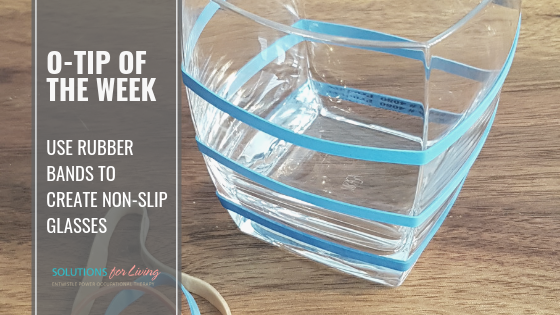
For someone who is lacking grip strength or for kids needing to use “glass” glasses wrap elastic bands around the glass to create a non-slip surface.

by

Making Groceries Easier – New Services Help People with All Abilities

Julie Entwistle, MBA, BHSc (OT), BSc (Health / Gerontology)

The major grocery stores in Ontario have been increasingly focusing their efforts on offering free or low-cost online shopping and pick up or delivery for customers.  Thought to be a result of Millennial overscheduling and impatience, this trend can provide life-changing services for persons with disabilities.  Whether a disability is physical, cognitive, mental or behavioural, public places can be extremely stressful and difficult for some people to navigate.  With online ordering and pick up, shoppers simply need to select items and pay online, arrange a pick-up time, park in a designated spot, call to state their arrival and wait until the purchases are loaded into their vehicle.

This can help to not only improve the ease of shopping but also varies the level of participation which can benefit some people.  For example, instead of sending a caregiver to the store with a list, if someone can use a computer, they can order the items they want independently and just leave the caregiver to do the pick-up.  No more problems with getting that wrong type of pasta sauce!

This is also actually more cost-effective, even considering the fees.  For example, if a caregiver is $25 per hour, then having them do shopping may cost $25-$50 in their hourly fee alone.  With the pick-up option, the fees may be minimal (or “free” depending on the size of the order) and the caregiver can just spend 10-15 minutes doing the pick-up (or unpacking items if they are delivered) versus taking an hour or more to shop.

Here is some information on the offerings by store that are now available in most major stores across Ontario and if not, will be soon:


Additional helpful services in major stores include the self-scan option.  For example, some Walmart locations offer self-scan in which you grab a scanner at the entrance and as you’re shopping you scan the items before putting them in your cart (and it’s pretty simple to remove items yourself if you change your mind).  When you are finished shopping head to the reserved self-scan checkout, scan the barcode on your scanner, and your whole order pops up – you pay and leave without having to wait in line or converse with a sales associate or cashier.  This option can be very helpful for people who may have social anxiety, limited tolerances for standing, walking, bending or reaching, have little time to do other responsibilities, or who are otherwise unable to tolerate the checkout part of shopping.

Overall, the possibilities and benefits are positive, and these services are proving very useful for people of all abilities.

by

Adaptive Physical Activity Guidelines for Children with Disabilities

Participaction and the Canadian Society for Exercise Physiology, have created a fantastic resource for parents of children with disabilities.  The Ability Toolkit’s purpose is to ensure that all children are meeting daily movement requirements.  The toolkit helps to break down what a healthy day should look like for children and youth and provides ways to modify and adapt activities for many physical disabilities.  Take a look at the Ability Toolkit here and if you’re struggling to find adapted physical activities for your child consult an Occupational Therapist who are experts in providing solutions for living.

The Ability Toolkit

by

Organization O-Tip of the Week: What to do with Those Rolls of Wrapping Paper

Our O-Tip of the week series we will be providing valuable “OT-Approved Life Hacks” to provide you with simple and helpful solutions for living. 

Did you know that being organized can help you to reduce stress?  Spring is around the corner, and with it comes Spring Cleaning!  Therefore, for the month of April, our O-Tip of the week series will share some of the best tips to help you get organized because an organized space is a healthier space!

Due to Birthdays, new babies, weddings, and more there always seems to be a gift to wrap, therefore in our household we always have rolls of paper, gift bags, and bows on hand.  This consumes valuable storage space and can become quite messy if not organized properly.  Why not try using vertical space to store these items?  Try large hooks or magazine holders to neatly organize your gift bags and try plastic bag holder affixed to the wall to effortlessly keep all your paper rolls together.


photo care of onegoodthingbyjillee.com

by

Organization O-Tip of the Week: Make Room by Rolling

Our O-Tip of the week series we will be providing valuable “OT-Approved Life Hacks” to provide you with simple and helpful solutions for living. 

Did you know that being organized can help you to reduce stress?  Spring is around the corner, and with it comes Spring Cleaning!  Therefore, for the month of April, our O-Tip of the week series will share some of the best tips to help you get organized–  because an organized space is a healthier space!

Is it time to give your linen closet a makeover?  Create additional space and keep towels fresh by rolling and stacking them to store.  This rolling trick doesn’t just apply to bath towels but works for kitchen linens too.  Give it a try and you may end up with more spacious storage spaces.

by

Protecting Client Confidentiality in Public: Public Networks

Julie Entwistle, MBA, BHSc (OT), BSc (Health / Gerontology)

Free Wifi?  Great…but what about having your device and its content available to others?  In our previous blogs we talked about confidentiality in public places with conversations (Confidentiality in a Coffee Shop? Conducting Business in Non-Private Places), phones and computers (Protecting Client Confidentiality in Public: Laptops and Phones), but what about accessing public and shared networks?  Care of Wired Magazine and our IT department, here are some tips to protect yourself:

  1. Know your network – only connect to networks you recognize and feel you can trust.
  2. Make the connection secure – choose HTTPS when on public networks.
  3. Only provide the bare minimum – when signing into public WIFI you are often asked to provide personal details.  It is advised to provide only the minimum necessary.
  4. Read the fine print – know what exactly you are signing up for before logging in.
  5. Use two-factor authentication  –  Basically, enabling two-factor authentication requires an additional password or code to sign into certain sites and apps.  Learn more about this extra security layer here care of PC Magazine.
  6. Disable file sharing – although file sharing may be a handy feature at home, as you can easily share files between devices when in public you definitely want to remember to disable this function so others do not have access to your files.
  7. Use a virtual private network (VPN) – although you may need to pay for this service, if you are working in public spaces often, it is worth it.  Basically, a VPN acts as a “middle man” between your device and its files/information and the world wide web, protecting your information from those who may want to see it.

See the entire Wired Magazine article here to learn more about protecting your information online.

Remember that if you are a professional and have access to confidential and private information, you have a responsibility to protect this from others.  At work, home, or in public, keep information safe.