What word in the English language has three consecutive double letters?
Bookkeeper

Julie Entwistle, MBA, BHSc (OT), BSc (Health / Gerontology)
Co-written with Kayla Colling, Student Occupational Therapist
There are many reasons we become health care providers. Sometimes it is a passion for helping a certain population, a desire to help people achieve specific goals, or the recognition that people are needed to fill gaps in health care delivery. Whatever the reason, there are physical and emotional risks that come with “helping” work.
If you are a helping or social professional who uses compassion and empathy with your clients who have experienced trauma and suffering, you may already be familiar with compassion fatigue. Nurses, physicians, trauma therapists, social workers, workers in child protective services, and military healthcare teams are recognized to be at risk of exposure to second hand trauma through their work and may benefit from understanding and recognizing compassion fatigue. Other health care providers, such as occupational therapists, advanced practice registered nurses (APRNs), respiratory therapists and physical therapists may also suffer the consequences of compassion fatigue in their work with people and their families that are experiencing a health crisis.
Compassion fatigue is often described as the “cost of caring”. It can also be called “secondary traumatic stress”, which is a more clinical term, but it is generally agreed that these terms are interchangeable.
Compassion fatigue occurs when providers are exposed to another person’s trauma and suffering. This could be through routine interactions at our workplaces, when we provide compassion and empathy to clients or patients who have experienced trauma.
Compassion fatigue impacts individuals physically, emotionally and spiritually, and tends to have a rapid onset of symptoms. The symptoms listed below are not exhaustive and not exclusive to compassion fatigue, so they should not be used to diagnose. If you are concerned, consider making an appointment with your physician or other mental health worker to discuss your concerns.
Physical: chronic fatigue, frequent headaches, gastrointestinal complaints, sleep disturbances, muscle tension, aches and pains, and anxiety.
Emotional and Spiritual: heavy heart, emptiness, decreased sense of purpose, low self-esteem, high self-expectations, helplessness and hopelessness, numbness, apathy, depression, anger, irritability.
Behaviour Changes: avoiding or dreading work, calling in sick frequently, inability to maintain empathy, chronic lateness, overworking, and difficulty focusing and concentrating.
Burnout has a more gradual onset and results from an accumulation of ongoing, daily stressors at work that wear us down if we do not take proper care of ourselves and try to address the contributing workplace issues. Symptoms of burnout tend to be more subtle and are sometimes misinterpreted. It is still very important that we try to both address and prevent burnout, but this is clinically different from compassion fatigue.
Although we cannot entirely prevent compassion fatigue from happening, we can take steps to reduce the risk, recognize warning signs and seek support early in order to reduce the impact on ourselves, our coworkers, our clients and our friends and families.
By reading this blog, you have already taken a step toward learning more about it. If we can normalize these emotions after exposure to these types of situations, it might help us to seek and accept support when we need it.
If your workplace permits, it can be helpful to have regular debriefings, even if a specific incident or crisis has not occurred.
Self-care strategies have been shown to help prevent compassion fatigue. These strategies will likely include enhancing your boundaries to separate your work life from your home life as much as possible. It also often involves balancing your activities outside of work as well, including engaging in a variety of relaxing, pleasurable and productive activities throughout the week. Importantly, getting enough sleep at night and eating healthy and regular meals are also parts of self-care. Avoiding maladaptive coping mechanisms (such as turning to alcohol, increasing smoking, eating or spending) is also important, including recognizing when things are deteriorating to get help quickly.
Practicing self-compassion can also help us to build resilience against compassion fatigue. You can find meditations to help cultivate self-compassion, or it might be something you explore through reading, watching TedTalks, attending a course or workshop, or talking to your therapist about. Having a regular mindfulness or meditation practice may also help you build resilience, along with other positive and adaptive outlets like exercise and social time.
If you are interested in learning more about compassion fatigue, check out the references below.
If you want to “check in” with yourself, you may be interested in looking at the Professional Quality of Life Scale (ProQOL) available here. This scale will allow you to calculate scores on scales that consider compassion satisfaction, burnout and secondary traumatic stress (compassion fatigue). I am not suggesting using this scale for self-diagnosis but it can sometimes be helpful to indicate if there is a concern you might want to speak to a professional about.
The symptoms of compassion fatigue can be severe – if you are concerned for your safety, please call your local crisis/distress line for support. Find a crisis line near you.
References
Sorenson, C., Bolick, B., Wright, K. & Hamilton, R. (2016). Understanding compassion fatigue in healthcare providers: A review of current literature. Journal of Nursing Scholarship, 48(5), 456-465. doi: 10.1111/jnu.12229
Sorenson, C., Bolick, B., Wright, K. & Hamilton, R. (2017). An evolutionary concept analysis of compassion fatigue. Journal of Nursing Scholarship, 49(5), 557-563. doi: 10.1111/jnu.12312
Vu, P. &Bodenmann, P. (2017). Preventing, managing and treating compassion fatigue. Swiss Archives of Neurology, Psychiatry and Psychotherapy, 168(8), 224-231. doi: 10.4414/sanp.2017.00525

If you’re a keen and organized shopper, I’m sure you have the majority of your holiday gifts already purchased, and if you’re anything like my Mother had everything done and wrapped in August! However, if you’re anything like my husband, you are waiting until the 24th to think about Christmas.
Although Santa and his Elves are hard at work building the toys your children put on their Christmas wish list, there may be a few items you still need to purchase.
We consulted our talented team of Pediatric Occupational Therapists and are happy to provide you with some fun but functional gift inspiration. These are gifts that are educational and stimulate child development:


Our O-Tip of the week series delivers valuable “OT-Approved Life Hacks” to provide you with simple and helpful solutions for living.
For the month of Movember, a month dedicated to Men’s Health, our “MO”-Tip series will provide you with OT-approved ways to take care of the men in your life.
Studies show that men have harsher cold and flu symptoms than women, therefore, men may not be simply exaggerating symptoms as many women claim. That’s right… the ‘man cold’ is real! So men, to avoid getting the dreaded ‘man cold’ or flu this season, follow these great tips care of the Center for Disease Control.
CDC: Preventing the Flu: Good Health Habits Can Help Stop Germs
Learn more about the scientific evidence of the ‘man cold’ care of CBC News.
CBC News: Canadian doctor says there’s evidence the ‘man flu’ is actually real
Solve the following:

Puzzle care of www.thinkablepuzzles.com
1. Think Twice About It
2. Walk on Water
3. Space Invaders
4. You Are Always on my Mind
5. Keep on Smiling
6. It Doesn’t Add Up

Many employers know that a Physical Job Demands Analysis involves a health professional outlining the physical aspects of a specific job position. These are common in manufacturing or production industries where jobs can be heavy, repetitive, or require high physical demands. But these reports are seldom helpful if an employee suffers a brain injury, cognitive or emotional impairment and their return to work issues relate to cognitive or psychological changes and not necessarily physical impairment.
A Cognitive Job Demands Analysis is an objective evaluation of the specific cognitive, emotional and psychological skills required to perform the essential job duties of a given position. As mentioned, traditional Job Demands Analysis typically address only the physical components of the essential job duties. Yet, jobs are multifaceted and performance at work depends on the interplay of human physical, cognitive, emotional, behavioral and environmental factors. As such, having a cognitive job demands analysis in conjunction with a physical job demands analysis is ideal, or these can be completed as a standalone assessment if required.
Cognitive job demands analyses can be helpful in providing a baseline measurement tool against which an individual’s cognitive and psychological capacities may be compared, such as when hiring new employees, developing and implementing training programs, or to assist in return to work post injury or illness. These comprehensive and detailed assessments can be utilized when any health condition (cognitive, physical, or emotional) impacts an employee’s thinking, cognition and/or their interpersonal processes and abilities.
Much like with a physical job demands analysis, a cognitive job demands analysis involves an on-site observation of a worker(s) completing the job in question and usually includes objective measurements, and sometimes interviews with employers and co-workers. Some of the more specific aspects examined include:
A comprehensive job demands analysis should include comparisons of the information obtained to standardized classification data related to occupations, such as those outlined by the National Occupational Classification 2011 proposed by Human Resources and Skills Development Canada. After a report is generated, recommendations and interventions for consideration can be developed.
Do you feel that your organization has positions that need to be outlined via a cognitive job demands analysis? Do you have more questions on how a cognitive job demands analysis can be used in the return to work process? If so, seek out the services of an Occupational Therapist, or contact us for a free consultation.
For additional informative posts on workplace health and wellness please refer to our Healthy Workplace page.
Resources
Haruko Ha, D., Page, J.J., Wietlisbach, C.M. (2013). Work evaluations and work programs. In H. McHugh Pendleton and W. Schultz-Krohn (Eds.) Pedretti’s Occupational Therapy Practice Skills for Physical Dysfunction (337-380), St. Louis, Missouri: Elsevier Mosby.

You survived the birds and bees talk… what can be more awkward than that? Having a discussion about end of life wishes is something all adults should do with their adult children, partner, and/or loved ones. Though the topic may be awkward and something you would rather avoid, without these conversations it is difficult for children, or powers of attorney, to make the decisions you would want if and when the need arises. The following article care of Chatelaine Magazine reinforces the importance of having these discussions and what they should include.
Chatelaine: How to talk to your family about end-of-life decisions
Our O-Tip of the week series delivers valuable “OT-Approved Life Hacks” to provide you with simple and helpful solutions for living.
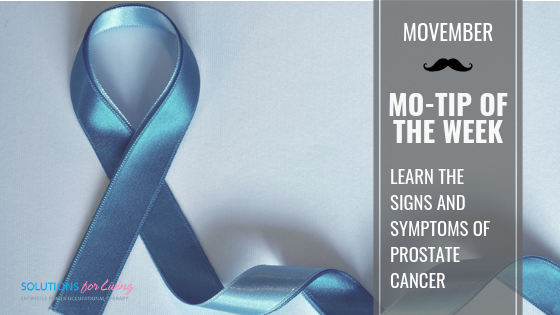
For the month of Movember, a month dedicated to Men’s Health, our “MO”-Tip series will provide you with OT-approved ways to take care of the men in your life.
Prostate cancer is the most commonly diagnosed cancer in men and, according to Prostate Cancer Canada, 1 in 7 Canadian men will be diagnosed with prostate cancer in their lifetime. The rate of survival is highly increased the earlier the cancer is diagnosed, therefore, knowing the symptoms could save your life. Learn about the symptoms and when to see your Doctor in the following care of the Canadian Cancer Society.
There is a 4 letter word that can be placed in front of each of the following words to make a new word… what is it?
____ Board
____ Lamp
____ Dress
____ Start
____ Line
Head

This great resource provides some helpful advice to seniors that face the difficult decision to “stay or go” when it comes to housing as they age:
The “Bottom Line” as outlined in this link is helpful, but I have added some other thoughts relating to the important “stay or go” decision:
The Bottom Line
Older adults’ loss of independence and declining capacity often lead to a decision to move to safer housing where care will be provided.
It is true that one of the most important factors in staying or going from the home includes the ability to get care. Homecare from the public sector is not usually sufficient and private care is costly. Friends, family and neighbors can only do so much. But what if there was a way to delay the need for care by being proactive and addressing declining health actively by making changes to promote safety and independence BEFORE care needs become significant? Occupational therapy can help people to be safer and more independent at home, and should be one of the first people you consult with if you are facing declining function.
The most important factors when making this decision are usually social and psychological considerations, not merely practical or economic considerations.
This is also true. Isolation and reduced ability to self-motivate, engage and activate important self-care and home tasks greatly impact if someone can manage with or without supports. Often the loss of a spouse or partner creates isolation and quickly forces people to have to adapt to a new way of living and managing alone. This can often be the catalyst that determines if a home is too much to manage, or if a person can remain where they are. Many seniors have the economic resources and family support to make changes to their home or living situation, but often they resist using these resources to manage their own needs.
Having a better understanding of the range of factors influencing older adults will help family members and professionals better support them in the decision-making process.
Also a great point. However, I would argue that solving issues related to senior housing and living needs to be a customized approach. “Understanding seniors” does not create a roadmap of how to help people through their unique challenges. There is no cookie cutter solution and getting input and help at the actual home (i.e. not in an office or clinic) is the ideal approach to develop the most appropriate solutions.
Consider occupational therapy if this can help you or a loved one to stay home safely, independently and for as long as possible.
Learn more about factors to consider when looking to Age in Place in our post, Occupational Therapy and Aging in Place.