On the second day of Inspiration my OT gave to me…
The story of a groom who, after taking his wedding vows, became a hero by jumping into a nearby river to save the life of a little boy.


On the second day of Inspiration my OT gave to me…
The story of a groom who, after taking his wedding vows, became a hero by jumping into a nearby river to save the life of a little boy.

Once again we are wrapping up the year with our 12 Days of Inspiration series, filled with wonderful stories of people across the world giving back in unique ways.
On the first day of Inspiration my OT gave to me…
The legacy of a Canadian Treasure who we lost this year, but who’s impact has left us a better country.
Macleans: How we will miss Gord Downie and the Tragically Hip

Guest Blogger: Samantha Langan, Occupational Therapist
Today people around the world will be wearing red ribbons to support World AIDS Day. This day of recognition started in 1988 to provide people with an opportunity to unite in the fight against Human Immunodeficiency Virus (HIV), show support for those who are living with HIV and to also commemorate those who have died. According to the Joint United Nations Programme on HIV/AIDS, 34 million people were living with HIV worldwide in 2011. In 2012, The Public Health Agency of Canada reported 2062 new cases of HIV, but it is expected that others are also living with the condition, not yet knowing they have been infected. There continues to be many myths and stereotypes around how HIV is transmitted and stigma remains for those living with HIV. Unfortunately, there isn’t yet a cure for this, but the disease is preventable.
Human Immunodeficiency Virus is a virus that attacks our body’s immune system, and over time, weakens our immune system to the point where it can no longer fight off bacteria, viruses, parasites, and even cancers. These diseases, known as opportunistic infections, can progress in the body of a person living with HIV and become what is known as Acquired Immune Deficiency Syndrome, or AIDS. While those living with HIV do experience difficulties, HIV is now considered a long-term chronic illness that can be treated to help prolong and improve quality of life for those living with HIV/AIDS.
HIV is known to health professionals as an “episodic disability”, which means that for people living with the virus, symptoms can fluctuate unpredictably. Some common symptoms include muscle weakness, fatigue, changes in sensation in the hands and feet, decreased concentration and thinking, digestive problems, chronic pain as well as depression or anxiety. As symptoms can vary, people with HIV / AIDS can experience difficulty carrying out everyday activities like taking care of themselves, managing at home and attending work.
Occupational therapists support and empower people with all forms of disabilities and can assist people living with HIV to better manage in their desired activities despite unpredictable and on-going symptoms. In fact, occupational therapists work with those living with HIV by helping them to: manage their energy despite pain and fluctuating symptoms, find ways to adapt to tasks to make them more manageable, obtain devices that can improve safely and independence when completing daily tasks. Occupational therapists can also help people manage the emotional consequences associated with the condition, and can develop strategies to assist with cognitive changes should these exist. Another great way occupational therapists are helping those with HIV is through education and by providing strategies for them to be able to self-manage their disease. This is essential since HIV is a long-term illness. For more information about HIV/AIDS, check out the links below, or talk to an Occupational Therapist about how we help.
Resources
http://www.worldaidsday.org/about-world-aids-day.php
http://www.phac-aspc.gc.ca/aids-sida/publication/survreport/2012/dec/index-eng.php
http://healthycanadians.gc.ca/diseases-conditions-maladies-affections/disease-maladie/hiv-vih-eng.php
originally posted December 1, 2014

Guest Blogger Lauren Heinken, Student Occupational Therapist
The Current Market
Over the last few years housing prices have been on the rise throughout most of Canada. The GTA in particular has seen soaring real estate prices, but this done little to deter buyers. Houses are selling quickly, and sellers often receive multiple offers that are well above asking price. This makes purchasing a home difficult, and those with accessibility needs may face additional challenges throughout this process. This, combined with an aging population of people trying to downsize or find more “suitable” homes, makes for a unique opportunity to enlist the expertise of an Occupational Therapist (OT) for buying consultation.
An Unlikely Partnership
It is not often that one would think of an OT partnering with a real estate agent or broker to provide homebuyer services. However, this synergy, as I will explain, could have beneficial outcomes for all involved.
OTs are all about helping people function, and our homes are at the core of where we spend most of our time. The home can be a support or a barrier to our physical, mental and emotional health. It can help us go about our daily activities easily, or can make managing a struggle. It can impact our mood – positively or negatively and either be a determinant of good health, or a cause of injury, sickness or death. Therefore, finding the right home is essential for reasons beyond just aesthetics, price tag and neighborhood. Yet, homes vary greatly, and the current real estate market moves quickly, so finding just the right fit, especially for those with a disability, can prove difficult.
An OT is well suited to assist in the home buying/modification process, and can bridge the knowledge gap that may exist in addressing the unique needs of the person with realtors who have their own knowledge of homes, the housing market, and the buying process. Realtors and OT’s joining forces has the potential to change the way people with unique accessibility needs shop for, and purchase, their next home.
The infographic below summarizes a potential service delivery model involving OT and real estate:
 Payment for Services and Benefits to the Real Estate Agent or Brokerage
Funding for this service could come from multiple sources, including the real estate agent or brokerage, the customer themselves, and there are also grants and charitable funding options that might be available. If the real estate brokerage is providing payment they will incur OT fees as part of their cost, so as to provide an accessible home buying experience for their clients. Having this service as an available option may help the agent or broker to attract a new segment of the home buyer population, thereby increasing their own marketability and profitability in this area. This would ideally produce positive economic gains for the brokerage that far exceed the costs they will be paying for OT consultation. Or, at the least, the OT should be a “vendor” on the list of other vendors the agent typically supplies to clients during the buy / sell phase (i.e. like movers, stagers, painters etc.). Then, the client can call the OT to discuss pricing as they would any other supplier.
As the OT profession grows over time, opportunities for partnership with other professionals outside of the usual allied health circle are going to become increasingly common. Thinking forward to opportunities that may exist creates the opportunity for OT’s and other professionals to work together for optimal service outcomes.

I have a large money box that measures 48 cm square and 42 cm tall. Roughly how many coins can I place in my empty money box?
Just one, after which it will no longer be empty.

December is, legitimately, the most stressful month of the year. Shopping and presents, food preparation, cards, socializing, crowds, different schedules and routines, decorations, spending, pressure to buy the right thing for the right person – and not forgetting anyone.
I wanted to offer some practical suggestions to reduce stress and help you enjoy the holiday season this year. Here are Julie’s TOP 10 TIPS based on my own experiences as a busy mom, but also as an occupational therapist who often helps people to break down tasks into more manageable, and less stressful chunks:
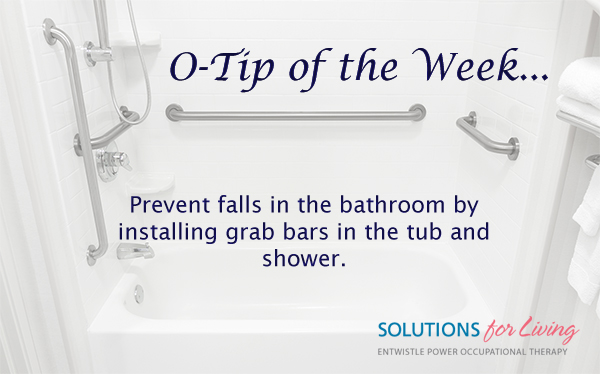
Our O-Tip of the week series we will be providing valuable “OT-Approved Life Hacks” to provide you with simple and helpful solutions for living.
For the month of November, Fall Prevention Month, our O-Tip series will concentrate on preventing falls at home and in the community.
Falls are the leading cause of injury among older Canadians with 20-30% of seniors experiencing one or more falls each year (Statistics Canada). With seniors most falls often happen when someone is just trying to go about their day by having a shower, coming down the stairs, or taking a leisurely walk.
This week’s O-Tip of the Week returns to the bathroom, which can be the most dangerous room in the home, especially for seniors. Transitions into and out of the tub or shower are often the cause of falls in the bathroom. The installation of grab bars in the tub or shower can greatly reduce this risk. An Occupational Therapist can help by assessing the older adult’s functional status and reviewing the hazards in their environment that may put them at risk for falling.
Learn more helpful fall prevention tips for older adults from our infographic: An OT Knows How to Help Seniors Age in Place.
Solve the following:

1. Better safe than sorry
2. Wheel of Fortune
3. Hard times ahead
4. Black eyed peas
5. Jumbo Jet
6. Minimize

Julie Entwistle, MBA, BHSc (OT), BSc (Health / Gerontology)
As Occupational Therapists, we spend a significant amount of time with people in their homes and in the community. In this role, we witness daily injustices, challenges or problems that our clients unnecessarily or unfortunately experience due to vendors, landlords, or business owners / operators failing to understand, care, or address the needs of people with disabilities.
Recently, a student I was supervising on placement experienced an accessibility challenge with a client as they attended a local coffee shop. We blogged about this in our post, Accessibility Issues in Our Daily Lives. As her mentor, I discussed with her the need to advocate for change and to send the owner a letter about the problems that client experienced.
That situation made me reflect on my history of advocacy as a person and an OT. I remember as a teen writing a letter to a restaurant who would not book us a reservation on the “main floor” such that my two disabled grandparents could attend my birthday dinner. As a young adult, I wrote a letter to an Alaskan cruise line about the challenges my grandfather experienced using his scooter around the boat and on the gangways. Then I became an OT and the advocacy continued. I have written, and continue to write, letters to equipment vendors, drug and department stores, public and private places, major banks, landlords, the CCAC, and fast food restaurants. Sometimes my letters are specific and highlight an “incident”, while others speak more to general accessibility or service problems. My advocacy initiatives even resulted in me building a training program aimed at helping the “average Joe” best service people with disabilities. I personally feel that advocacy is how I will make my mark on the world, regardless of how small, with the hope of leaving this world in better shape than how I found it.
For this blog, I wanted to take the spirit of advocacy further, and to embrace our human responsibility to try and be catalysts of social, environmental and institutional change, by sharing a guide of sorts that could be used by other therapists, clients, caregivers or really anyone who wants or needs to bring an issue to someone’s attention. Give this a try and keep us posted on your outcomes:
DATE
Name of Person / Establishment
Address
Dear Representative/Manager/Person:
I am X. On DATE (I, my family member, client etc) experienced the following problems (when accessing your establishment, using your services, interacting with your staff, etc):
In bullet or paragraph format, list the problems you had. Be factual, truthful and professional. Avoid judgement, anger or threats as these will not result in change.
Provide some input on how you feel the problems you had might be impacting their service, business, etc. Try to hit home with how the issues you experienced will turn people away, or jeopardize their reputation.
Next, explain what you feel the solutions are or how it can be better for you next time. Help them to know what to do. You don’t have to be prescriptive or specific, but maybe they need to consider some building modifications, better trained staff, to understand disability codes or acts, an easier to navigate website, consultation with someone who can develop solutions with them etc. This is where you can really try to be helpful.
End the letter by thanking them for considering your feedback and provide your contact information. Be prepared to have a discussion with them about it. Some might ignore your letter, but I hope most will not. Either way, if your letter stays friendly and is perceived as helpful, they may want to thank you for your time or seek more input.
Of course, add a final sign off like “sincerely” and your name.
I hope this format / suggestion will be helpful as you venture forward and try to educate, share and advocate for the change you hope to see in the world.

Pain is real. It can prevent people from engaging in activities that are important to them, or at the least inhibit enjoyment and full participation in those things they want and need to do. It doesn’t matter if the cause of the pain is fully understood — the person’s experience of pain is what is important, and is what affects function. As the role of an occupational therapist is to enable clients to engage in activities that they want, need, or are expected to do, OT’s have the capability to help individuals with chronic pain to better manage their lives.
The following from article from Medical Xpress sheds light onto the benefits of OT for managing chronic pain and helping sufferers maintain a better quality of life.
Medical Xpress: Occupational therapy shown to improve lives of people in chronic pain
Learn more about how OT can assist with chronic pain in the following episdoe from our OT-V series, Managing Chronic Pain.