Close

Archive for category: Solutions For Living

by

Functional Modifications that Won’t Break the Bank

There is a misconception that home renovations for safety or disability need to be expensive.  While this can be true for large-scale projects, there are some quick-fix modifications that are small but pack a punch.  Watch our latest OT-V Episode below for our top 10 pick of modifications you can make for under $100:

by

Sleep: Does it Change with Age?

Sleep is one of the most important determinants of health.  Proper sleep helps to restore our minds and bodies so that we are able to effectively tackle another day.  Sleep supports growth and development, and helps with the body’s healing process.  However, knowing how many hours a person actually needs each night is difficult as this differs from person to person and can change with age.

Learn more about sleep and how it can change as we age in the following care of the McMaster Optimal Aging Portal.

McMaster Optimal Aging Portal:  Sleep and aging: How many zzz’s are optimal to stay healthy?

If you struggle with sleep take a look at our OT-V Episode, Improving Sleep, for some solutions that can help.

by

Your Best Brain: Use It or Lose It

The old cliché is true when we talk of cognition – “use it or lose it”.

Our brains are made of billions of neurons, which interact with each other to complete specific tasks. Signals are sent from one neuron to another along neural pathways, and these determine our thoughts, emotions, insights, and so much more. Each task relies on a different neural pathway, so the pathway for reading a book is different than the pathway for putting on our shirt. The more we use a pathway, the stronger the connection becomes.

These neurons have the ability to physically change themselves when faced with new and difficult experiences. This ability is called neuroplasticity. As we are exposed to new areas, tasks, information or experiences, neural pathways are formed and existing ones are reshaped. This will continue throughout our entire lives as we learn. As we have experienced through practicing a musical instrument, memorizing our shopping list or recalling a friend’s phone number, if we consciously focus and train our brains in a certain area, they will become faster and more efficient at performing those tasks.

Just as we need to exercise the muscles in our body, we also need to exercise our brain.

Some great ways to keep “work up a cognitive sweat” include:

  •         Online cognitive training programs and apps
  •         Playing board games
  •         Reading books
  •         Completing puzzles such as a daily crossword or Sudoku
  •         Learning a new language or skill
  •         Getting artistic

Try our 30 Day Healthy Brain Challenge to help you find other ways to boost your brain and prevent cognitive decline.

by

Ways to Care for Yourself as a Caregiver

Caregivers do not really “elect” the role. They are not trained to be a caregiver, and really just try to do their best with the skills and resources they possess. However, where many fall short is maintaining their own health and well-being in dedicating their physical and emotional time to another person.  We have penned many blog posts about the importance of caregivers avoiding burnout by asking caregivers to “put on their own oxygen masks first.”  The following care of Alzlive provides some fun and specific ideas for caregivers to try to ensure they are concentrating on their own health as well as that of their loved one.

Alzlive:  Tack on Fridge:  Fun Tips for Caregiver Wellness

by

O-Tip of the Week: Plan Ahead – Shop once!

Our O-Tip of the week series we will be providing valuable “OT-Approved Life Hacks” to provide you with simple and helpful solutions for living. 

For the month of March, Nutrition Month, our O-Tip series will feature kitchen hacks to make your meals more nutritious, less time-consuming and more convenient.

Do you know the biggest way you can save time, energy and money each week?  Plan ahead!  Planning your meals for the week not only allows you to ensure you are eating healthy meals every day, but saves you unnecessary trips to the grocery store throughout the week.  Try our printable weekly meal planner to help you on your way!

by

How Can Occupational Therapists Best Support Older Adults as they Transition to Non-Drivers?

Guest Blogger Lauren Heinken, Occupational Therapist

It’s winter, and with the season comes decreased daylight and increased risk of weather-related adverse driving conditions. These factors can contribute to a higher incidence of motor vehicle collisions, and this may be particularly true for older adult drivers who are experiencing physical and cognitive health changes. The Ontario Ministry of Transportation (MTO) reports that senior drivers with cognitive impairment/dementia have up to 4.7 times the risk of being involved in a motor vehicle collision. The MTO’s Senior Driver License Renewal Program operates in an effort to ensure that older adult drivers are screened for health changes that may impact their ability to drive. Occupational Therapists (OTs) may be involved in the process by administering the screening tools that can play a role in determining an individual’s fitness-to-drive; however, physicians and the MTO work together to ultimately decide whether an individual is able to maintain their license or not.

Many older adults see driving as imperative for maintaining their independence, especially if they have been lifelong drivers or are relatively unfamiliar with other forms of transportation. More physically demanding forms of transportation, walking to bus stops, or cycling, may no longer be viable alternatives for many. Outside of the main urban centres, Canada’s population is dispersed across great geographic distances; in more rural areas, public transportation services may be sparse if available at all. The distances individuals need to travel on a frequent basis to access services and participate in activities of their choosing are often great. As health professionals who focus on helping individuals find ways to engage in their chosen occupations, it fits that OTs should be involved in supporting older adults who have lost, or are at risk of losing, their ability to drive.  OTs can work with their clients to minimize the way in which losing one’s license influences overall quality of life and ability to engage in chosen occupations.

As with any major life change, planning for the loss of one’s drivers license well in advance can help to limit the impact of the change when it happens. After all options for ensuring and promoting someone’s ability to drive safely have been exhausted, the next responsible therapist-client step would be to initiate discussions related to transportation alternatives, regardless of whether or not this lifestyle change will be occurring in the near future. It is understandable that OTs may be reluctant to initiate these discussions as safe continuation of driving is often an emotionally charged subject and can lead to very difficult conversations.  Introducing the subject slowly and matching the content of the conversation to the client’s comfort level can help to limit any negative effects on the OT-client therapeutic relationship. Below is a proposed progression of an OTs involvement with a client who has lost, or is at risk of losing their ability to drive.


OTs should let the changing seasons serve as a reminder to consider initiating these discussions during client sessions. Although clients may be unreceptive and unwilling NOW to accept intervention aimed at preparing for this lifestyle change for LATER, a brief discussion may be enough to get them thinking about this important topic to help them adjust to the possibility when / if it arises.  Sometimes as therapists the ideas we introduce early are not accepted for months or years later, but our role includes having the patience to work with clients around their comfort level and to support change when they are ready to accept it.

by

Dementia in the Workplace

Although dementia is most common in older adults, it can and does affect younger people.  The Alzheimer’s Society of Canada states that approximately 564,000 Canadians are currently living with dementia.  Of those affected, 16,000 are under the age of 65.  With an aging workforce in Canada, there is a greater possibility of dementia in the workplace which, without proper awareness, can lead to an unfamiliar situation for both employers and employees.  Take a look at the following article care of Workplace Strategies for Mental Health which provides information on awareness, recognition, risk management and supportive responses.

Workplace Strategies for Mental Health:  Dementia Response


by

O-Tip of the Week: Consider the Benefits of A Furry Friend

Our O-Tip of the week series we will be providing valuable “OT-Approved Life Hacks” to provide you with simple and helpful solutions for living. 

For the month of February, Heart Month, our O-Tip series will feature Heart Smart Life Hacks.

Consider adopting a dog.  While choosing to have a dog, or a pet of any kind, is a big decision not to be entered into lightly, research shows that having a dog can improve your health, both mentally and physically.  Learn more about a new study who’s findings indicate owning a dog is associated with lower risk of heart disease in the following care of CNN.

CNN:  Want to live longer? Get a dog

by

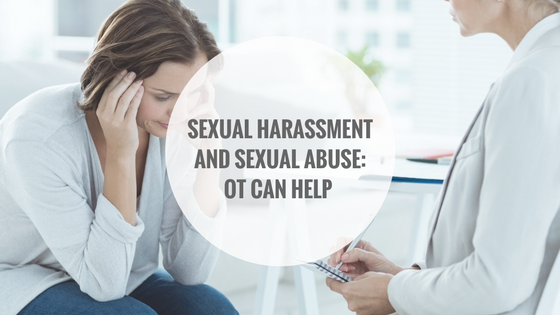
Sexual Harassment and Sexual Abuse: OT Can Help

Julie Entwistle, MBA, BHSc (OT), BSc (Health / Gerontology)

The pendulum has surely shifted on what society will and will not tolerate when it comes to sexual harassment and sexual abuse.  For those that remain confused on these two overlapping but very different concepts, here are simple definitions from Wikipedia:

Sexual Harassment:  bullying or coercion of a sexual nature, or the unwelcome or inappropriate promise of rewards in exchange for sexual favors.

Sexual Abuse:  undesired sexual behavior by one person upon another.

Sexual harassment has often been related to the workplace and women tend to be the most common recipients.  It also tends to involve a power imbalance whereby one person is in a position of authority over the other, but by definition, this does not have to be the case.  With the current societal shifts, it is now recognized that harassment can extend beyond the workplace, and is not gender specific.  Sexual abuse, on the other hand, has always been more of a global term, applying to anyone, anywhere, anytime, who is forced into sexual activity without their consent.  It has always been socially unacceptable, even when sexual harassment was more of a commonality.

Truth be told, I have been a victim of both.  I can say that harassment is easier to talk about but at the time I was being harassed it was not as socially unacceptable as it has become.  In fact, it almost seemed common that a young woman working (and in my case playing sports) who was exposed to men in more senior positions would be solicited, propositioned, flirted with or asked on dates or to social events.  I was fortunate in that none of these experiences turned into sexual abuse and I trust (hope) that men today behave much more professionally around women in general.  Sexual abuse, on the other hand, is much harder to talk about, and my experience with this is not one I am comfortable sharing publicly.  I do know though that victims of sexual abuse often need therapy to help them recover from their trauma, and I am hopeful that the recent media attention to this will encourage victims to come forward and seek help should they need it.

Occupational therapy can be one form of treatment for people who have suffered from sexual harassment or abuse.  When people are off work or struggling with work, our therapy helps people to discover functional barriers, develop solutions, proactively engage in problem solving, and then assists people to forward in their new chosen direction (albeit return to work, seeking new work, or addressing retraining).  With sexual abuse some occupational therapists are trained in psychotherapy and work with people directly to address the results of their trauma.  Occupational therapy also helps people to rebuild the elements of their life that have been lost because of their trauma.  Sometimes victims of sexual abuse develop maladaptive ways to cope (addictive behaviors, inactivity, social isolation to name a few) and these can be addressed in treatment.  It is also common that depression and anxiety surface following sexual abuse, and these too can be tackled through activation at home and in the community.  Occupational therapists work very well with other providers who may also be involved – social workers, psychologists, and the medical team, helping to create a cohesive and impactful approach to recovery.

If the media attention to these problems results in positive societal and behavioral change, then we all need to be thankful and grateful to the people that have come forward and for the stories that have been shared.  And if sexual harassment or abuse have caused problems for you and impact how you manage your day-to-day activities including work, taking care of yourself, enjoying leisure, or managing important elements of how you want to spend your time, consider occupational therapy as one element of your recovery team.


by

Tips for a Healthier Dining Out Experience

Eating out for pleasure is always a treat, however, for the many who find dining out to be a large part of their work-life on a regular basis, restaurant dining can lose its appeal!  Although recently more restaurants have expanded menus to include healthier options, large portion sizes and high sodium levels can put the diners’ health at risk.

Learn some great tips on how to make healthier choices when dining out in the following article care of Forbes Magazine.

Forbes:  How To Eat Healthy In A Restaurant