
Check out the amazing video of when Christina’s dream came true thanks to the Chicago Black Hawks.
Change Your Habits, Change Your Mood
A habit is defined as “a settled or regular tendency or practice, especially one that is hard to give up.” Habits can sometimes become something we do without even realizing it, until someone points it out. Recently Time Magazine published an article on 12 habits that are bad for your mental health. Check them out to see if you are doing any of the following, and if so, how you can change to live a happier life.
Time Magazine: The 12 Worst Habits for Your Mental Health
Inspired
“It’s hard to dance with a devil on your back; so shake him off .”
Florence and the Machine, Shake It Off
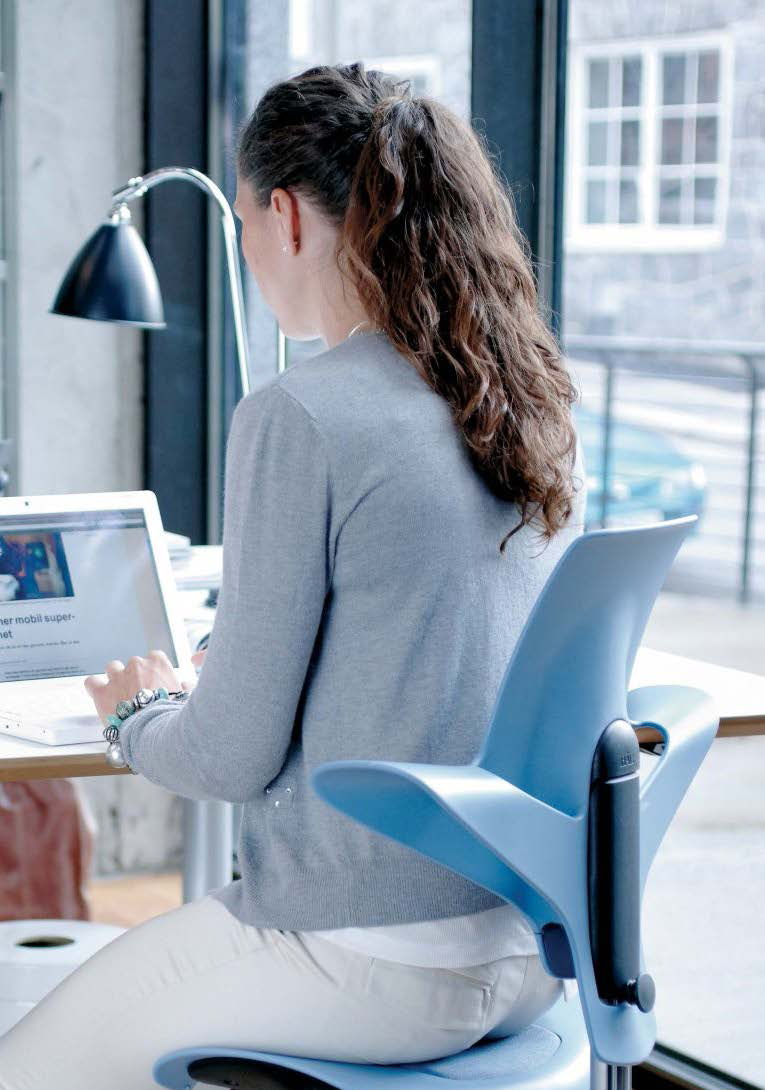
Back to Routine, Back to Ergonomics
With the change in routine through the summer months, it is time to rethink about how we are sitting and working all day to make sure our body can adjust to the new routines that are devoid of summer vacation and summer activities.
Today we focus on proper ergonomics to support your back.
In 2010, back pain was found to be the single leading cause of disability world-wide according to the Global Burden of Disease. It has been estimated that 186 million work days are lost each year to back pain alone which greatly impacts workplace productivity and costs. The Mayo Clinic has found that a number of factors can contribute to back pain and back injuries at work. The four most common factors include:
1. Force: Job demands that require lifting or moving heavy objects exerts force on our back which can lead to injury.
2. Repetition: Repetitive movements leads to muscle fatigue and in turn can lead to injury, particularly if these movements involve stretching our back near the limits of our range of motion or using awkward body positions.
3. Posture: Posture is a critical component in preventing fatigue and injury. Slouching or sitting in awkward positions alters the natural curves in our back, increasing fatigue and can lead to pain and injury.
4. Stress: While we often think of the negative impacts stress can have on our mental well-being, it also impacts our physical well-being. High levels of pressure at work or increased stress leads to muscle tension and tightness, which can contribute to or worsen back pain.
If back pain is something you or someone in your workplace experience, there are some strategies you can use to help minimize existing problems and even prevent issues before they arise:
· Ensure that your feet are flat on the floor, as this helps stabilize our pelvis and lower back
· If you have an adjustable chair, alter the settings so that your lower back has increased support
· Get a colleague to take a photo of you sitting at your desk or workstation and examine your posture. Can this be adjusted?
· Take regular breaks to stretch, stand up and walk around the office to complete other tasks
For more information, take a look at our FREE downloadable resource on office ergonomics and stay tuned for more Workplace Wednesday blog postings highlighting stretches and exercises to help address common work-related concerns such as back pain.
Resources
http://www.inthefaceofpain.com/content/uploads/2011/09/factsheet_Workplace.pdf
Inspired


“Letting Go” in September
Julie Entwistle, MBA, BHSc (OT), BSc (Health / Gerontology)
September is the month of many things – adjusting to new schedules, the end of summer vacations, changing weather, and for those with kids, a return to the hectic schedule of school and extracurricular programs. As a mother of four, I always find September stressful (see my blog last year “Stress-tember”). I also know, from having many Septembers under my belt, that it takes me two to three weeks to “adjust” to the changes this month brings. However, this year, in an attempt to combat stress and move to acceptance of what is, I have decided to take a different approach. This year, instead of losing sleep and being stressed, I am going to try and “let go”. I will explain what I mean but first I want to explain what brought me to this concept in the first place.
First, in July our oldest child travelled out the country on her own as a part of an international school program. Leading up to her trip, I was most worried about how she would do away from home for several weeks, if she would enjoy her trip, and of course hoped it would be an unforgettable learning experience. Soon after she left, I realized this trip was huge for me too – it was one of the initial phases of me needing to “let go” of my daughter as she grows up. While scary for a teenager to travel away from home, it is equally scary for a parent – especially when the traveler is your oldest and you have not experienced this before. Not seeing or talking to her daily, her room staying untouched, the cat having no one to sleep with, not sitting with her for a tea in the morning – all things I became mindful of missing in her absence.
Second, I recently ran into some neighbors on my morning walk. They have sold their house and are moving out of the country. This is coming at the time where their youngest is now entering university. In talking to them about this massive transition, my heart could feel for them in all the things they were experiencing – moving away from the town they raised their children in, where their family and friends are, becoming “empty nesters” for first time as they no longer have children at home, moving across the world to accommodate a work opportunity and not having easy access to their children that will remain in Canada. It made me realize there are many dimensions and layers in the process of “letting go” and for some this period is gradual, and for others not so much.
So, back to the fall. I have several things I need to let go of. I need to move from feeling that I need to control everything because that is what has always kept my kids healthy and safe. I need to help them “self-regulate” their time and behaviors around the choices they will make at school and after school. I need to stop being “right” (“mom knows best”) about everything and let some natural consequences be their teaching tool. I need to support them in their decisions and in those life events that will confront them this year, without solving their problems for them. And I need to “let go” of the concept that as parents we can “do it all” and “be everything” to our children. At work I plan on “letting go” of the thought that “if I could only clear my inbox I would feel less stressed” as the reality is that as a business owner my inbox will never be empty, and if it was, that would actually cause me more stress! Personally, I want to “let go” of how hard I can be on myself when I don’t get it all done, or when I take time for myself amongst things that still need my attention.
I love this quote from Ajahn Chan: There will never be a time when life is simple. There will always be time to practice accepting that. Every moment is a chance to let go and feel peaceful.
The Tiny Buddah sites 40 strategies for “letting go”…I will share my personal favorites here:
Focus all your energy on something you can actually control instead of dwelling on things you can’t.
Remind yourself these are your only three options: remove yourself from the situation, change it, or accept it. These acts create happiness; holding onto bitterness never does.
Hang this statement somewhere you can see it. “Loving myself means letting go.”
Consider this quotation by Eckhart Tolle: “Worry pretends to be necessary but serves no useful purpose.” Questioning how your stress serves you may help you let it go.
Replace your thoughts. Notice when you begin thinking about something that stresses you so you can shift your thought process to something more pleasant, like your passion for your hobby.
Organize your desk. According to Georgia Witkin, assistant director of psychiatry at Mount Sinai School of Medicine, completing a small task increases your sense of control and decreases your stress level.
Laugh it out. Research shows that laughter soothes tension, improves your immune system, and even eases pain. If you can’t relax for long, start with just ten minutes watching a funny video on YouTube.
So, Happy September. Whether you are changing jobs, retiring, returning to a job you love (or not), are starting a new volunteer position, hobby or exercise routine, are putting your child in day care, kindergarten, into high school or university, embrace it. In the words of Trace Adkins in his song “You’re Going to Miss This”:
you’re going to miss this
you’re going to want this back,
you’re going to wish these years hadn’t gone by so fast…
Inspired
“Knowing trees, I understand the meaning of patience. Knowing grass, I can appreciate persistence.”
Hal Borland
Laughter Therapy

Weekly Mind Bender
What year comes next in this sequence: 1973, 1979, 1987, 1993, 1997, 1999…
2003: they are prime years.
Inspired
Check out the incredible story of the world’s first child to receive a double hand transplant.