Close

Author Archive for: jentwistle

by

Brain Injury Recovery O-Tip of the Week: There’s an App for That!

Our O-Tip of the week series we will be providing valuable “OT-Approved Life Hacks” to provide you with simple and helpful solutions for living. 

June is Brain Injury Awareness Month.  Occupational Therapists are a vital part of a team of professionals that assist with the rehabilitation from brain injury.  Therefore, for the month of June, our series will be providing solutions to assist with some of the common cognitive deficits that can result from brain injury.

Remember the old Apple commercials… “There’s an app for that!”  Well, isn’t that the truth.  You can find apps for just about anything, and in fact, there are some great apps that can assist with memory and cognition for those who are recovering from a brain injury.  Some of these apps are summarized below:

by

LGBTQ+: Three Strategies to Make Your Business More Inclusive

Julie Entwistle, MBA, BHSc (OT), BSc (Health / Gerontology)
Co-written by Jacquelyn Bonneville, Occupational Therapist and proud member of the LGBTQ+ community

Have you ever been on vacation to Jamaica, Dominica, or St. Lucia? Have you ever Googled pictures of the beautiful Maldives? Did you know that all of these countries, and some 70 others, have anti-homosexuality laws punishable by fine, imprisonment, or death? Globally we still have a long way to go, but like all progress, we must remain proud of the steps forward we are taking in regards for Lesbian, Gay, Bisexual, Transgender, and Queer (LGBTQ+) awareness and rights.

Pride month is celebrated in June in every year in honour of the 1969 Stonewall riots in Manhattan, USA; a turning point for LGBTQ+ activism. If you don’t identify with this culture you may not feel that pride month is relevant to you, however, the spirit of pride month is to embrace diversity and peace, which all of us should celebrate, especially as proud Canadians.  This point, and the concept of peace, is even more prominent today considering the 2016 events in Orlando that resulted in the senseless killing of 49 innocent people as they attended a nightclub frequented by the LGBTQ+ community.

In honour of pride month, we’d like to offer 3 simple ways you can make your business more LGBTQ+ friendly:

 1.  Challenge Your Assumptions

It can be easy to assume that everyone is straight; when you ask a man if he has a wife, or a woman if she has a husband, you could be unintentionally making an awkward scenario for a non-straight person. If you have an intake form that only has two gender options (male or female), you could be instantly excluding someone or causing them to feel uncomfortable about your services.

As therapists, we are often in a position of asking about our client’s social supports. Instead of making assumptions, ask more open-ended questions such as “Are you in relationship with someone right now”, “who is your main source of support”, or “do you have a significant other?” Have an “other” option for gender on intake forms, or include sex as well as gender if someone’s sexual organs are relevant to your medical field. Consider expanding “married” on your intake process to include “common law” and “long term relationship”.  You’ll still get the information you need, but in a more inclusive way.

2.  Don’t be Afraid You’ll Use the Wrong Terminology

My husband’s name is Kelly.  Many times people have assumed he would be female:  he has been put on the girls’ draw in tennis tournaments, rendered us to win the prize for the “ladies best foursome” in a golf event, and often our mail and solicitation calls are directed to Mrs. Kelly. We’ve all called someone by the wrong name/gender accidentally before. It’s embarrassing – usually, they correct us, we apologize, and chances are you’ll never forget their name again. It happens, but in the grand scheme of things, it isn’t a big deal.

Gay, lesbian, queer, bisexual, bigender, cisgender, gender fluid, asexual, feminine/masculine of center, intersex, MSM/WSM, pansexual, trans*, two-spirit, ze – what does it all mean? If you are not part of any particular minority group, it can be difficult to know if you’re wording something ‘correctly’ and it may make you uncomfortable. You may even be afraid to offend someone – isn’t ‘queer’ an offensive term? It all comes down to individual preference – and you won’t know until you ask.

Instead of assuming a person is Sir or Ma’am, Mr. or Mrs. based on your assumption of their gender, get used to asking more inclusive, generalized questions as part of your daily routine. There is nothing wrong with asking a client/patient, “What’s your preferred name?” or “How should I address you?” And if you slip and use the wrong pronoun or term in addressing them, simply apologize, correct yourself, and move on. Besides, a good businessperson should have a healthy dose of humility – your clients will respect you more for trying to use their preferred terminology, even if you make a mistake. Don’t worry.

3.  Understand Some of the Systemic Barriers LGBTQ+ Persons may Face in Your System 


Knowledge of some of the challenges in your own business that directly affects persons of various sexual orientations and genders will only make your business more inclusive. Some questions that may be relevant to health care professions include:

  • Can a bisexual person donate blood in your city?
  • Is a transperson legally able to give emergency medical consent if their loved one is unconscious?

Will a queer person be safe in a shared hospital room if their partner comes to visit them?

Health care isn’t as easily accessible as you may think. It can be very challenging to find competent medical and rehabilitation practitioners that are educated on health factors more common in certain minority populations, and so not all people feel they can be open with their family doctor or access health care without judgment. Knowledge is power – keep an eye out for changing laws, trends, or factors affecting the LGBTQ+ population in your area.

In the end, consider adopting some of these strategies into your everyday life, and you’ll be making maximum impact with minimal effort. To quote a Futurama cartoon episode:  “When you do things right, people won’t be sure you’ve done anything at all.”

No one may notice you changed your language, or thank you for making the change – but to that client who needs to know that they’re safe with you, I guarantee you that your choice of inclusive words will make all the difference.

As Occupational Therapists we are lucky to be able to assess our clients holistically and to consider all of the factors that may be affecting their occupational performance including sexual orientation, gender, sex, and social support networks. We can constantly challenge our assumptions to help develop into even better practitioners.

Happy Pride Month!

Originally posted June 2016
 

by

The Warm Weather Has Arrived: What’s in Season?

The warm weather is here and summer is officially around the corner.  It’s time to enjoy freshly picked delicious fruits and vegetables.  Eating foods grown locally and in-season can improve your health, your bottom line and help the environment.  Take a look at Foodland Ontario’s Fruits and Vegetable availability chart so you can plan for the season.  Enjoy!

Foodland Ontario:  Availability Guide

by

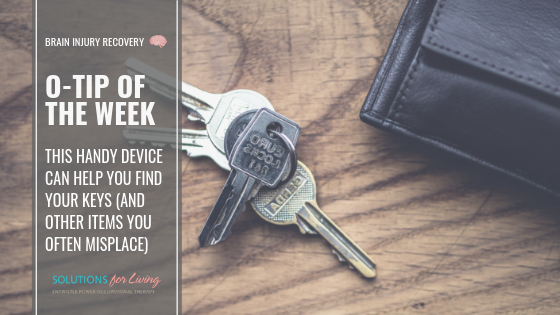
Brain Injury Recovery O-Tip of the Week: This Handy Device Can Help You Find Your Keys

Our O-Tip of the week series we will be providing valuable “OT-Approved Life Hacks” to provide you with simple and helpful solutions for living. 

June is Brain Injury Awareness Month.  Occupational Therapists are a vital part of a team of professionals that assist with the rehabilitation from brain injury.  Therefore, for the month of June, our series will be providing solutions to assist with some of the common cognitive deficits that can result from brain injury. 

This tip definitely does not only apply to those recovering from brain injury… If you’re someone who is always misplacing your keys and/or wallet (or other items) this helpful piece of technology is for you!  Tile is a small Bluetooth tracking device you can attach to a keychain, slip into your wallet or attach to anything you frequently have to search for.  This device syncs with an app on your smartphone that will allow you to easily locate your items when in need – saving you a lot of time, effort and frustration!

Learn more here: https://www.thetileapp.com/en-us/how-it-works


by

Treating Executive Dysfunction: There is No “One Size Fits All”

Julie Entwistle, MBA, BHSc (OT), BSc (Health / Gerontology)

As a caring professional, I refuse to believe that my clients are not motivated.  All of my clients have goals or I would not be treating them.  However, their ability to achieve their goals independently remains the reason that they require active therapy.  Previously, I wrote about executive functioning (Brain Injury and Executive Functions – When the CEO is on Hiatus), the capacities we require to achieve a goal, and used the example of moving to highlight how people with executive dysfunction may feel on a regular basis when completing relatively simple tasks.

Treatment for executive dysfunction is as broad as it is specific.  It is broad because everyone experiences brain injury differently and comes into that type of trauma with varying levels of ability to start with.  However, treating problems with executive function is really as simple as taking a goal and breaking this down into component parts, manageable chunks, and smaller goals within the whole.

So, returning to the moving example, assisting someone with executive dysfunction with a pending move will involve making checklists, with time frames, and checking on progress frequently.  Personally, I like to take a project approach:  calling the goal “Operation Move” and mapping out – start to finish – the metrics for success.  Perhaps in month one an “apartment hunting worksheet” is created to help a client summarize all the places they are looking at, the pros/cons, address, and list of questions that need to be answered (price, utilities included, length of the lease, etc.).  Often I encourage my clients to use a smartphone to take photos of the options then we cross-reference these and catalog them to keep things organized.  From there, the process continues with checklists for calls to make, addresses to change, ways to organize packing and management of belongings.  Ensuring the client is responsible for follow-up via “homework” between sessions and holding them accountable for completion of this aids to developing independence.  Really, the therapeutic goal is more than just ensuring the client is able to move successfully.  Rather, it is demonstrating a model and method that can be used for any future transitions, goals or tasks.  This ensures success that is transferable to other events at later dates. 


Previously posted June 2013

by

Brain Injury Recovery O-Tip of the Week: Create a Medical Appointment Notebook

Our O-Tip of the week series we will be providing valuable “OT-Approved Life Hacks” to provide you with simple and helpful solutions for living. 

June is Brain Injury Awareness Month.  Occupational Therapists are a vital part of a team of professionals that assist with the rehabilitation from brain injury.  Therefore, for the month of June, our series will be providing solutions to assist with some of the common cognitive deficits that can result from brain injury. 

Recovering from a brain injury, or injury/illness of any kind, often means frequent meetings and appointments with numerous healthcare professionals.  From Occupational Therapists to Physiotherapists, Family Doctors to  Neurologists, it can be difficult for individuals to keep straight who said what, let alone be able to share this information with family and/or caregivers who need to know.  We suggest using a single notebook that has dividers so a section for each healthcare professional can be created.  This book should be taken to each appointment and the important information can be recorded.  This will help keep the patient and their loved ones organized and informed.