Close

Author Archive for: jentwistle

by

Kick off Cottage Season Safely

The Victoria Day long weekend in Canada is known as the kick off to summer and the official beginning of cottage season.  Whether you own, rent or visit friends and family with cottages make sure you do so safely, as cottages have dangers you may not need to think of at home.  Make yourself familiar with some these safety tips care of the Federation of Ontario Cottager’s Associations (FOCA) and the Insurance Bureau of Canada (IBC). 

Heading to the cottage this long weekend? IBC and FOCA partner up to offer Top 10 Tips


by

O-Tip of the Week: Open Jars with Ease

Our O-Tip of the week series we will be providing valuable “OT-Approved Life Hacks” to provide you with simple and helpful solutions for living. 

For the month of May, our O-Tip series will showcase some creative solutions using a commonly found household item – rubber bands.

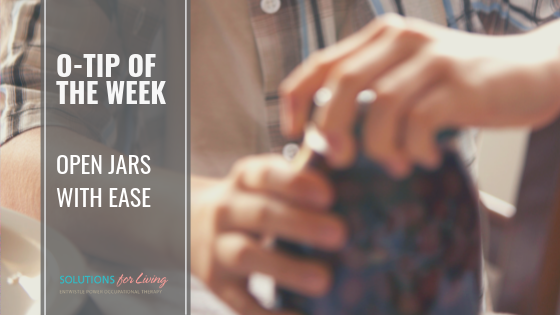
Are you always struggling to open stubborn lids on jars?  No need to struggle anymore!  Simply wrap a thick elastic band around the lid and twist.  No need to purchase fancy gadgets with these free helpful tools in your kitchen drawer.


by

Do You Listen to Music While You Work?

Music at work… a distraction or a helpful part of your working environment?  The following article care of Inc Magazine discusses the science behind how music affects the brain and provides insight into the best times to play some tunes, and the circumstances where a quiet environment is more beneficial.

Inc Magazine:  What Listening to Music at Work Does to Your Brain (It’s Pretty Amazing)

We want to hear from you… do you listen to music while you work?  And… do you find it helpful or distracting? 

by

O-Tip of the Week: A Non-Slip Solution Care of Rubber Bands

Our O-Tip of the week series we will be providing valuable “OT-Approved Life Hacks” to provide you with simple and helpful solutions for living. 

For the month of May, our O-Tip of the Week series will showcase some creative solutions using a commonly found household item – rubber bands.

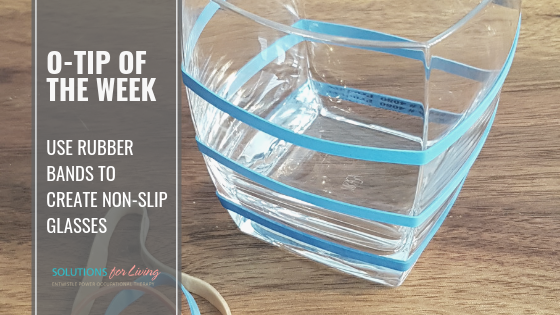
For someone who is lacking grip strength or for kids needing to use “glass” glasses wrap elastic bands around the glass to create a non-slip surface.

by

A Place Called Vertigo

Julie Entwistle, MBA, BHSc (OT), BSc (Health / Gerontology)

I am not sure what the word “vertigo” refers to in U2’s hit song, but as someone living with vertigo, I can tell you it is not a place you want to be.  Vertigo is highly unpleasant and can be caused by multiple factors including visual or auditory problems, or more commonly, head injury.  I best describe my vertigo as my eyes and ears sending different messages to my brain regarding the position of my body in space.  So, while my eyes tell me I am sitting still in a chair, my ears tell me I am on a boat in the middle of a hurricane.  The result of these mixed messages is spinning, nausea, dizziness, problems walking, and ultimately dysfunction.

For me, my benign positional vertigo (BPV) lives in my right ear.  As a result, I cannot lie on my right side, laterally flex my head to the right, lie flat with my neck extended, or look down into extreme flexion.    While I can tolerate these movements momentarily, I cannot hold these positions for more than a few seconds otherwise I am sent into a spin that can last for days.  I am fortunate to know my triggers and do my best to avoid them (no yoga for me).  I have also learned, after living with this problem for two decades, how to catch my symptoms early to prevent a slight episode of dizziness from turning into days of bed rest.

When my clients experience vertigo and describe this to me, I can fully appreciate where they are coming from.  The story is a book I too could write.   But, like other “hidden” ailments, I get concerned when the medical community does not take this complaint seriously.  This is especially true in my industry where insurers and their assessors often want “proof” of a health problem to support someone’s recovery. While I recognize that people can be dishonest, my experience is that people don’t make this stuff up.  Health professionals need to give people the benefit of the doubt, including insurance situations. To understand, or better yet, support someone with any “invisible” problem like vertigo, health professionals need to be compassionate and should care enough to listen, to research and learn, and ultimately believe.  Empathy, TRUST, and understanding will go a long way to support those that need it. I can only imagine how frustrating, devastating and angering it would be for someone to assume or opine that my “place called vertigo” is not a place at all: because, believe me, I live here.


previously posted August 2013

by

The Relationship Between Physical Activity and Depression

We have talked a lot on our blog about the benefits of regular physical activity for your physical, cognitive and mental health.  Why?  Because quite simply, other than laughter, physical activity is the best medicine!  A study recently published in The Journal of the American Medical Association (JAMA) Psychiatry looks at the relationship between regular exercise and depression.  Learn more about this study here care of the New York Times.

The New York Times:  Exercise May Help to Fend Off Depression

by

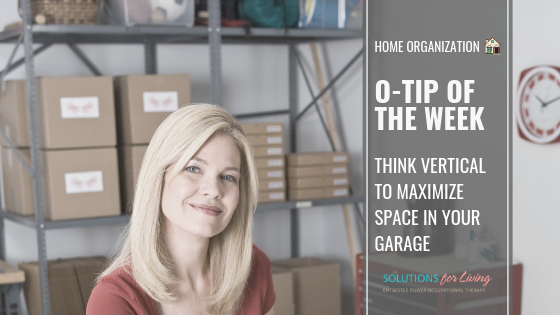
Organization O-Tip of the Week: Think Vertical to Maximize Space

Our O-Tip of the week series we will be providing valuable “OT-Approved Life Hacks” to provide you with simple and helpful solutions for living. 

Did you know that being organized can help you to reduce stress?  Spring is around the corner, and with it comes Spring Cleaning!  Therefore, for the month of April, our O-Tip of the week series will share some of the best tips to help you get organized–  because an organized space is a healthier space!

If your garage is anything like mine it is used for more than simply storing your vehicles.  Sports equipment, garbage and recycling bins, lawnmowers, snowblowers and more share this space and without some strategic organization it can get quite crowded.  The best solution for an organized garage is to take advantage of vertical space.  Use wall shelves and peg boards for smaller items, and install hooks and shelves on the ceiling and walls to allow for increased space around the perimeter.

by

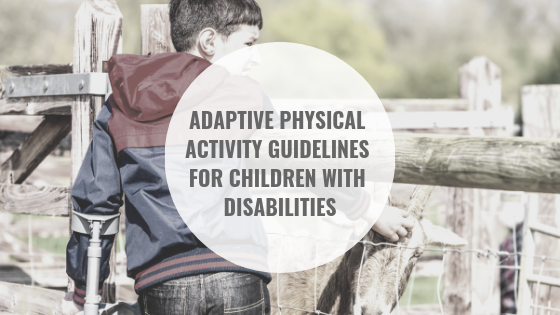
Adaptive Physical Activity Guidelines for Children with Disabilities

Participaction and the Canadian Society for Exercise Physiology, have created a fantastic resource for parents of children with disabilities.  The Ability Toolkit’s purpose is to ensure that all children are meeting daily movement requirements.  The toolkit helps to break down what a healthy day should look like for children and youth and provides ways to modify and adapt activities for many physical disabilities.  Take a look at the Ability Toolkit here and if you’re struggling to find adapted physical activities for your child consult an Occupational Therapist who are experts in providing solutions for living.

The Ability Toolkit