“I’ll ride the wave where it takes me…”
Pearl Jam, “Release”

“I’ll ride the wave where it takes me…”
Pearl Jam, “Release”

According to statistics Canada, about 2 in 5 Canadians will develop cancer in their lifetime. In 2014 alone it was estimated that 191,300 Canadians developed cancer (Canadian Cancer Society, 2014). The effects of cancer can be vast and at times, devastating. However, with early detection and new treatments, the five-year relative survival ratio has been found to be up to 63% (Canadian Cancer Society, 2014). Considering that almost half of cancer survivors are diagnosed at working age, as an employer it is important to understand your role and responsibilities should an employee require your support to manage a cancer diagnosis or recovery (Mariotto, Yabroff, Shao et al, 2011).
There are a number of responsibilities employers have regarding employee illness. It is important that employers are familiar with both provincial and federal legislation, such as The Employment Standards Act, the Ontario Human Rights Code and the Accessibility for Ontarians with Disabilities Act. It is also key that employers and human resources professionals have clear policies and guidelines on insurance supports, along with any unique company operations related to health and illness. For example, if your company offers private health, dental or vision insurance, or short and long term disability insurance, can you assist an employee to access these? Do you know your vacation and sick day policies? Are you familiar with your responsibilities to them regarding their medical leave and a reasonable accommodation process?
Related to this, is also being aware and mindful of where your employee is in their diagnosis or treatment stage. When an employee discloses their diagnosis to you, it is important that you are open, accepting and maintain non-judgemental. Is the diagnosis recent? Or are they in the rehabilitative stage, or are preparing to return to work? It is important to be aware of this so that you can ask the right questions, provide support, and work in collaboration with them to address any issues or needs they may have.
Depending on your employee and their unique situation, it can also be helpful to have a sense of how the type of cancer and the associated symptoms are impacting their ability to complete their job demands. Cancer can lead to physical changes, like changes to muscle strength, impaired mobility and fatigue, cognitive changes like reduced ability to concentrate or forgetfulness as well as emotional changes such as low mood and (understandably) increased levels of stress. However, with certain changes to the environment and/or job demands, your employee can still be a productive member of your team. Recruit the assistance of an Occupational Therapist to work with you, your human resources professionals and your employee to explore and implement ways for them to remain at work as long as their symptoms and course of treatment allows. An OT can help them to be comfortable at work while maximizing productivity and helping to foster a positive work environment.
References and Resources
Mariotto AB, Yabroff KR, Shao Y, Feuer EJ, Brown ML. Projections of the cost of cancer care in the United States: 2010-2020. J Natl Cancer Inst. 2011 Jan 19;103(2): 117-28. Epub 2011 Jan 12
Cancer + Careers
http://www.cancerandcareers.org/en/at-work
Canadian Cancer Society
http://www.cancer.ca/~/media/cancer.ca/CW/publications/Canadian%20Cancer%20Statistics%202014/Canadian-Cancer-Statistics-2014-EN.pdf
University Health Network
http://www.uhn.ca/docs/HealthInfo/Shared%20Documents/Returning_to_Work_after_Cancer_Treatment.pdf

A healthy, heart smart diet is one of the main ways you can help to ensure heart health. A diet full of healthy fruits and vegetables, low in cholesterol and sodium is the optimum way to eat for your heart. Check out the following slideshow from WebMd featuring “23 Foods That Can Save Your Heart.”
“Hardships often prepare ordinary people for an extraordinary destiny.”
C.S. Lewis
Julie Entwistle, MBA, BHSc (OT), BSc (Health / Gerontology)
My grandmother is legally blind. She first lost her hearing in her 60’s but managed this well with hearing aids and the ability to lip read. She also learned some sign language. Then, in her 70’s, her sight also started to fail her. This progressed until she was left with what she calls “cheese cloth” and shadow vision in her right eye and minimal, if any, vision in her left. While adjusting to failing sight was of course difficult for her, adjusting to also losing the ability to lip read and communicate with people was an even bigger challenge. She had always used her vision to compensate for her hearing loss and this was no longer an option.
As an occupational therapist I have worked with people who have low vision, and can say that no two people will experience this the same. First of all, vision loss, and legal blindness, do not mean total blindness, so the first step is always trying to understand what people can see and the ways their vision continues to work (or not) for them. This of course involves multiple professionals, but as occupational therapy is about “function” we need to look at how their vision works, and doesn’t work, in the environments in which they live and access.
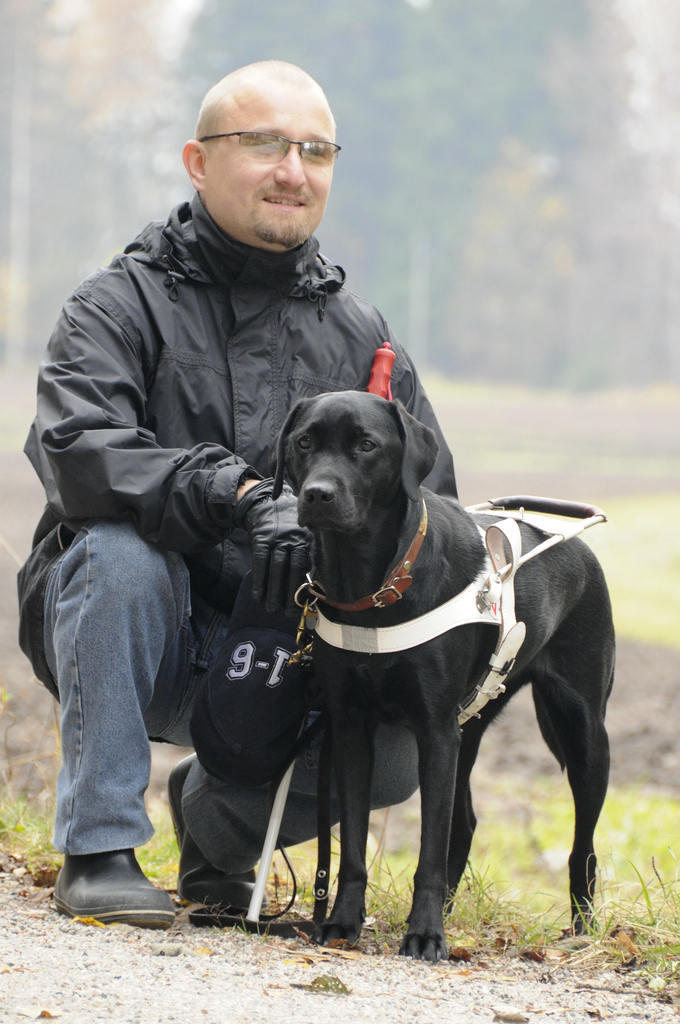
Of course, safety is always the primary concern when dealing with vision loss. Safety in the home involves looking at fall risk, ease of mobility, cooking and meal preparation, and of course the ability to respond to an emergency. In the community this involves how someone with vision loss can negotiate roads and streets, manage around other people, complete paperwork at stores and offices, and avoid compromising situations such as becoming victimized or managing money transactions. Transportation is also an issue and getting from A to B usually involves the use of an attendant, taxi, or walking via a service dog or with the use of a white cane (which is mainly used to notify others of a visual impairment and to detect obstacles).
So as an occupational therapist, what type of strategies do we employ? Well, of course it will vary depending on the amount of vision someone has and of course the functional tasks they want to achieve. But here are the main ways we help:
Sleep – insomnia is a significant problem for people with vision loss. Lack of sight can impact the sleep / wake cycle and restlessness is a common problem. Yet, with poor sleep comes poor physical, emotional and cognitive function in the days following so addressing sleep issues is very important. For this we can help by suggesting sleep and relaxation CD’s, mindfulness methods to reduce anxiety and mental unrest, and positioning aids to promote comfort. Helping people to creating predictable sleep / wake cycles is also important. Some audiobooks are also helpful provided they promote cognitive rest, and not cognitive stimulation. We also discourage television or computer use, or listening to news or world events before bed as this can also stimulate the mind making sleep more difficult.
Personal Care – it is very important that someone with a visual impairment have a consistent personal care routine. This helps to promote sleep / wake cycles and keeps the body on a predictable schedule. The bathroom can be a very unsafe place if equipment is not provided to ensure transfers in / out of the shower or tub are safe, it is easy to get on / off the toilet without grabbing the towel rack, and to prevent falls that can be common in this space. Organization is key to ensuring that the individual can find the items they need when they need them, without unnecessary and timely searching. Lighting and contrast on bottles or counters, and using shapes to identify objects is helpful.
Cooking – there are many ways to address function in the kitchen, but the main ingredient is always organization. People with visual impairment need things to be consistently placed where they expect to find them. Their ability to search and locate is impaired, and thus it is inefficient (and unsafe) for them to be rummaging through drawers or cupboards to find cooking utensils or other items. Color contrast is also important. Using tape, foam, Dycem, stickers, markers, or even shelf paper we can adjust surfaces to promote contrast or to re-label items in larger print. Items can also be purchased in different colors or shapes, depending on what is easier for the individual to see. There are several other devices and tools that can also be used to help someone with a visual impairment to know when they have filled a pot or glass, to know the buttons on the microwave, to more safely chop or cut, and lighting in the space is very important (but note that too bright and too dark can both be problematic).
Technology – there are many technology aids and devices that can promote the function of someone who is visually impaired. Voice recognition software, text to talk technology, closed circuit readers, and Siri-managed phones and tablets. Using a computer, someone who is visually impaired can order groceries online, do their banking, shop, communicate with others, read the paper, and interact with the world. This allows them to function in needed and purposeful ways, but safely and independently.
As you can tell, most of these suggestions involve the environment and modifying this to promote function. That is really the heart of occupational therapy – if we can’t change the person or the impairments they experience, we can at least adjust their environment to accommodate their needs, compensate for any deficits and promote independence. But this of course also requires the by-in from other people using the space as without the entire family on board, the strategies could get lost after implementation.
My grandmother functions extremely well for someone with both hearing and vision loss. She is probably the smartest person I know at 88 years old. I fully believe that she now compensates for her deficits with her extremely sharp mind that allows her to retain and remember everything. As my dad says “she is blind in one eye and sharp as a tack in the other”. She is an inspiration and has managed to adjust to some significant challenges in her later years. However, I do get concerned when I visit and she wants me to read her scale so she knows how much she weighs. I always ask her what she wants to hear and her response is something along the lines of “you are a rotten kid”…something her and my grandfather always called me – especially when I took a quarter off them playing cribbage.
Aspirations…

How many bananas can you eat if your stomach is empty?
Just one—after that, it’s not empty anymore.
This is sure to brighten up your day! Check out this video showing the power of friendship as a little girl’s Make-A-Wish dream comes true.
Yesterday, January 28th was “Bell Let’s Talk Day” across Canada. A day to acknowledge the mental health issues that plaque thousands of Canadians, to raise funds towards mental health research and care, and to provide knowledge about how to help someone who is struggling with mental health concerns. The 2015 campaign has provided great information about how to end the stigma by changing thoughts and actions.
Check out the “5 simple ways to help end the stigma around mental illness” from Bell Let’s Talk and help to create change today!