Close

Archive for category: Original Posts

by

Healthy Workplace O-Tip of the Week: Properly Set Up Your Screen

Our O-Tip of the week series we will be providing valuable “OT-Approved Life Hacks” to provide you with simple and helpful solutions for living.

October is Occupational Therapy Month and Healthy Workplace Month!  In celebration, for the month of October, we will be providing you with OT-Approved tips for a healthier day at work.

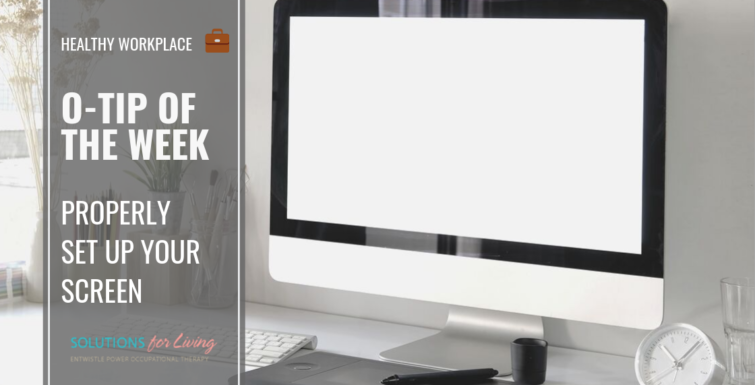
Many jobs today require long periods of screen time. If this is the case for your workstation, make sure that there is an arm’s length distance between your eyes and the screen. Also, make sure that the top of the monitor or screen is level with your forehead. This allows for the head and neck to remain in a neutral position by avoiding continued periods of looking up or down. If a job requires frequent paper reading or phone use alongside computer use, consider a document holder or headset.

by

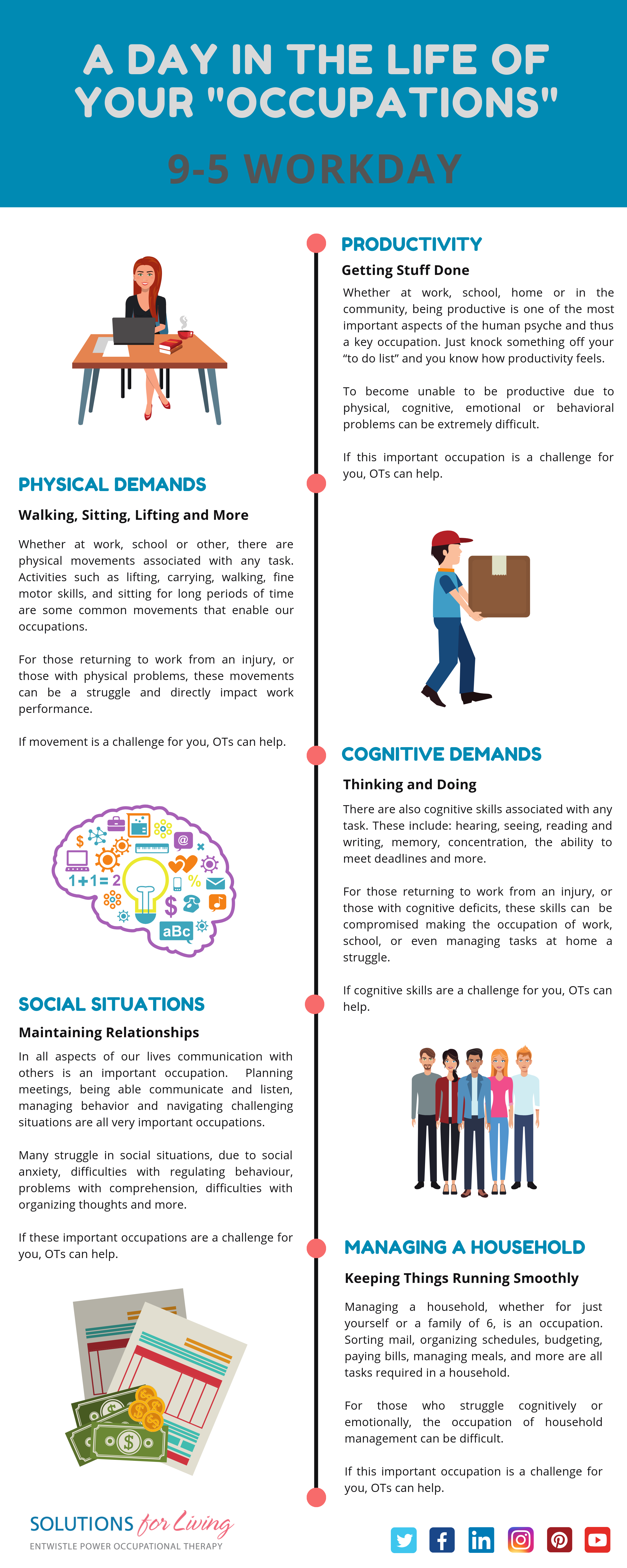
A Day in the Life of your “Occupations” — 9 to 5 Workday

Contrary to the traditional understanding of the word, occupational therapists define “occupation” differently. For OTs, the word “occupation” does not only include “paid” work, employment, or jobs. Rather, we define it as the way people “occupy” their time and as such it actually includes all roles involved in living (therapy for living, who knew?). So, for Occupational Therapy month, we will explore “A Day in the Life of Your Occupations” complete from morning to night, highlighting common important occupations and how OT’s can help when things breakdown along the continuum that is living.

This week we discuss the important occupations that arise during the 9-5 Workday. If you missed our “Rise and Shine” post, you can view it here.


by

Healthy Workplace O-Tip of the Week: Put a Stop to Sitting Disease

Our O-Tip of the week series we will be providing valuable “OT-Approved Life Hacks” to provide you with simple and helpful solutions for living. 

October is Occupational Therapy Month and Healthy Workplace Month!  In celebration, for the month of October, we will be providing you with OT-Approved tips for a healthier day at work.

There are many negative health effects of sitting for extended periods of time.  Studies show that in the long-term “sitting disease” can lead to increased risk of heart disease, diabetes, and a decreased lifespan.  A great way to beat sitting disease is to build movement into your day.  We recommend setting a reminder, once per hour, to get up and move.  Walk around the office, take the stairs to the lobby and back up, physically go and talk to a co-worker.  However you decide to move, using regular reminders will help!

by

Mental Health Services for Youth

Nicole Kelday, Student Occupational Therapist (University of Toronto)

Cowritten by:  Julie Entwistle, MBA, BHSc (OT), BSc (Health / Gerontology)


It is staggering to realize that 39% of Ontario high school students show active symptoms of anxiety and depression. And while there are a multitude of resources available to help students that may require mental health services, only 40% of Canadians aged 15-19 reported they have not accessed these when needed. This begs the question…why are these youths not seeking services?

Reaching out for help can be daunting and many report stigma related to mental health concerns, especially in high schools. So, how do we encourage youth to access the services available to them and talk to those who may be experiencing similar concerns? A new emerging trend in mental health care is the concept of youth-led groups. Youth-led groups involve a shift in thinking, instead of viewing youth as our clients; they are viewed as partners and leaders to improve the practice of youth engagement in the mental healthcare system.

Across the province, community agencies have begun to initiate youth-led groups by involving youth with mental health illness in leading each other to raise mental health awareness and fight existing stigma. With support from a clinical adult ally, youth have participated in the creation of youth-friendly services by designing waiting rooms in clinical environments to encompass the interests of this group.

It is known that participation in meaningful activities and roles can enhance emotional well-being and social competence. Occupational therapists (OTs) have the unique ability to evaluate and facilitate supportive environments in order to promote mental health amongst children and youth. By involving all key stakeholders, OTs are able to determine factors that influence the ability of a youth to fulfill their primary roles and occupations and provide interventions to promote maximal functional participation in such.

As a student occupational therapist, I could immediately recognize how this concept strongly resonated with the core beliefs of client-centredness. Youth-led groups truly highlight the client as not only an active partner but also a leader, in their healthcare experience. Youth are equipped with vast knowledge and perspectives that we as healthcare professionals may not immediately recognize, which may help to explain why youth are not seeking available services in the first place.


References

1. Centre for Addiction and Mental Health (2018). Transforming mental health for children and youth. Retrieved from https://www.camh.ca/en/camh-news-and-stories/transforming-mental-health-for-children-and-youth

2. Hartman, L., Michel, N., Winter, A., Young, R., Flett, G. & Goldberg, J. (2013). Self-Stigma of Mental Illness in High School Youth. Canadian Journal of School Psychology, 28(1), 28-42.

3. The New Mentality (2016). TNM Groups. Retrieved from https://www.thenewmentality.ca/what/tnmgroups/

4. The American Occupational Therapy Association, Inc. Mental health in children and youth: the benefit and role of occupational therapy. Retrieved from https://www.aota.org/~/media/Corporate/Files/AboutOT/Professionals/WhatIsOT/MH/Facts/MH%20in%20Children%20and%20Youth%20fact%20sheet.pdf

by

Think Pink for Breast Cancer Awareness

Breast cancer affects 1 in 9 women in their lifetime. Many of you may know someone or may yourself have been affected by breast cancer. October is Breast Cancer Awareness Month and the following resources from the Canadian Cancer Society can help you to be educated about breast health, offering many lifestyle tips to reduce your risk of developing breast cancer and help you attain your optimal health.

Canadian Cancer Society:  Breast Cancer

by

Healthy Workplace O-Tip of the Week: Follow the 20-20-20 Rule

Our O-Tip of the week series we will be providing valuable “OT-Approved Life Hacks” to provide you with simple and helpful solutions for living.

October is Occupational Therapy Month and Healthy Workplace Month!  In celebration, for the month of October, we will be providing you with OT-Approved tips for a healthier day at work.

Staring at a screen all day? Try applying the 20-20-20 rule… your eyes will thank you for it! Here’s how it works: Every 20 minutes look at something 20 feet away for 20 seconds. Get into the habit and you will significantly reduce the risk of vision-related headache and fatigue.

by

A Day in the Life of your “Occupations” — Rise and Shine

Julie Entwistle, MBA, BHSc (OT), BSc (Health / Gerontology)

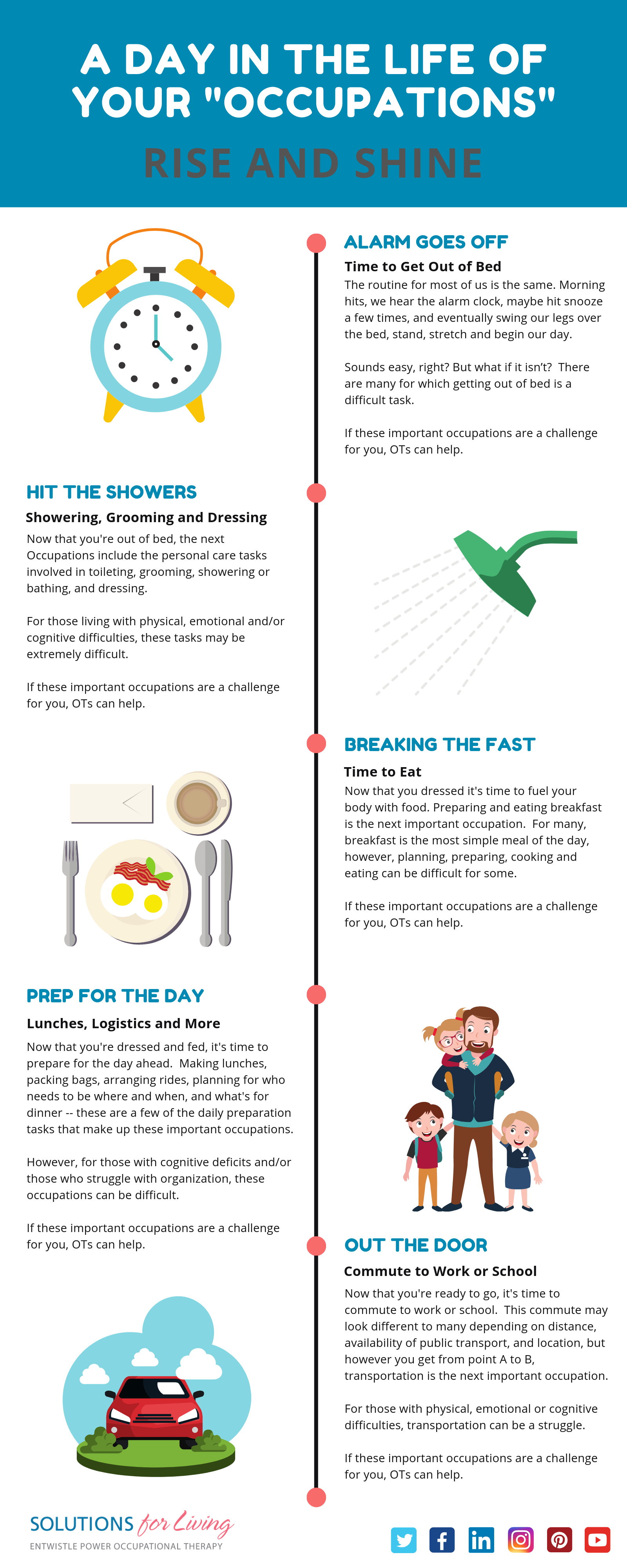
Contrary to the traditional understanding of the word, occupational therapists define “occupation” differently. For OTs, the word “occupation” does not only include “paid” work, employment, or jobs. Rather, we define it as the way people “occupy” their time and as such it actually includes all roles involved in living (therapy for living, who knew?). So, for Occupational Therapy month, we will explore “A Day in the Life of Your Occupations” complete from morning to night, highlighting common important occupations and how OT’s can help when things breakdown along the continuum that is living.

by

The Accessible Playground

How does your local playground stack up when it comes to access for all?  Is it accessible?  Older playgrounds were not built with accessibility in mind; however, newer builds are breaking barriers for users with not only physical disabilities but invisible disabilities such as autism and sensory processing disorders.  In the following article learn more about how the universal design of playgrounds is becoming standard, creating more welcoming spaces for children and youth of all abilities.

The Globe and Mail: Playgrounds can alienate children with disabilities. Now, they’re being built with accessibility in mind