Close

Archive for category: Solutions For Living

by

Eyes Up! Ontario’s New Distracted Driving Laws

Julie Entwistle, MBA, BHSc (OT), BSc (Health / Gerontology)

Welcome to 2019!  While the New Year is a wonderful time to reflect, organize, plan, appreciate and look forward with enthusiasm and gratuity, this year in Ontario it is also an important time to familiarize ourselves with the new laws for Distracted Driving.

Working in Ontario’s insurance industry, our role as Occupational Therapists is to help people recover from car accidents.  While this work is both rewarding and fulfilling, it is also fraught with heartache and loss as we meet and work with people who have endured so much, and sometimes “lost everything” with their accident.  We see loss of income, function, or hope.  Sometimes there is the corresponding death of a child, spouse, friend or family member. There is a loss of roles, purpose, and meaning.  Occasionally an accident causes poverty and loss of shelter, independence and a means of transportation.  Recovery is not easy, it always takes longer than people expect or want, and the insurance system is designed to challenge the client (oddly their “customer”) for what they want and need to get better.  Talk to anyone in the system and most (all?) say they just “want their old life back”.  It is important that we listen to them and their stories and do all we can to prevent ourselves from causing someone else’s loss, or from becoming a “client” ourselves.

Yet, despite all the ongoing education and media about how unsafe distracted driving is, I still see it daily.  I can typically count 3-5 people per day that I see driving and texting or texting at a stop light.  The easiest ones to spot are on the highways as you see them drifting lanes and quickly over-correcting.  I suppose all of these offenders believe “it won’t happen to me”…until it does.  Hopefully, these new laws will scare them straight, or they will be ticketed and stop this unsafe behavior before they hurt themselves or others.

So, what are the new distracted driving laws in Ontario (https://www.ontario.ca/page/distracted-driving):

Distracted driving is no longer limited to just texting and making phone calls. It also now includes anything from simply holding an electronic device in one’s hand to eating while behind the wheel.

  • Simply holding an electronic device in your hands (hand-held communication during driving is against the law)
  • Using a cellular phone to talk, text, check maps or switch playlists
  • Eating (there may not be a license suspension, but the RCMP warn you could be fined or given six demerits depending on the food)
  • Reading books or documents
  • Typing a destination into the GPS

What are the consequences:

  • First offence: 3 days suspension and $1,000 fine
  • Second offence: 7 days suspension and $2,000 fine
  • Three or more offences: 30 days suspension, $3,000 fine and six demerit points

For Novice Drivers (G1, G2, M1 or M2 license) the rules are different and include:

  • First offence: 30 days suspension and $615-$1000 fine
  • Second offence: 90 days suspension and $615-$2000 fine
  • Three or more offences: Cancellation of your license, $615-$3,000 fine

So, what is allowed:

  • a hands-free device (e.g. Bluetooth) but only to turn it on and off
  • a mounted device (e.g. phone, GPS) as long as it is secure – not moving around while driving

What do you have to lose by being a Distracted Driver?  Maybe nothing, or maybe everything: your physical, mental or emotional function, your job, spouse, house, car, your independence and freedom, your pain-free “do what I want when I want” physical and mental abilities…or maybe you don’t lose those, you just cause the loss of those for others which might launch you into a lawsuit that takes years to resolve and threatens every asset you have and the livelihood of you or your family.  Or, maybe it just riddles you with guilt as you live every day with the knowledge that you killed or hurt someone.  And all for a text or a call?  Or to multi-purpose driving and eating a hamburger?  Sorry, but nothing is more important than the protection of the health and wellbeing of ourselves, our family, and others.

by

How to Achieve Your Goals — The Secret Sauce

Julie Entwistle, MBA, BHSc (OT), BSc (Health / Gerontology)

What if I told you that there was one easy way to achieve the goals you have set for yourself?  Could it be that simple?  People are complicated creatures, true.  But if you have taken the time to set goals, are you measuring these and achieving them?  Are you working on your goals every day?

Here is the secret sauce…with every fork in the road, and there are tons of them, ask yourself: which decision aligns with my goals?

Let’s take health as an example.  Your goal is to lose weight, be more active, or be less breathless at the top of the stairs.  So you get to work and the first decision is: should I take the elevator or the stairs?  Then it is lunch and you have the option to work at your desk or go out for a short walk.  Or you don’t bring a lunch and need to decide if you should buy pop or water.  The salad or burger.  With each of these examples, one decision aligns with your goals and one does not. Yet if you continuously choose the option that aligns with your goals, results will follow.  This is true even if you make a small decision in the right direction – like taking the stairs for one flight then catching the elevator for the rest of the ride.  Or instead of ordering the salad, you just choose to not order the fries.

Using my life as an example, I have five key goal areas:  health, family, career, finances and personal growth.  Every evening I have the option of bringing my computer home to continue working into the night.  To do so may align with a financial goal of earning a suitable income, and a career goal to run a successful business, but it negates two other important goals of health (working means I will not exercise), and family (working means I won’t be spending time with my children).  So, I have a conundrum.  But in these cases, the reality is that my day at work has already been spent on my career and financial goals, while my other goals have taken a backburner to work time.  So, considering this, aligning my evening time with two different goals helps me to make the important decision to leave the computer at the office, minus the guilt that comes from leaving some work unfinished.

Yes, achieving goals takes discipline, but it is far easier to make small consistent choices, then to make a drastic change that might not be sustainable.  So, on the path to awesomeness that involves you setting goals and blowing these out of the water, just ask yourself daily, as you need to make decisions around your behavior and time, “which option here will help me to achieve my goal(s)?” Then, as you align your decisions with your top priorities, results will follow.


It is the New Year — a great time to set goals for the year ahead.  Take a look at our Goal Planning Guide to help you set and achieve your goals in 2019!


by

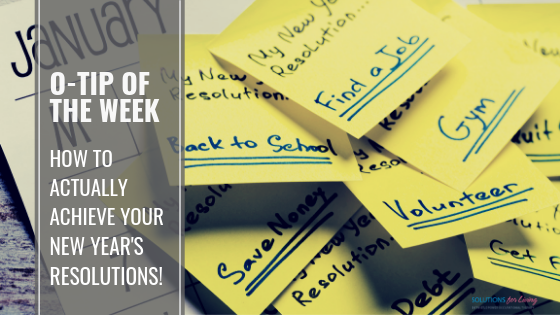
O-Tip of the Week: How to Actually Achieve Your New Year’s Resolutions!

Our O-Tip of the week series delivers valuable “OT-Approved Life Hacks” to provide you with simple and helpful solutions for living. 

For the month of January, our O-Tip series will provide you with ways to kick bad habits and establish good ones.  This week we look at how to set yourself up for success with New Year’s resolutions.

The start of a new year brings with it the opportunity to start something new or make positive changes by setting goals or resolutions.  Many start the year with exciting plans to achieve these goals, however, research shows that most people “give up” before the month of January is over.  How can you achieve resolution success?  Take a look at our OT-approved tips to help you accomplish your New Year’s Resolutions.

The Complete Guide to New Year’s Resolution Success


 “Today is the first blank page of a 365-page book.  Write a good one.” 


by

Giving Back this Holiday Season

Julie Entwistle, MBA, BHSc (OT), BSc (Health / Gerontology)

Tis the season for me to carefully balance my dislike for the Holiday season with my desire to not bring those around me down with my “baa-hum-bug” attitude.  My hate-on for Christmas started in my late 20’s probably around the time I had four kids under age 5 and through some lack of communication among my family, my kids had like 15 presents to unwrap EACH.  No, I am not complaining that my kids have access to such “abundance” by some very loving and well-meaning people, but with this display of affection comes a parent’s concern that their child will love Christmas because of the stuff.  And the more stuff they get, the more they want.  The more they want, the more they miss the point on the difference between want and need and the more they expect the “bar” to be raised with each passing year.

So, in my search to not pass on my “hate-on for the holidays” gene to my children, I landed on charity and acts of service to balance the fact that they, like most of their friends, live in abundance but still need to be mindful and grateful that they get a lot of what they want, while “needing” nothing.  After all, most of us can give something and there are so many options for this.  This new approach has been helping me to beat the Holiday Blues for the last few years.  It helps me to slow down, reflect, and be mindful and grateful for the things I have and can provide others, and for the pleasures of my own life. 

But in stepping out and getting my girls involved in local charities over the holidays, I have realized that there is an art to “giving” that can have the most impact.

Here are my Top 5 Things to Consider when Giving Back This Holiday Season:

Donate Money – good and responsible charities are appreciative of every dollar.  From the Salvation Army Bell Ringers to putting in a payment online or in the mail.  Money does help.  Search online with your kids to find a charity close to your heart, and have every member of the family donate.

Donate Items – some charities collect food, clothing, toys, or housewares to provide to those in need.  Time to purge those things you don’t need or use.  But before you donate items, ASK the charity what they need and HOW they want the items provided.  If they want new toys, these need to be packaged and un-used.  If they want them unwrapped then don’t take the time to wrap them – it only adds cost and time for you, and cost and time for the charity to unwrap the item before distributing.  Also, ASK what age groups they have a hard time providing for.  I was volunteering at the Good Shepherd recently and they had an abundance of items for small children, but very few for teens.  If you ask them, they will tell you the age categories they struggle to provide for.  Lastly, be sensitive.  If the charity is serving refugees or people immigrating from war-torn countries, toys that involve violence or war (i.e. guns or tanks) might not be appropriate and will need to be screened out by the charity before providing it to the recipient, again adding time and administration during a busy season.

Purchase Charity Goods – some charities sell “goods” that provide an item with a donation.  World Wildlife Federation sells small stuffed animals to represent an “endangered species” and most of the cost of the animal goes to the charity.  So, for $40.00 my child gets an “endangered stuffie” with a certificate about the animal they have adopted, and the charity gets $32.00 as a donation to their cause.  This is also true of other charities that aim to sell farm animals or agriculture supplies that are provided to third world countries.

Support Events – many charities offer dinners, auctions, or other seasonal events to raise money.  This is a great way to donate while engaging in an “experience” with a friend, partner or as a family.

Donate Time – sometimes donating your time reaps the best reward for you and the charity.  Not only does it provide you with an opportunity to see how the organization operates and allow you to be “hands on” in making a difference, it saves the charity from needing to fund staffing to manage the busy holiday season.  I have been at the Good Shepherd three times this month doing anything from sorting clothing donations, food donations, stocking housewares on the shelves in their store, and sorting toys for their Christmas hampers.  There are many organizations that just need some extra hands during the holiday season and sometimes our time is our most impactful gift.

Next week on our blog we begin our annual tradition of giving back to our readers with the 12 Days of Inspiration.  We hope you find these uplifting stories a source of inspiration and hope this Holiday Season.  

Previously Posted December 2016

by

Holiday Survival O-Tip of the Week: Make a list and check it twice!

Our O-Tip of the week series delivers valuable “OT-Approved Life Hacks” to provide you with simple and helpful solutions for living. 

For the month of December, one of the busiest months of the year, our O-Tip series will provide you with OT-approved ways to not just “survive the holidays,” but actually enjoy them!  In this week’s O-Tip of the week we take a page from Santa Claus himself.

December is a stressful time of year so organization is key.  Make a list.  Make multiple lists!  Plan it, buy it, store it, and then cross it off your list.  Make separate lists for separate tasks:  cards to send, presents to buy, food to coordinate, functions to attend, decorating to do – then set it and forget it.  Pull out one list a week, tackle it, and then discard.  Repeat.

Try using our printable Holiday Gift Planner to help you stay on track and stress less this Holiday Season.

by

“The Cost of Caring” — Coping with Compassion Fatigue

Julie Entwistle, MBA, BHSc (OT), BSc (Health / Gerontology)

Co-written with Kayla Colling, Student Occupational Therapist

There are many reasons we become health care providers.  Sometimes it is a passion for helping a certain population, a desire to help people achieve specific goals, or the recognition that people are needed to fill gaps in health care delivery.  Whatever the reason, there are physical and emotional risks that come with “helping” work.

If you are a helping or social professional who uses compassion and empathy with your clients who have experienced trauma and suffering, you may already be familiar with compassion fatigue.  Nurses, physicians, trauma therapists, social workers, workers in child protective services, and military healthcare teams are recognized to be at risk of exposure to second hand trauma through their work and may benefit from understanding and recognizing compassion fatigue.  Other health care providers, such as occupational therapists, advanced practice registered nurses (APRNs), respiratory therapists and physical therapists may also suffer the consequences of compassion fatigue in their work with people and their families that are experiencing a health crisis.

What is compassion fatigue?

Compassion fatigue is often described as the “cost of caring”.  It can also be called “secondary traumatic stress”, which is a more clinical term, but it is generally agreed that these terms are interchangeable.

Compassion fatigue occurs when providers are exposed to another person’s trauma and suffering.  This could be through routine interactions at our workplaces, when we provide compassion and empathy to clients or patients who have experienced trauma.

Symptoms

Compassion fatigue impacts individuals physically, emotionally and spiritually, and tends to have a rapid onset of symptoms.  The symptoms listed below are not exhaustive and not exclusive to compassion fatigue, so they should not be used to diagnose.  If you are concerned, consider making an appointment with your physician or other mental health worker to discuss your concerns.

Physical:  chronic fatigue, frequent headaches, gastrointestinal complaints, sleep disturbances, muscle tension, aches and pains, and anxiety.

Emotional and Spiritual:  heavy heart, emptiness, decreased sense of purpose, low self-esteem, high self-expectations, helplessness and hopelessness, numbness, apathy, depression, anger, irritability.

Behaviour Changes: avoiding or dreading work, calling in sick frequently, inability to maintain empathy, chronic lateness, overworking, and difficulty focusing and concentrating.

So it’s like burnout?

Burnout has a more gradual onset and results from an accumulation of ongoing, daily stressors at work that wear us down if we do not take proper care of ourselves and try to address the contributing workplace issues.  Symptoms of burnout tend to be more subtle and are sometimes misinterpreted.  It is still very important that we try to both address and prevent burnout, but this is clinically different from compassion fatigue.

Building Resiliency/Prevention

Although we cannot entirely prevent compassion fatigue from happening, we can take steps to reduce the risk, recognize warning signs and seek support early in order to reduce the impact on ourselves, our coworkers, our clients and our friends and families. 

By reading this blog, you have already taken a step toward learning more about it.  If we can normalize these emotions after exposure to these types of situations, it might help us to seek and accept support when we need it.

If your workplace permits, it can be helpful to have regular debriefings, even if a specific incident or crisis has not occurred.

Self-care strategies have been shown to help prevent compassion fatigue.  These strategies will likely include enhancing your boundaries to separate your work life from your home life as much as possible.  It also often involves balancing your activities outside of work as well, including engaging in a variety of relaxing, pleasurable and productive activities throughout the week.  Importantly, getting enough sleep at night and eating healthy and regular meals are also parts of self-care.  Avoiding maladaptive coping mechanisms (such as turning to alcohol, increasing smoking, eating or spending) is also important, including recognizing when things are deteriorating to get help quickly.

Practicing self-compassion can also help us to build resilience against compassion fatigue.  You can find meditations to help cultivate self-compassion, or it might be something you explore through reading, watching TedTalks, attending a course or workshop, or talking to your therapist about.  Having a regular mindfulness or meditation practice may also help you build resilience, along with other positive and adaptive outlets like exercise and social time.

Resources

If you are interested in learning more about compassion fatigue, check out the references below.

If you want to “check in” with yourself, you may be interested in looking at the Professional Quality of Life Scale (ProQOL) available here.  This scale will allow you to calculate scores on scales that consider compassion satisfaction, burnout and secondary traumatic stress (compassion fatigue).  I am not suggesting using this scale for self-diagnosis but it can sometimes be helpful to indicate if there is a concern you might want to speak to a professional about.

The symptoms of compassion fatigue can be severe – if you are concerned for your safety, please call your local crisis/distress line for support.  Find a crisis line near you.

References

Sorenson, C., Bolick, B., Wright, K. & Hamilton, R.  (2016).  Understanding compassion fatigue in healthcare providers: A review of current literature.  Journal of Nursing Scholarship, 48(5), 456-465.  doi: 10.1111/jnu.12229

Sorenson, C., Bolick, B., Wright, K. & Hamilton, R.  (2017).  An evolutionary concept analysis of compassion fatigue.  Journal of Nursing Scholarship, 49(5), 557-563.  doi: 10.1111/jnu.12312

Vu, P. &Bodenmann, P.  (2017).  Preventing, managing and treating compassion fatigue.  Swiss Archives of Neurology, Psychiatry and Psychotherapy, 168(8), 224-231.  doi: 10.4414/sanp.2017.00525


by

“MO”-Tip of the Week: Prevent the ‘Man Cold’ (It’s a Real Thing!)

Our O-Tip of the week series delivers valuable “OT-Approved Life Hacks” to provide you with simple and helpful solutions for living.

For the month of Movember, a month dedicated to Men’s Health, our “MO”-Tip series will provide you with OT-approved ways to take care of the men in your life.  

Studies show that men have harsher cold and flu symptoms than women, therefore, men may not be simply exaggerating symptoms as many women claim.  That’s right… the ‘man cold’ is real!  So men, to avoid getting the dreaded ‘man cold’ or flu this season, follow these great tips care of the Center for Disease Control.

CDC:  Preventing the Flu: Good Health Habits Can Help Stop Germs

Learn more about the scientific evidence of the ‘man cold’ care of CBC News.

CBC News:  Canadian doctor says there’s evidence the ‘man flu’ is actually real

by

The Cognitive Job Demands Analysis: Your Brain at Work

Many employers know that a Physical Job Demands Analysis involves a health professional outlining the physical aspects of a specific job position.  These are common in manufacturing or production industries where jobs can be heavy, repetitive, or require high physical demands.  But these reports are seldom helpful if an employee suffers a brain injury, cognitive or emotional impairment and their return to work issues relate to cognitive or psychological changes and not necessarily physical impairment.

A Cognitive Job Demands Analysis is an objective evaluation of the specific cognitive, emotional and psychological skills required to perform the essential job duties of a given position. As mentioned, traditional Job Demands Analysis typically address only the physical components of the essential job duties.  Yet, jobs are multifaceted and performance at work depends on the interplay of human physical, cognitive, emotional, behavioral and environmental factors.  As such, having a cognitive job demands analysis in conjunction with a physical job demands analysis is ideal, or these can be completed as a standalone assessment if required.

Cognitive job demands analyses can be helpful in providing a baseline measurement tool against which an individual’s cognitive and psychological capacities may be compared, such as when hiring new employees, developing and implementing training programs, or to assist in return to work post injury or illness. These comprehensive and detailed assessments can be utilized when any health condition (cognitive, physical, or emotional) impacts an employee’s thinking, cognition and/or their interpersonal processes and abilities.

Much like with a physical job demands analysis, a cognitive job demands analysis involves an on-site observation of a worker(s) completing the job in question and usually includes objective measurements, and sometimes interviews with employers and co-workers. Some of the more specific aspects examined include:

  • Hearing, vision and perception
  • Reading, writing and speech
  • Memory, attention, and higher level cognitive abilities, like problem solving, insight and judgement
  • Safety awareness
  • Work pace
  • Self-supervision
  • Deadlines and work pressure
  • Interpersonal skills required for the job
  • Self-regulation and the need to work independently, with supervision, or in a group

A comprehensive job demands analysis should include comparisons of the information obtained to standardized classification data related to occupations, such as those outlined by the National Occupational Classification 2011 proposed by Human Resources and Skills Development Canada. After a report is generated, recommendations and interventions for consideration can be developed.

Do you feel that your organization has positions that need to be outlined via a cognitive job demands analysis? Do you have more questions on how a cognitive job demands analysis can be used in the return to work process? If so, seek out the services of an Occupational Therapist, or contact us for a free consultation.

For additional informative posts on workplace health and wellness please refer to our Healthy Workplace page.

Resources

Haruko Ha, D., Page, J.J., Wietlisbach, C.M. (2013). Work evaluations and work programs. In H. McHugh Pendleton and W. Schultz-Krohn (Eds.) Pedretti’s Occupational Therapy Practice Skills for Physical Dysfunction (337-380), St. Louis, Missouri: Elsevier Mosby.

by

Why You Need to Talk About End of Life Decisions

You survived the birds and bees talk… what can be more awkward than that?   Having a discussion about end of life wishes is something all adults should do with their adult children, partner, and/or loved ones.  Though the topic may be awkward and something you would rather avoid, without these conversations it is difficult for children, or powers of attorney, to make the decisions you would want if and when the need arises.  The following article care of Chatelaine Magazine reinforces the importance of having these discussions and what they should include.

Chatelaine:  How to talk to your family about end-of-life decisions

by

Sparking Change in the Wake of Tragedy – ‘Buckle up for The Broncos’

Julie Entwistle, MBA, BHSc (OT), BSc (Health / Gerontology)

As a kid in the 80’s I remember seeing a newspaper article about a girl that was struck by a car after exiting a school bus.  There was a picture of the girl on the ground being attended to by emergency personnel.  It was a disturbing image and I was about her age.  After that, it seemed that school buses started to have stop signs and flashing lights, and huge fines were imposed for passing a school bus when it stopped to let children on or off.  Whether these two events are directly related or not, it is true that laws tend to change when something horrible happens and people are hurt or killed.

In April of this year, tragedy struck Saskatchewan as the Humboldt Bronco’s Junior hockey team bus was in a collision with a transport truck, killing 16 people on board and seriously injuring 13 others.  Those killed and injured were teenagers, coaches, and trainers.  Could any good come of this senseless loss of life and talent?  Maybe, as those involved are asking people to #buckleupforthebroncos by encouraging the use of seat belts on tour buses if these are present. 

Transport Canada is already responding and by 2020, all newly built transport buses will be required to have seatbelts.

So, what are the current laws in Canada for this?  Well, seatbelt use falls under the jurisdiction of the provincial and territorial governments and in most provinces the law states that seatbelts must be worn if they are provided, but of course, most motor coaches are not required to be equipped with belts, so they are not always available to be worn.  That will change in 2020.

Working in the field of auto insurance where my clients are people injured in car accidents, I can state clearly that seatbelts save lives.  Bus accidents are rare but are catastrophic when they happen.  These new laws could save many lives and hopefully will reduce the significance or impact of bus-accident-related injuries.

But all of this got me thinking…my daughter is a varsity athlete for a prominent University.  I asked her if the coach bus that transports them to games and tournaments has belts.  Her answer was “no, they do not”.  I suspect this means that most University, College or Sports teams buses don’t as well, so change is necessary and if these buses can’t be retrofitted to include belts, they need to be replaced.   I too am in the sports arena as the assistant coach of a sports team and our club also travels by coach bus.  I have asked our travel coordinators to make sure our tour operators provide buses with belts, and if they don’t, to find another vendor.  Hopefully, that can help promote change — one team at a time.

We all need to buckle-up and if belts exist, use them.  Even if you don’t feel the need to wear a belt, in the event of an impact if you are unsecured you would be tossed around the inside of the vehicle, threatening the security of others.  Secure yourself, secure your belongings, and secure your passengers.  There is no logical reason not to.