Julie Entwistle, MBA, BHSc (OT), BSc (Health / Gerontology)
In celebration of summer, I wanted to repost our popular blog on pool safety. These helpful tips and tools are good things to review and consider…especially this time of year.
I was a fortunate child who grew up with an in-ground pool. As the only house on the street with a pool in our yard, the neighborhood kids would loiter around our home hoping for an invite. My mom developed a wonderful system using a Canada flag. If the flag on our fence was up – everyone was welcome for a swim. The only rule was that the kids needed to bring a parent. Mandatory. And despite the kids that would sit on our lawn whining about not having an adult to join them, my mom was firm to the rule.
We have a pool in our yard. This is separately fenced. As our kids are getting older, and have been able to swim for years, we are giving them more freedom around the pool. As long as an adult is home, they are welcome to swim. However, recently I was reminded of an important lesson – just because my kids can swim, that is not necessarily true for others of the same age. We had a pool party for our twins’ birthday and all the kids arrived and proceeded to jump in the pool. One child was hanging around the shallow end and I asked her if she could swim – nope. I was surprised that in dropping her off to a pool party, her parents would not mention this very important fact.
A few summers ago on a street very close to mine an 18 month old child drowned when he was able to get outside while his father had a 15 minute nap. Drowning is the second most common cause of accidental death among children aged 14 and under in Ontario, after motor vehicle accidents. Yet, like many risks, drowning is absolutely preventable. Here are some safety precautions to consider:
1. Constant and vigilant supervision. Supervision of any child is a full-time job. Most drowning’s occur when a child is playing near the water and falls in – not while “swimming”. So, when it comes to kids, the “within arm’s reach” rule should always apply – whether they are in, or around, water.
2. Using safety devices for the pool. These could include:
- Poolside Alarm– A motion sensor is installed along the pool edge, which sounds an alarm when waves are detected from a body falling into the water.
- Child Immersion Alarm– A wristband worn by a child, which will sound an alarm when they come into contact with water.
- Pool Fences– Fences should be at least four feet tall, surround the entire pool and have self-latching gates out of the reach of children. Speclocks prevent children from entering the pool area, as they are complex or require adult strength to open. Gate alarms can also be installed to alert when the gate is unexpectedly opened.
- Pool Covers– A cover built to fit your pool dimensions will act as a barrier for a falling body, as they will not enter the water.
- Door locks – special locks, difficult for children to open and installed at the top of a door, prevent kids from being able to get into the yard without an adult.
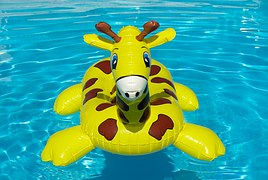
3. Use life jackets, not just floaties. If your child is not a strong swimmer, they should always be wearing a life jacket – in a pool, at the beach, or on a boat. Like wearing a seat-belt and helmet, children should be taught from a young age that wearing a life jacket is necessary around water. From a functional standpoint, life jackets are safer than floaties. Floaties can develop small holes that actually fill with water, or can deflate, causing the child to slowly sink lower into the water. A well-fitting life jacket is designed to keep a child’s head above water, and to flip a child over onto their back to facilitate breathing. They cannot deflate. It also provides something for an adult to grasp if they need to pull the child out of the water.
4. Know the signs of drowning. Contrary to popular belief, drowning does not happen when people are flailing their arms, yelling and calling for help. It is actually the opposite. People that are getting into trouble in the water often look like they are climbing an invisible ladder. They can’t yell or cry for help as their body is low on oxygen and is focused on trying to keep air in, not yell it out. Know the signs – check out this link for the “8 Quiet Signs of Drowning.”
5. Knowledge of first aid. Parents should always consider having knowledge of CPR or basic water rescue. This could prove handy for many situations beyond just water safety.
6. Swimming lessons. Give your kids a head start by helping them to become comfortable in the water from a young age. Every minute they can stay afloat could save their life.
But remember, when it comes to children, nothing is safer than diligent and attentive supervision.