
Check out the inspirational story of Connor Yates: a young boy who’s courageous speech created awareness for autism and inspired people around the world.
Accessible Technology
Check out the latest in smart devices for people with visual impairment. The following smartwatch, called “Dot,” uses active dots to allow people who are blind or visually impaired to read texts, emails and even books with braille. The following article from Mail Online explains this great new technology in more detail.
Mail Online: Now THAT’S a smart watch
Inspired
“I am beautiful no matter what they say, words can’t bring me down. I am beautiful in every single way, yes words can’t bring me down… So don’t you bring me down today”
Christina Aguilera, Beautiful

Back to Routine, Back to Ergonomics
With the change in routine through the summer months, it is time to rethink about how we are sitting and working all day to make sure our body can adjust to the new routines that are devoid of summer vacation and summer activities.
In our previous posts, we have discussed using proper ergonomics to help support your back, neck and shoulders. Today, we look at how to reduce wrist pain and related injuries.
Wrist injuries and corresponding pain are common work-related musculoskeletal disorders that can have detrimental consequences. Repetitive hand movements completed on the job is often a key culprit, however, improper positioning of the wrists, forearm and shoulder can also be a factor. Keyboarding, use of a mouse and extended periods of sitting at a computer in one position can lead to symptoms like wrist and forearm pain, weakness, numbness or tingling in the fingers and in some cases, development of cysts or nodules around the wrist joint and tendons.
Injuries to the wrist are particularly troublesome as we heavily require use of our hands throughout the work day. Barr, Barbe and Clark (2004) reported that work-related musculoskeletal disorders of the wrist and hand cause the longest absences from work and as such, are associated with greater losses in productivity and wages than injuries in other body areas. This research was also supported by a more recent study, which found that lost productivity costs related to hand and wrist injuries was roughly $411 million dollars per year and this was the highest among any other injury type studied (de Putter, Selles, Polinder et al., 2012). There are some strategies that can be used to prevent and address wrist pain, but it is essential to keep in mind that as with any other potential for injury at work, the worker, work station and job demands must all be considered. Some great strategies to address wrist pain at work include:
- Take regular breaks to stretch and allow your wrists to rest. If needed, use a timer on your computer to tell you when it is time to take a break. There are several free timers you can download and use such as Focus Booster (available for download at https://www.focusboosterapp.com/download) or Orzeszek Timer (available for download at http://www.orzeszek.org/dev/timer/)
- Alter your job demands between typing, using the phone, filing or other duties that reduce strain on the wrist.
- Ensure you are positioned so that your wrists remain in a neutral position during typing. This may require adjusting your keyboard, mouse or chair.
Many other great solutions to address wrist pain at work can be recommended by an Occupational Therapist, with solutions ranging from low to high cost. For more information, check out Entwistle Power’s FREE Office Ergonomic E-Book or contact an Occupational Therapist to help meet the ergonomic needs of your organization.
Resources
Barr, A., Barbe, M. & Clark, B. (2004). Work-related musculoskeletal disorders of the hand and wrist: epidemiology, pathophysiology and sensorimotor changes. J Orthop Sports Phys Ther. Oct 2004, 34 (10), 610-627.
de Putter, C., Selles, R., Polinder, S., Panneman, M., Hovius, S. & van Beeck, E. (2012). Economic impact of hand and wrist injuries: health-care costs and productivity costs in a population-based study. J Bone Joint Surg Am. 2012, 94:e56 (1-7).
http://www.ccohs.ca/oshanswers/ergonomics/office/mouse/mouse_problems.html
Inspired

Eating Well Can Reduce Cognitive Decline
Eating well is important at all stages of life for many reasons. As we age, healthy eating becomes increasingly important to lower risk of heart disease, reduce the risk of diabetes, provide energy– the benefits are endless. And now, a new study shows that eating well as you age can help to reduce the risk of cognitive decline. Check out the following from CBC Hamilton which discusses the study in depth and provides additional motivation to maintain a healthy and nutritious diet.
CBC Hamilton: Healthy diet for seniors tied to lower risk of cognitive decline
Inspired
“Every great dream begins with a dreamer. Always remember, you have within you the strength, the patience, and the passion to reach for the stars to change the world.”
Harriet Tubman
Home Modifications for Under $100
Julie Entwistle, MBA, BHSc (OT), BSc (Health / Gerontology)
There is a misconception that home renovations for safety or disability need to be expensive. While this can be true for large-scale projects, there are some quick-fix modifications that are small, but pack a punch. Here is my top 10 pick of modifications you can make for under $100.
Offset Door Hinges – if the doors of your home just seem a bit too narrow , consider that the width of the door, when open, makes the door opening smaller than it is. Consider purchasing some recessed hinges that will allow your doors to swing as wide as your door frame, giving you an extra few inches to get through with a walker, wheelchair or commode.
(www.adapativeaccess.com)
Drawer Pulls – if knobs are too difficult to grasp, consider swapping your kitchen and bathroom hardware for U shaped pulls that require less fine motor grasp and control to open.
Easy Grip Shower Head – handheld shower heads are great for allowing people to sit to shower, or to reach difficult areas without bending and twisting, but for people with a reduced grasp, I love these Easy-Grip shower heads from Moen.
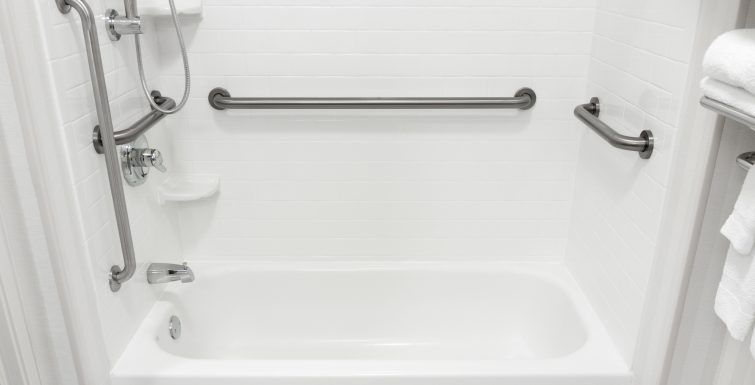
Grab Bars – these don’t need to look industrial or institutional and many colors and configurations exist. One strategically placed grab bar can help you get out of the shower / tub or even on / off the toilet. Consider the multi-use line from Moen that has grab bars with built in soap or toilet paper holders to help save space. 
Threshold Ramps – these small ramps are portable and make it easier to transition over small thresholds that are often present at entry doors. (www.electro-ease.com)
Lever Door Handles – sometimes grasping and turning a door handle can be a problem for people with arthritis or who have issues with fine motor control. Swapping out some door knobs with lever-style handles is a quick fix to help promote someone’s ability to open and close doors themselves.
Removing Shower Doors – often shower doors can get in the way as we get older. While some people use them to grab and hold, these have a threshold and limit the ability to use a bench or seat in the shower. Removing the shower doors and replacing these with a curtain provides more versatility for equipment, makes it easier for a caregiver to help you shower, and is easier to clean and maintain.
Railings – installing a basic railing on any stair is an inexpensive way to greatly reduce the risk of falling when going up and down.
Adhesive Shower / Tub Strips – easy to install, these anti-slip strips give you added protection from falling when you are getting in / out or standing in the shower / tub with bare feet on a wet surface. Strips are easier to maintain and clean than a standard bath mat and stick better to the bottom of the tub / shower.
Shower Seats – with or without a back, these sturdy and often height-adjustable seats allow people with reduced endurance or balance problems to sit when showering. Sitting means less chance of falling, which can cause injury. The smaller seats are easy to remove for other people who want to use the shower as well.
Do you feel you need a more custom approach to addressing how you manage your activities at home? Consider the services of an Occupational Therapist as we are the functional experts!
Laughter Therapy

Weekly Mind Bender
Solve the following…

1. Drawn to scale
2. Round of Applause
3. Splitting Hairs
4. They’re all the same
5. There’s no end to it
6. Different strokes for different folks