Close

Author Archive for: jentwistle

by

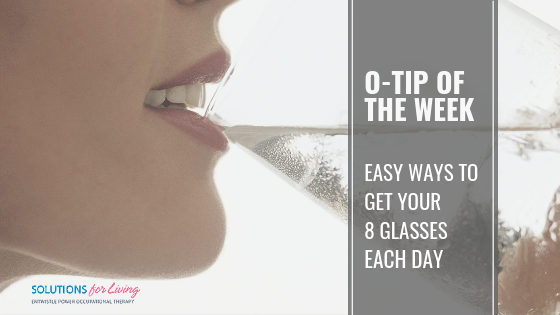
O-Tip of the Week: Stay Hydrated with These Helpful Hacks

Our O-Tip of the week series delivers valuable “OT-Approved Life Hacks” to provide you with simple and helpful solutions for living. 

For the month of January, our O-Tip series will provide you with ways to kick bad habits and establish good ones.  This week we talk about hydration and how to get your 8 glasses (or more) each day!

We all have heard of the “eight glasses a day” rule, but is this the right amount for everyone?  The answer is not as simple as you think.  Depending on your age, overall health, and activity level you may actually require more.  At the least, this year, create the habit of ensuring you consume at least 8 glasses of water each day.  Try one or more of the following strategies to see what works for you:

  • Track the habit!  Use our habit tracker to stay accountable to your goal of drinking 8 glasses per day.
  • Set alerts on your phone, fitness tracker, and/or smart home device to remind you to have a glass every 2-3 hours.
  • Always have a glass of water before you eat something.  Thirst can disguise itself as hunger, so try water first!
  • We love the simple hack of using a permanent marker to indicate times of day on your water bottle to remind you how much how much to have and when.  Like the one pictured here care of musthavemom.com.

If you would like to learn more about the importance of hydration and your unique requirements check out our previous post, Help with Hydration – How Many Glasses Do You Really Need?

by

Confidentiality in a Coffee Shop? Conducting Business in Non-Private Places

Julie Entwistle, MBA, BHSc (OT), BSc (Health / Gerontology)

In many ways, the local coffee shop has become the new “mobile office”.  Grab a beverage and maybe food, the WiFi is free and available, and no one needs to pay rent or worry about booking a reservation.

I was grabbing a tea the other day and while in line there were two women at a table beside me having a meeting.  I got the sense that the one woman was providing a service to help the other woman find her birth parents.  Within minutes I knew where the one woman was born, her date of birth, birth name, the people that adopted her, date of her adoption, where she grew up, current address…probably enough information for identity theft (if I was into that), but definitely more than I needed or cared to know, and probably more than what this woman would want strangers to overhear.

I have a client that likes to meet in a coffee shop.  He prefers that to his house where he has family that can overhear our delicate conversations.  Before agreeing to meet him there I reminded him that confidentiality is difficult in a public place, and there is no guarantee that people won’t overhear or listen to our conversation.  We discussed alternatives, but in the end, he accepted the privacy risks and continues to request a public place as our meeting spot.

As health professionals we are, or should be, always cognizant of personal privacy and information protection.  We need to safeguard our clients from potential information breaches by keeping our paper and electronic records safe and secure, but by also being very aware of our surroundings and the likelihood of our services and conversations becoming public.  Even in hospitals where there are ward rooms and open treatment areas, busy hallways and nurses’ stations: privacy and confidentiality, while difficult to maintain at times in these public forums, must be maintained.

I recently had a medical appointment at a hospital.  I had forms that I needed to bring.  When I arrived, a volunteer took my forms and in the open waiting area began summarizing these with me.  I was quiet and asked her if our conversation needed to be public.  She was an older woman and seemed startled by my question.  But honestly, not only was I uncomfortable talking to a volunteer (who is not bound by the same privacy and confidentiality rules as health professionals) about my appointment, but my discomfort was heightened when she was reviewing my personal papers openly.

The risk of personal information and privacy breaches are significant.  The media is constantly sharing stories of our information being sold, hacked or otherwise being “gathered” for purposes we don’t often consent to.  I guess the most important thing to consider is that we are mindful and aware of the information we provide about ourselves, to whom we provide it, and the presence of others in these discussions.  A coffee shop might be a suitable place to conduct some business, but I would argue not all, and that anyone engaging in conversations in public places, health professionals or not, need to be mindful and aware of their surroundings.  Consent is key, and it is important to draw people’s awareness to the location and to ask them for their permission to have sensitive or otherwise private conversations in non-private locales.


by

Social Outings Rx

We’ve said this before and we will say it again… being social is good for your health.  Occupational Therapists recognize the importance of social interaction within leisure activities for persons with and without disabilities. We work with clients to explore their interests to help find activities that offer opportunities for social interaction and, if needed, find ways to address the different barriers to engaging in these meaningful past times.

Great news!  Your family doctor can help with this too. There is now a pilot program in Ontario that allows physicians to write prescriptions for social activities and the ROM is assisting with this initiative.  Learn more in the following care of CBC News.

CBC News:  Doctor’s orders: ‘Social prescriptions’ have been shown to improve health

by

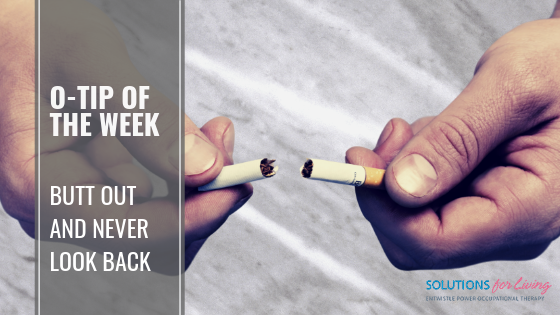
O-Tip of the Week: Butt Out and Never Look Back

Our O-Tip of the week series delivers valuable “OT-Approved Life Hacks” to provide you with simple and helpful solutions for living. 

For the month of January, our O-Tip series will provide you with ways to kick bad habits and establish good ones.  This week we tackle one of the hardest habits to kick – smoking!

According to Smoke Free Ontario, smoking kills approximately 13000 people in Ontario each year.  However, the good news is that the number of smokers continues to decrease yearly.  How can you become one of the quitters? 

A good friend of mine just celebrated her one-year anniversary of being smoke-free after 20+ years as a smoker.  For years she discussed wanting to quit but admits she couldn’t bring herself to do it because of FOMO (fear of missing out).  It wasn’t until she realized that there was nothing to give up and everything to gain that she was able to finally kick the habit. 

Smoking is an addiction and quitting is extremely difficult.  Many need to try different approaches before finally kicking the habit – for my friend, it was the book the “Easy Way to Stop Smoking” by Alan Carr that led to success.  Some other proven ways to butt out are discussed in our post, National Non-Smoking Week– Be a Quitter!

by

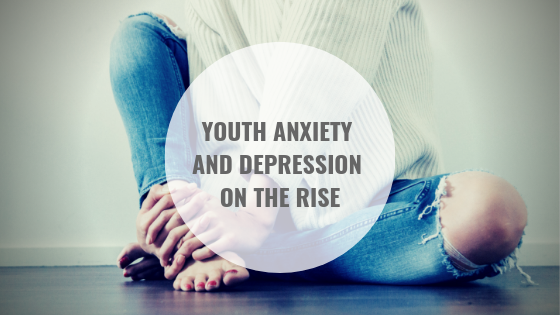
Youth Anxiety and Depression on the Rise

The Centre for Addiction and Mental Health (CAMH) has released the results of the latest Ontario Student Drug Use and Health Survey and the results are showing rising instances of anxiety and depression in grades 7-12 students.  Learn more about the results and how gender may play a role in the following care of CAMH.

The Centre for Addiction and Mental Health:  Half of female students in Ontario experience psychological distress, CAMH study shows


by

O-Tip of the Week: Get in the Habit

Our O-Tip of the week series delivers valuable “OT-Approved Life Hacks” to provide you with simple and helpful solutions for living. 

For the month of January, our O-Tip series will provide you with ways to kick bad habits and establish good ones.  This week we discuss how to create lasting lifestyle changes by forming healthy habits. 

Did you know it can take three weeks or more to develop a new routine or habit?  And following the formation of habits, it can take up to four months to fully change your lifestyle.  Making positive change is a commitment, and with commitment comes accountability.  We recommend using a daily habit tracker, like our free printable below, to help you stay accountable to yourself and your goals.  Ensure you tick the box each and every day and you will be well on your way to creating lasting change!

by

Eyes Up! Ontario’s New Distracted Driving Laws

Julie Entwistle, MBA, BHSc (OT), BSc (Health / Gerontology)

Welcome to 2019!  While the New Year is a wonderful time to reflect, organize, plan, appreciate and look forward with enthusiasm and gratuity, this year in Ontario it is also an important time to familiarize ourselves with the new laws for Distracted Driving.

Working in Ontario’s insurance industry, our role as Occupational Therapists is to help people recover from car accidents.  While this work is both rewarding and fulfilling, it is also fraught with heartache and loss as we meet and work with people who have endured so much, and sometimes “lost everything” with their accident.  We see loss of income, function, or hope.  Sometimes there is the corresponding death of a child, spouse, friend or family member. There is a loss of roles, purpose, and meaning.  Occasionally an accident causes poverty and loss of shelter, independence and a means of transportation.  Recovery is not easy, it always takes longer than people expect or want, and the insurance system is designed to challenge the client (oddly their “customer”) for what they want and need to get better.  Talk to anyone in the system and most (all?) say they just “want their old life back”.  It is important that we listen to them and their stories and do all we can to prevent ourselves from causing someone else’s loss, or from becoming a “client” ourselves.

Yet, despite all the ongoing education and media about how unsafe distracted driving is, I still see it daily.  I can typically count 3-5 people per day that I see driving and texting or texting at a stop light.  The easiest ones to spot are on the highways as you see them drifting lanes and quickly over-correcting.  I suppose all of these offenders believe “it won’t happen to me”…until it does.  Hopefully, these new laws will scare them straight, or they will be ticketed and stop this unsafe behavior before they hurt themselves or others.

So, what are the new distracted driving laws in Ontario (https://www.ontario.ca/page/distracted-driving):

Distracted driving is no longer limited to just texting and making phone calls. It also now includes anything from simply holding an electronic device in one’s hand to eating while behind the wheel.

  • Simply holding an electronic device in your hands (hand-held communication during driving is against the law)
  • Using a cellular phone to talk, text, check maps or switch playlists
  • Eating (there may not be a license suspension, but the RCMP warn you could be fined or given six demerits depending on the food)
  • Reading books or documents
  • Typing a destination into the GPS

What are the consequences:

  • First offence: 3 days suspension and $1,000 fine
  • Second offence: 7 days suspension and $2,000 fine
  • Three or more offences: 30 days suspension, $3,000 fine and six demerit points

For Novice Drivers (G1, G2, M1 or M2 license) the rules are different and include:

  • First offence: 30 days suspension and $615-$1000 fine
  • Second offence: 90 days suspension and $615-$2000 fine
  • Three or more offences: Cancellation of your license, $615-$3,000 fine

So, what is allowed:

  • a hands-free device (e.g. Bluetooth) but only to turn it on and off
  • a mounted device (e.g. phone, GPS) as long as it is secure – not moving around while driving

What do you have to lose by being a Distracted Driver?  Maybe nothing, or maybe everything: your physical, mental or emotional function, your job, spouse, house, car, your independence and freedom, your pain-free “do what I want when I want” physical and mental abilities…or maybe you don’t lose those, you just cause the loss of those for others which might launch you into a lawsuit that takes years to resolve and threatens every asset you have and the livelihood of you or your family.  Or, maybe it just riddles you with guilt as you live every day with the knowledge that you killed or hurt someone.  And all for a text or a call?  Or to multi-purpose driving and eating a hamburger?  Sorry, but nothing is more important than the protection of the health and wellbeing of ourselves, our family, and others.