I am not alive, but I can grow. I do not have lungs, but I need air to survive. What am I?
Fire.

I am not alive, but I can grow. I do not have lungs, but I need air to survive. What am I?
Fire.

Guest Blogger Lauren Heinken, Student Occupational Therapist
For anyone with an interest in how Canada’s single-payer medicare system works and how it may be improved, this book written by Dr. Danielle Martin and released earlier this year is a must-read. Although it is written from a medical perspective, the author appreciates that an individual’s health is dependent on much more than biology, and the active role individuals need to play in their own medical care is emphasized throughout the book. Dr. Martin takes the time to acknowledge the psychosocial factors that can impact well-being, and as a whole her perspective aligns well with the profession of Occupational Therapists. Better Now: Six Big Ideas to Improve Healthcare for All Canadians is written in such a way that it can be appreciated by anyone who reads it, but those who have direct contact or personal experience with Canada’s medical system may benefit the most from it’s content.
 The book’s introduction showcases Dr. Martin’s rational stance on many issues that at times provoke excessive fear amongst Canadians. An example of such an issue is the economic impact that the country’s aging population may have on the healthcare system. This book is able to provide an alternative, and often more optimistic view, on these “hot” issues compared with the fear-provoking opinions that are often shared through other media sources.
Each of the “six big ideas” discussed in this book form a chapter, and each chapter begins with Dr. Martin introducing a real-life patient case that demonstrates and supports the idea. Aside from providing a human component to the systems-level issues discussed in this book, these patient cases are useful in providing an opportunity for readers to apply chapter content to an actual user of the healthcare system. This helps facilitates readers being able to wrap their heads around what truly are “big ideas”.
You may be questioning what the relevance of this book is to OT practice. An issue identified within the book is that our medical system tends to be one that is largely disjointed, with different parts of the system often not communicating clearly with one another. This lack of connectivity comes at a cost to both individuals who use the system and those who fund it. Although implementation of better communication technology will play a large part in addressing this problem, I would argue that it could at least be improved if health practitioners and those administering the system knew a little bit more about what each other did. This book is a good way for OTs to learn more about the medical system, and they may potentially use this knowledge to influence a smoother and more cohesive system experience for their clients. It also better equips OTs to provide appropriate answers to questions they might be asked that relate to navigating the healthcare system.
The only disappointment in this book is the absence of the OT profession when Dr. Martin speaks to “other healthcare professionals”. OTs have the potential to make big contributions to proactive healthcare, but also to improving how the system functions and these are not explicitly considered in this book. However, OTs know their scopes best and have the skills to advocate for their contributions, so their absence in this book creates an opportunity for them to fill the gap. How? Stay-tuned for this to be discussed in a later blog post.
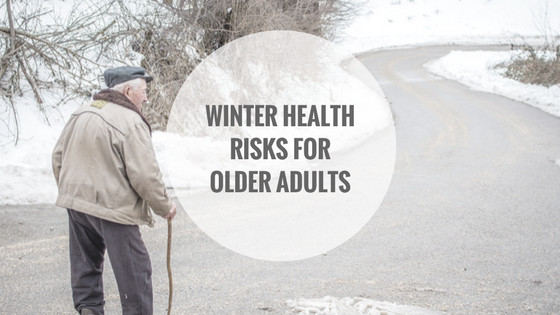
Although winter can be a beautiful time, did you know that the cold temperatures can be hazardous to the health of senior citizens? Learn more about the risks older adults face when the temperatures drop in the following care of Comfort Keepers.
Our O-Tip of the week series we will be providing valuable “OT-Approved Life Hacks” to provide you with simple and helpful solutions for living.
For the month of January our O-Tip series will concentrate on creating achievable resolutions and goals for the new year.
If you’re wanting your resolutions to stick long-term you need to turn the healthy behaviours into healthy habits. Learn how to create lasting habits that will help you reach your goals in the following post from our blog, featuring a free printable habit tracker!
When I take five and add six, I get eleven, but when I take six and add seven, I get one. What am I?
A clock.
Julie Entwistle, MBA, BHSc (OT), BSc (Health / Gerontology)
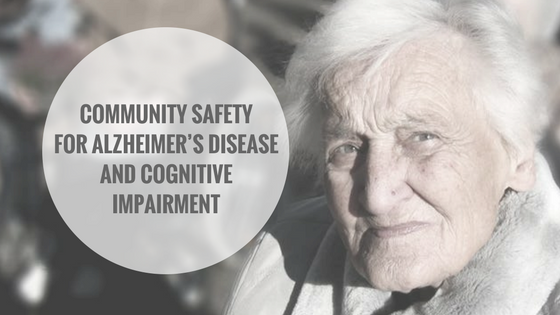
In recognition of Alzheimer’s Awareness Month, I wanted to touch on the important topic of helping people with Alzheimer’s disease (or cognitive impairment) to be safe in the community.
A few months back I received an email from a friend. She wanted to “pick my brain” about a problem they were encountering with her father who has Alzheimer’s disease. She mentioned that he enjoys spending time in the community on his own, but the family was growing increasingly concerned about his safety. She was wondering if I had any suggestions on how they could monitor his community activities, and be able to locate him should he not return home when expected.
My experience working in brain injury has had me looking for such solutions in the past. Some people, with behavioral or cognitive impairment, are at risk in the community because they become disoriented, confused, lose track of time, or are not attentive to traffic. There is such a loss of independence for people to be told they cannot leave the home alone, and some become agitated or angry when people try to supervise their activities. Yet, even a familiar route can become a problem for people if their cognitive status changes or deteriorates, and what is manageable one day may become problematic the next. Part of my role as an occupational therapist when dealing with cognitive impairment is to problem solve with the client and family the ways we can help them to pursue their goal of independence outside the home, while also ensuring their safety and easing the mind of the care provider. There are several ways to do this, and the list below is not exhaustive by any means.
Remember that Occupational Therapy is about helping people to solve the problems that arise when physical, emotional or cognitive abilities change rendering daily activities to become a struggle. In all cases, because disability is experienced differently by everyone, the solution for one person may not be the solution for another – even when dealing with the same diagnosis. So, consult an OT if you have a functional problem to solve!
Previously Posted September 2014

Making healthy and satisfying meals takes a lot of time and energy. For those living with injury, illness, or the effects of aging cooking can become something that easily zaps precious energy. The following care of Tru-Therapy Kitchen, an OT website focused on promoting optimal function and independence in the kitchen, discusses 5 great “hacks” that can help save time and energy when making meals.
Tru-Therapy Kitchen: 5 Energy Conservation Tips for Meal Prepping
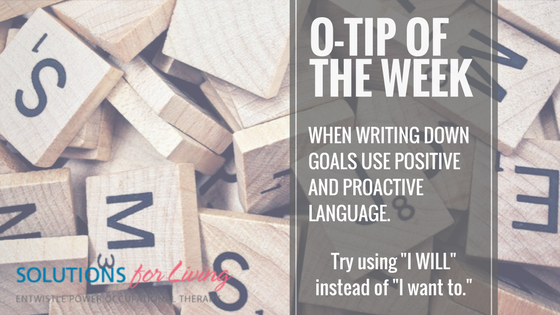
Our O-Tip of the week series we will be providing valuable “OT-Approved Life Hacks” to provide you with simple and helpful solutions for living.
For the month of January our O-Tip series will concentrate on creating achievable resolutions and goals for the new year.
When creating your goals try changing the phrases “I hope to” or “I want to” to “I WILL.” Let the power of a proactive and positive mind guide you to success this year!
Learn more about how the phrases you use can help you achieve success this year in the following article from our blog.
Solutions for Living: Say “I Will…” this New Year
A doctor and a bus driver are both in love the same woman. The bus driver had to take a trip for a week. Before leaving he gave the woman seven apples. Why?
An apple a day keeps the doctor away.

Julie Entwistle, MBA, BHSc (OT), BSc (Health / Gerontology)
I made a comment after the Holidays that I was slowly recovering from Christmas Affective Disorder. For me, Christmas is stressful, hectic and challenging. I struggle with it every year. After the seasonal rush, it takes me days, or even weeks, to get back to my normal equilibrium. However, really, winter despair is not a joke and for some, can be debilitating.
In fact, some research suggests that up to 15% of people in Ontario experience the “winter blues”. These leave you feeling tired, groggy, and maybe even sad or irritable. While this causes discomfort, it is not incapacitating. However, a more serious form of the winter blues, known as Seasonal Affective Disorder (SAD), can be. While occurring less frequently at 2-3% of the population, the symptoms can prevent individuals from leading a normal life. Symptoms of SAD include decreased energy, changes in appetite, especially leading to cravings for starchy or sweet foods, oversleeping and weight gain, among other things. If you feel this is you, talk to your doctor and have your symptoms investigated.
The problem is not always the blues, but how these create a negative behavior cycle. When you feel down, you revert, avoid, or change habits. This leads to feeling worse and the cycle continues. Occupational therapists (OTs) recognize the importance of being engaged in activities that are meaningful, active and productive, and understand how these contribute to health and well-being. In fact, one of the best treatments for beating the winter blues involves just “keep on keeping on” by doing what you normally do every day. Some tips include:
Finding ways to help you do the things you want to, need to, or enjoy, is at the heart of occupational therapy. While the winter months can be long, dark, and cold, ultimately how we adapt to the seasonal change is up to us. If moving or going south is not an option, consider some of the above tips to make the winter bearable, or dare I say, even enjoyable?
Resources:
Seasonal Affective Disorder. (Canadian Mental Health Association, 2013) http://www.cmha.ca/mental_health/seasonal-affective-disorder-sad/
Beat The Winter Blues (Readers Digest, no date) http://www.readersdigest.ca/health/healthy-living/beat-winter-blues
Kurlansik, SL & Ibay, AD. (2012).
Seasonal Affective Disorder. Am Fam Physician. 2012 Dec 1;86(11):1037-1041.
10 Winter Depression Busters for Seasonal Affective Disorder (Borchard, no date) http://psychcentral.com/blog/archives/2012/12/30/10-winter-depression-busters-for-seasonal-affective-disorder/
Previously Posted January 2017