Close

Archive for category: Original Posts

by

Adaptive Physical Activity Guidelines for Children with Disabilities

Participaction and the Canadian Society for Exercise Physiology, have created a fantastic resource for parents of children with disabilities.  The Ability Toolkit’s purpose is to ensure that all children are meeting daily movement requirements.  The toolkit helps to break down what a healthy day should look like for children and youth and provides ways to modify and adapt activities for many physical disabilities.  Take a look at the Ability Toolkit here and if you’re struggling to find adapted physical activities for your child consult an Occupational Therapist who are experts in providing solutions for living.

The Ability Toolkit

by

Organization O-Tip of the Week: What to do with Those Rolls of Wrapping Paper

Our O-Tip of the week series we will be providing valuable “OT-Approved Life Hacks” to provide you with simple and helpful solutions for living. 

Did you know that being organized can help you to reduce stress?  Spring is around the corner, and with it comes Spring Cleaning!  Therefore, for the month of April, our O-Tip of the week series will share some of the best tips to help you get organized because an organized space is a healthier space!

Due to Birthdays, new babies, weddings, and more there always seems to be a gift to wrap, therefore in our household we always have rolls of paper, gift bags, and bows on hand.  This consumes valuable storage space and can become quite messy if not organized properly.  Why not try using vertical space to store these items?  Try large hooks or magazine holders to neatly organize your gift bags and try plastic bag holder affixed to the wall to effortlessly keep all your paper rolls together.


photo care of onegoodthingbyjillee.com

by

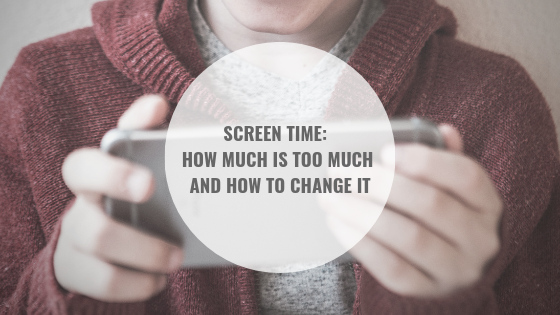
Screen Time: How Much is Too Much and How to Change It

Julie Entwistle, MBA, BHSc (OT), BSc (Health / Gerontology)

I was enjoying a nice dinner with a friend (also an occupational therapist) and we started a great conversation about phone use with our children.  She asked me “how much screen time is too much”?  Of course, there isn’t really an academic answer, but we talked from a professional perspective about the behavior of phones, the social risks and benefits, and from the parent side of our fears and worries about how these have become a staple in the lives of our kids. Then, she changed my world by introducing me to the concept of screen time (more on that below).

Parents have very polarized views on phones, so I get that how I manage this in my household may not fit with the values of others.  To recap, I have four teen daughters ages 14-18.  Our phone philosophy is that we provide our girls a phone for their 14th Birthday (Grade 9) and pay for this until their 18th Birthday.  After that, they are on their own to fund this expense (and can get as many gigs as they want).  On our plan, they have 2 gigs each and do not get an extension if they run out.  Their access to Wi-Fi at home is scheduled and is not limitless.  They are not allowed to have their devices in their bedrooms (concessions are made sometimes but they already have “old school alarm clocks” to negate the “I need it to wake up” argument) and they know that if this is beside their bed it needs to be in airplane mode to not disrupt their sleep.

Too strict?  Perhaps, but I see phones like every other “potentially harmful” thing I keep my kids from.  Sedentary time, junk food and pop consumption (tip – just don’t buy it!), and of course we do not serve them alcohol or buy them cigarettes.  I ensure they are all engaged in something active and encourage them to make decent food choices, even if they don’t.  Those things are easy for me to “parent about” because it is well established that “sitting disease” is a thing, “diabetes and obesity” are a problem, and alcohol and drugs are horrible for developing brains (not to mention illegal for my kids based on age).  But screen time?  How much is “too much”?  We don’t really know that yet.  We know that phones are highly addictive – more addictive than cocaine – and cause a whole host of behaviors that, like addictions, are hard to break.  They also promote highly sedentary behavior (they are typically used while sitting). So, here is how I handled this (and note this is for iPhones with a family plan, I don’t know how this works with any other devices):

  • Go to: “settings, screen time”.  To get to know how this works, the top shows your usage.  Push on that and you have the option to look at Today or the Last 7 Days.  Below that is a list of all the things you do on your phone and for how long.
  • Go back to “screen time” and you will see somethings below your usage:

o   Downtime (schedule time away from the screen)

o   App Limits (set time for apps)

o   Always Allowed (things you want to always have access to)

o   Content and Privacy (blocking inappropriate content

  • Then below that, you will see “Family” and a list of those “underage” as per your family plan.

Now for the cool parent stuff.  You can click on any one of your children’s devices and you can see for each of them what you can also see for yourself.  Patterns, usage behavior, time on certain things, and you can also put limits to the above (Downtime, Apps, Always Allowed and Content).  It asks you for a password so as a parent you can pick something that the kids won’t know.  They can’t change their limits on their own.

I don’t recommend arbitrarily just going in and setting limits as I think the best part of the “screen time” feature is the conversation that can happen around figuring out what is “reasonable”.  With my kids, I chatted with each of them about their usage pattern (something they never looked at).  We talked about the time on their Apps, and for some, questions like: “4 hours on Rodeo Stampede”?  This brought their awareness to their habits and allowed me to understand their insight into whether this was “good, bad or ugly”.  And honestly, it was a mix of all three.  After we understood their patterns, we decided on our “screen time limit” (for us three hours / day) and went through to give permission for all the “good” to continue, the “bad” to be limited, and the “ugly” to stop.  And the best thing is that these limits apply regardless of data or Wi-Fi – so even if they have unlimited Wi-Fi in public places, they can’t use their devices more than programmed.

Since implementing this several weeks ago, their screen time has dropped significantly, and they don’t even use their devices to their limits (which were set lower than their averages to start with).  In fact, three hours might be more than they need.

All of this brings me back to a popular concept in my profession of occupational therapy:  behavior change starts with being able to track and understand it in the first place.  Once you know where behavior is at, you can make a conscious and concerted effort to modify it to improve your own health.  Even if you drop your usage by 30 minutes a day and maintain that for several weeks, you just returned yourself 3.5 hours per week to do other (healthier?) things.

What’s next Apple?  An iFridge?

by

Organization O-Tip of the Week: Make Room by Rolling

Our O-Tip of the week series we will be providing valuable “OT-Approved Life Hacks” to provide you with simple and helpful solutions for living. 

Did you know that being organized can help you to reduce stress?  Spring is around the corner, and with it comes Spring Cleaning!  Therefore, for the month of April, our O-Tip of the week series will share some of the best tips to help you get organized–  because an organized space is a healthier space!

Is it time to give your linen closet a makeover?  Create additional space and keep towels fresh by rolling and stacking them to store.  This rolling trick doesn’t just apply to bath towels but works for kitchen linens too.  Give it a try and you may end up with more spacious storage spaces.

by

Protecting Client Confidentiality in Public: Public Networks

Julie Entwistle, MBA, BHSc (OT), BSc (Health / Gerontology)

Free Wifi?  Great…but what about having your device and its content available to others?  In our previous blogs we talked about confidentiality in public places with conversations (Confidentiality in a Coffee Shop? Conducting Business in Non-Private Places), phones and computers (Protecting Client Confidentiality in Public: Laptops and Phones), but what about accessing public and shared networks?  Care of Wired Magazine and our IT department, here are some tips to protect yourself:

  1. Know your network – only connect to networks you recognize and feel you can trust.
  2. Make the connection secure – choose HTTPS when on public networks.
  3. Only provide the bare minimum – when signing into public WIFI you are often asked to provide personal details.  It is advised to provide only the minimum necessary.
  4. Read the fine print – know what exactly you are signing up for before logging in.
  5. Use two-factor authentication  –  Basically, enabling two-factor authentication requires an additional password or code to sign into certain sites and apps.  Learn more about this extra security layer here care of PC Magazine.
  6. Disable file sharing – although file sharing may be a handy feature at home, as you can easily share files between devices when in public you definitely want to remember to disable this function so others do not have access to your files.
  7. Use a virtual private network (VPN) – although you may need to pay for this service, if you are working in public spaces often, it is worth it.  Basically, a VPN acts as a “middle man” between your device and its files/information and the world wide web, protecting your information from those who may want to see it.

See the entire Wired Magazine article here to learn more about protecting your information online.

Remember that if you are a professional and have access to confidential and private information, you have a responsibility to protect this from others.  At work, home, or in public, keep information safe.

by

A Space for Young People Living with Terminal Illness

A new website, livingoutloud.life, provides a safe and welcoming space for terminally ill teens and young adults and their families to connect, share stories, support each other, find resources and more.  Learn more about this initiative of the Canadian Virtual Hospice in the following article care of CBC News.

CBC News:  ‘My entire life has flipped’: Canadian website helps connect terminally ill young people

by

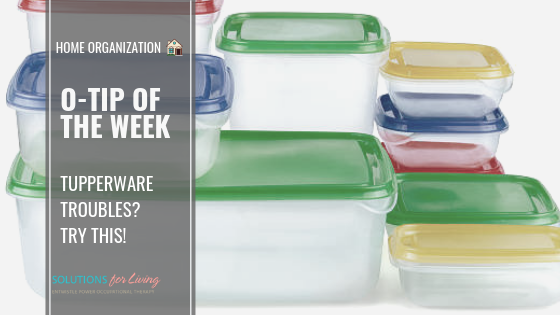
Organization O-Tip of the Week: Tupperware Troubles? Try This!

Our O-Tip of the week series we will be providing valuable “OT-Approved Life Hacks” to provide you with simple and helpful solutions for living. 

Did you know that being organized can help you to reduce stress?  Spring is around the corner, and with it comes Spring Cleaning!  Therefore, for the month of April, our O-Tip of the week series will share some of the best tips to help you get organized because an organized space is a healthier space!

Leftovers are great, but all the food storage containers required can sometimes make a disorganized mess in your kitchen cupboards and drawers.  Without some organization how will you ever be able to find a matching lid?  Tackle your tupperware problems with these smart storage solutions care of Better Homes and Gardens Magazine.

Better Homes and Gardens:  10 Genius Solutions for Food Storage Containers

by

The Cost of Disability

The cost of disability due to injury or illness is significant and stems from lost work time, medications, equipment, costs of personal care, therapy and more.

When struggling to make ends meet, people encounter stress, anxiety, panic, excessive worry, loss of sleep, relationship issues, poor decision making, and can result in addictions as a form of poor coping.  You can imagine how hard it would be to heal from injury or trauma when significant money stressors are created as a result!

Our OT-V episode below provides insight into how an Occupational Therapist can help you or someone you love plan for future costs related to the specific disability, provide treatment to help you manage your finances more efficiently, and deal with any associated symptoms.

by

What is Growth Mindset?

When it comes to “mindset” Carol Dweck, a professor of psychology, states that people have either a fixed or a growth mindset and states that:

  • With a fixed mindset, one believes their qualities and abilities are fixed and therefore cannot change even with practice.
  • With a growth mindset, one believes their qualities and abilities will continue to change with time, effort and experience.

The term “Growth Mindset” is used frequently when talking about children and youth pertaining to education, however, it is not just for kids.  As clinicians who work with people of all ages who have sustained life-altering injuries, we often come across fixed mindsets and work to help clients reframe their thoughts and form goals based on a growth mindset.   Learn more about growth mindset in this TedTalk featuring Carol Dweck.