Close

Archive for category: Original Posts

by

O-Tip of the Week: Control Clutter

Our O-Tip of the week series we will be providing valuable “OT-Approved Life Hacks” to provide you with simple and helpful solutions for living. 

Often the focus of occupational therapy becomes helping people to organize their activities, their stuff or their time.  So, for the month of April, our series will be all about organization.

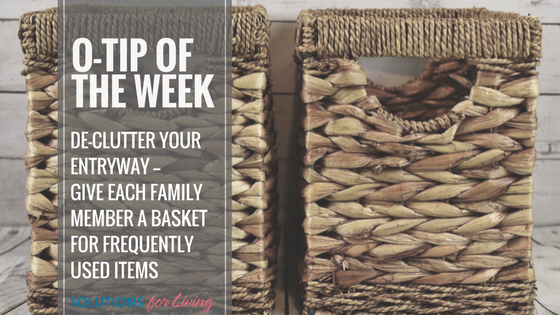
Tame the clutter in your entryway and/or mudroom with a little creative organization.  Give each member of the family their own labeled basket to easily stash frequently used items such as hats, gloves water bottles and more. 

by

Living with Autism: Occupational Therapy Can Help!

It is estimated that Autism Spectrum Disorder affects over 3 million individuals in the U.S. and tens of millions worldwide.

Occupational Therapy plays an important role in helping individuals living with autism.  Learn many of the ways an OT can support individuals and their families in the following infographic:

by

O-Tip of the Week: Avoid Cross-Contamination… Prep Separately

Our O-Tip of the week series we will be providing valuable “OT-Approved Life Hacks” to provide you with simple and helpful solutions for living. 

For the month of March, Nutrition Month, our O-Tip series will feature kitchen hacks to make your meals more nutritious, less time-consuming and more convenient.

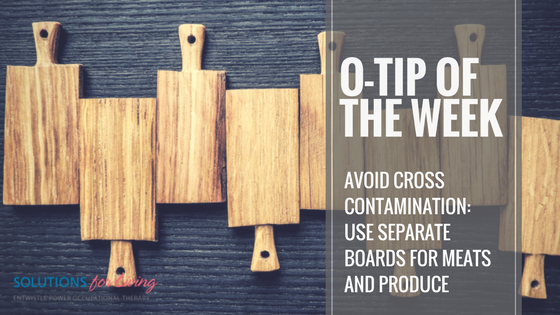
Combat cross-contamination by using multiple cutting boards.  Avoiding cross-contamination and the risk of foodborne illness by having separate boards:  one for meats and one for fruits, vegetables and other.  Easily distinguish between boards by labeling them with a permanent marker or by designating different coloured boards for different food types. 

by

Living with Epilepsy and the Role of Occupational Therapy

March 26th has been designated Purple Day across the globe in honour of epilepsy awareness. Individuals are encouraged to wear purple clothing, local organizations host events, and many of our nation’s landmarks will also be bathed in purple light to increase awareness of the need for research about epilepsy.

Increase your awareness and learn how Occupational Therapy can assist those living with epilepsy and their families to live life to the fullest in the following infographic.

by

The Costs of Convenience

Do you remember a time when eating out was for a special occasion, or when grabbing takeout happened once and a while?  For this generation, it seems that meals at restaurants and from takeout windows have become more of a regular occurrence than a special treat.  Why is this so bad?  Well other than the higher cost and lower nutritional values think about what this is (or is NOT) teaching your children?  In fact, the following article from the Huffington Post argues that this generation has prioritized convenience over cooking so much that “the simple act of cooking — a health-preserving life skill — is a skill that risks extinction.

The Huffington Post:  Teaching Your Kids To Cook Is More Important Than Teaching Them To Play Soccer Or Hockey

by

O-Tip of the Week: Tricks for Tear-Free Onion Prep

Our O-Tip of the week series we will be providing valuable “OT-Approved Life Hacks” to provide you with simple and helpful solutions for living. 

For the month of March, Nutrition Month, our O-Tip series will feature kitchen hacks to make your meals more nutritious, less time-consuming and more convenient.

Do you love onions but hate the stinging, teary eyes that result when you chop them?  Try this awesome hack that will leave you dry eyed… Place the onion in the freezer for approximately 15 minutes prior to chopping.  If you forget, you can always try the trick of sticking a piece of bread in your mouth while you chop.

by

Functional Modifications that Won’t Break the Bank

There is a misconception that home renovations for safety or disability need to be expensive.  While this can be true for large-scale projects, there are some quick-fix modifications that are small but pack a punch.  Watch our latest OT-V Episode below for our top 10 pick of modifications you can make for under $100:

by

Sleep: Does it Change with Age?

Sleep is one of the most important determinants of health.  Proper sleep helps to restore our minds and bodies so that we are able to effectively tackle another day.  Sleep supports growth and development, and helps with the body’s healing process.  However, knowing how many hours a person actually needs each night is difficult as this differs from person to person and can change with age.

Learn more about sleep and how it can change as we age in the following care of the McMaster Optimal Aging Portal.

McMaster Optimal Aging Portal:  Sleep and aging: How many zzz’s are optimal to stay healthy?

If you struggle with sleep take a look at our OT-V Episode, Improving Sleep, for some solutions that can help.

by

O-Tip of the Week: Cook once… eat twice (or more!)

Our O-Tip of the week series we will be providing valuable “OT-Approved Life Hacks” to provide you with simple and helpful solutions for living. 

For the month of March, Nutrition Month, our O-Tip series will feature kitchen hacks to make your meals more nutritious, less time-consuming and more convenient.

If you want to save time, energy and money while eating your healthiest meals then it’s time to learn to love your leftovers!  And leftovers no longer need to mean the exact same meal – learn to re-purpose them!  Take a look at these delicious double recipes care of Health Magazine.

Health:  Cook Once, Eat Twice Meals

by

Your Best Brain: Use It or Lose It

The old cliché is true when we talk of cognition – “use it or lose it”.

Our brains are made of billions of neurons, which interact with each other to complete specific tasks. Signals are sent from one neuron to another along neural pathways, and these determine our thoughts, emotions, insights, and so much more. Each task relies on a different neural pathway, so the pathway for reading a book is different than the pathway for putting on our shirt. The more we use a pathway, the stronger the connection becomes.

These neurons have the ability to physically change themselves when faced with new and difficult experiences. This ability is called neuroplasticity. As we are exposed to new areas, tasks, information or experiences, neural pathways are formed and existing ones are reshaped. This will continue throughout our entire lives as we learn. As we have experienced through practicing a musical instrument, memorizing our shopping list or recalling a friend’s phone number, if we consciously focus and train our brains in a certain area, they will become faster and more efficient at performing those tasks.

Just as we need to exercise the muscles in our body, we also need to exercise our brain.

Some great ways to keep “work up a cognitive sweat” include:

  •         Online cognitive training programs and apps
  •         Playing board games
  •         Reading books
  •         Completing puzzles such as a daily crossword or Sudoku
  •         Learning a new language or skill
  •         Getting artistic

Try our 30 Day Healthy Brain Challenge to help you find other ways to boost your brain and prevent cognitive decline.