Close

Our Blog

by

Brain Injury Awareness – The Caregiver

Julie Entwistle, MBA, BHSc (OT), BSc (Health / Gerontology)

We cannot (or should not) discuss brain injury awareness without spending time recognizing the family and friends that take on the caregiving role after someone they love has an injury of this nature. On June 9 I co-facilitated a workshop for caregivers of brain injury survivors. What a great event! Not only was this well attended, but the speakers provided an amazing amount of education, skills and insight into how to both cope, manage, and achieve success as the care provider of someone with a brain injury. I wanted to take a moment to highlight my personal takeaways from this event:

Everyone has a story. As someone who lost a brother-in-law to the effects of a catastrophic brain injury, I understand how telling our story – be it about loss, change, remorse, guilt, fear, or triumph can bring people together and has immense therapeutic benefit. Caregivers benefit from collaborating, talking, sharing, laughing, crying and growing together. Our health system needs to create these opportunities, or caregivers need to find ways to make this happen.

Grieve. In my undergrad I studied grief and loss and even worked in hospice. What I realized at our workshop, however, is that the permanence of death allows people to grieve their loss, achieve acceptance, and eventually move on. When dealing with survival from a traumatic event, however, grief is not always experienced as our loved one is still present, albeit different. Yet, our speakers emphasized the importance of grieving: the life that once was, the life that may never be, and the changes and adjustments that have occurred. Caregivers need to let this grief process happen, or should seek support from a trained professional to experience this important emotion.

Find a new normal. Clients, caregivers, and health care professionals need to always consider that the old “normal” may never return. In that case, we all need to collaboratively look ahead to creating a “new normal”. Different does not always have to be bad, and it requires an open and optimistic mind to think that way. For OT’s that means taking the abilities of the individual, considering their resources, and helping them to create that new life of function, fulfillment, meaning and productivity.

Put on your own oxygen mask first. We spoke extensively about the importance of caregivers taking the time to attend to their own personal needs, to have positive coping mechanisms and sources of support. Then, at break I was speaking with a man whose wife suffered a brain injury. He talked about the “airplane analogy” and how this applies to caregivers – put on your own mask before helping another. I smiled and told him that I wrote a blog on that exact topic, with that exact title last year. As he found that analogy practical and helpful, I thought I would share the contents of that previous blog here, to highlight this important third point:

Posted September 25, 2013

If you have ever travelled by air you are familiar with the drill. Instructions on how to buckle and unbuckle your seatbelt, where the life vest is located, emergency exits, and “should cabin pressure change, an oxygen mask will fall from the overhead compartment…passengers should always put on his or her own mask before assisting children, or a disabled passenger”.

I read a mommy blog the other day that called this the “airplane example” and the writer related this to how moms should approach motherhood. Ultimately the message is this: as a mom, put your own health first because you are useless to your kids and spouse if you ignore your own needs. Really, you can’t help a child with an emergency escape from a crashing plane if you pass out helping them with their mask.

While I do agree that mothers (and fathers for that matter) need to consider their own needs in providing for the family, this is also true of people that provide care to a disabled person. My experience is that often caregivers do not really “elect” that role. They are not trained to be a caregiver, and really just try to do their best with the skills and resources they possess. However, where many fall short is maintaining their own health and wellbeing in dedicating their physical and emotional time to another person: a person with challenging and multiple needs. The job of a caregiver is often 24 hours, and resources don’t often permit, nor does the government provide, sufficient relief from this responsibility. Caregivers are often sleep deprived, suffer from muscle and joint pain in fulfilling their role, and can become isolated and depressed due to the changes they have made to take on these new responsibilities. Sound familiar? This very closely mimics motherhood (especially for new moms).

The answer? Put on your own oxygen mask first. What can you do to breathe easier? What helps you to feel clear-headed, energetic and optimistic? What gives you that ability to stay positive, appreciate and take on your responsibilities with some enthusiasm? The answers are often different for all of us. In the end, figuring out how to wear your oxygen mask first requires you to be honest about your abilities and skills, to utilize the resources available, and to ultimately ask for help if this is needed.

And for us health care professionals? We need to be very careful of the responsibilities we place on caregivers. This is especially true in the medical community where we repeatedly discharge people into the care of family, without family really knowing what the responsibilities will entail. As health care providers our responsibility is always to the client, yet we need to take that extra time to check in with the caregiver, talk about how they are coping and managing and if needed, offer them an oxygen mask.

I hope the caregivers that attended our workshop felt that by spending a day focusing on themselves, expanding their knowledge, and learning the keys to success, that this was one step towards them being able to put their own mask on first. This was highlighted at the end of the day when the caregiver of a survivor, whose loved one was injured 13 years ago gave this advice: “If I could do it again, my priorities would be self, family, then my loved one with a brain injury”. What a great lesson for me to take forward in my practice.

For more posts related to brain injury please visit our Brain Health Archive.

by

Weekly Mind Bender

You are trying to get dressed. Unfortunately, the power is out and it is pitch black, so you cannot see a thing. You know that your sock drawer contains exactly 10 white socks and 10 black socks, but they are mixed together.

How many socks in total must you take to guarantee a matching pair?


You must take 3 socks. If the first two are not a match, the third will match one of them.

by

This Friday the 13th—Ride Safely!

Tomorrow is Friday the 13th and as a tradition in Southern Ontario, this will mean that thousands of motorcycle riders will head to Port Dover for the day. Statistics from the Ministry of Transportation show that Motorcycle riders in Canada are at least 15 times more likely to be involved in a crash than automobile drivers. And 1 in 10 traffic deaths on the road involves a motorcycle. However, it is anticipated that with safe and undistracted driving these statistics could improve. Here are some safe riding and tips for car drivers to safely share the road.

Information For Riders: www.roadawareness.org

Information For Drivers: Bracebridge Examiner: Frequency of motorcycle collisions a concern for OPP


by

Just Say ” I Don’t” to Texting and Driving

Did you know that “texting while driving is the same as driving blind for 5 seconds at a time.” (VA. Tech Transportation Institute)
Last month on the blog we discussed the dangers of texting and driving in our post “LOL…OMG…RIP” and during Brain Injury Awareness Month we felt it was important to reiterate the dangers of distracted driving. The Ontario Brain Injury Association (OBIA), has launched a website dedicated to the prevention of texting and driving. Check it out and sign the pledge to never text and drive.

www.idont.ca

by

Concussions – Bungee Jumping Meets My Face

Julie Entwistle, MBA, BHSc (OT), BSc (Health / Gerontology)

Brain injury awareness month continues…next stop – concussions!

If you ask a crowd of people if they have ever had a concussion, about 1/3 will raise their hand. Direct hits to the head, and closed head injuries, are not uncommon in children and young adults, decrease in frequency in adulthood, but increase again in seniors. My last blog on prevention discussed the statistics and outlined that the most common causes are falls, motor vehicle accidents and sports.

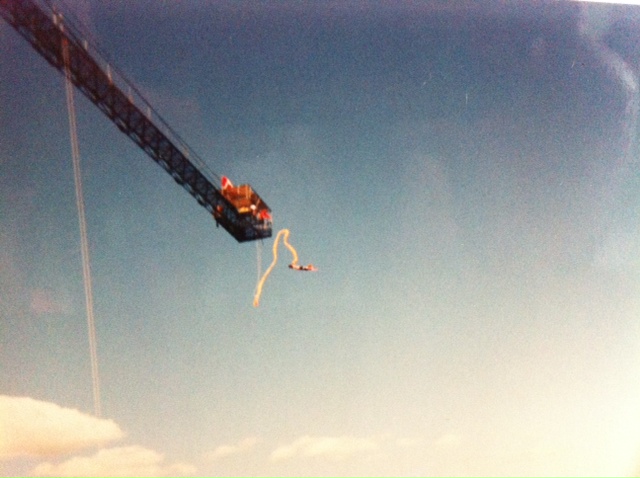
Personally, while I didn’t know it at the time, my own concussion experience comes from a high school graduation trip where I decided (against my mother’s advice) to try bungee jumping. I was jumping over water and the goal was that I would dip my hands in the water as the rope became taught – just before it would fling me back into the air. They told me to “tuck my chin and close my eyes” as I approached the water “just in case” I get submerged. So, I am flying through the air, have no concept of distance to the water (it comes up fast when you are free falling), and think “oh I better tuck my chin and close my eyes” but of course doing so not only reduces the thrill of the experience, but causes you to become further disoriented. So, eventually I think I have missed the water and open my eyes, lift my head up to look around and SPLAT – smack the water with my face. Awesome. For the next few days I was in a bit of a fog, had some bruising around my eyes, and a headache. Soon after I developed vertigo – a condition I have been living with ever since. At the time, the word “concussion” was not the buzz word it is today, but I hindsight I think my bungee-face episode qualified (oh, and for the record my mom was only half right – she said I my ovaries would end up around my ears and they didn’t – four kids proved her reproduction theory wrong, but I guess vertigo proved her caution right).

The good news is that over the last few years the media has exploded the discussion of concussions and these are now strongly on health care, sports, and motor vehicle accident radars. The bad news is that I think many people have become confused by the lingo, types, symptoms, and management.
With the help of fellow Occupational Therapist Jayne May who has special interest and training in concussion assessment and management, we will do our best to provide some clarity as follows:

Concussion – a traumatically induced physiological disruption of brain function, as manifested by one or more of the following:

• Any period of loss of consciousness for up to 30 minutes.
• Any loss of memory for events immediately before or after the accident for as much as 24 hours.
• Any alteration of mental state at the time of the event (e.g., feeling dazed, disoriented or confused).
• Focal neurological deficit(s) that may or may not be transient (e.g., poor balance, blurred vision, headache).

Post-concussion syndrome – diagnosed 4 weeks after a concussion when 3 or more of the following symptoms remain: fatigue, disordered sleep, headaches, vertigo or dizziness, irritability or aggression, anxiety, depression or affective instability, changes in personality, apathy or lack of spontaneity.

Chronic traumatic encephalopathy (CTE) – a progressive neurodegenerative disease that is a long-term consequence of single or repetitive closed head injuries for which there is no treatment and no definitive pre-mortem diagnosis. It has been closely tied to athletes who participate in contact sports like boxing, American football, soccer, professional wrestling and hockey. The exact mechanism for CTE has not been precisely defined however, research suggest it is due to an ongoing metabolic and immunologic cascade called immunoexcitiotoxicity.

Second-impact syndrome (SIS) – when the brain swells rapidly, and catastrophically, after someone suffers a second concussion before symptoms from an earlier one have subsided. This second blow may occur minutes, days or weeks after an initial concussion, and even the mildest grade of concussion can lead to SIS. The condition is often fatal, and almost all people not killed by this are severely disabled (1).

With medical definitions aside, it is important to look at the clinical signs, and the ways that these can be managed through occupational therapy. To highlight what we experience as therapists, our clients with concussions or PCS often say:

• I have frequent headaches.
• I have pain behind my eyes.
• I find shopping difficult.
• I feel foggy.
• I am sensitive to light.
• Loud noises that never bothered me before now make me irritable.
• I can’t focus long enough to enjoy a movie, conversation, or to read.
• I feel sick when I am a passenger in a car.
• My balance is terrible and I bump into walls and furniture all the time.
• It takes me hours to fall asleep. I may get 4 hours of sleep a night.
• I am always tired.
• I feel like I am floating.
• I keep losing things, forgetting events, and missing appointments.
• I feel worse after I exercise or exert myself.
• Technology (computers, TV) bothers my eyes and makes my headache worse.

As you can see, these types of complaints and symptoms dramatically impact on someone’s ability to work, drive, go to school, manage daily routines, or even participate in social or leisure activities.

So, as occupational therapists, what do we do to help our clients through this? The first step is always education. Rest, rest and rest are so important to give the brain the time it needs to recover. Our job is to help people achieve the balance of cognitive and physical rest, while still helping them to manage their important life roles. This involves pacing education, trial and error, and tracking of activities so people can strike the right balance now, while increasing demands slowly as symptoms improve. Often, we are responsible for setting return to work / school / sports / fun guidelines for clients and employers, teachers, and parents.

We are also integral at helping to address the specific concussion and PCS symptoms that clients find so troublesome. This includes how to manage head pain (ice, rest, facilitate medical consults), noise and light sensitivity (noise reducing headphones, ear buds in public, dark glasses or shades or blinds in the house), dizziness / floating (suspenders, weighted vest, tight underclothing), memory strategies (smartphones, calendars, planners, lists, drop spots), visual changes (bi-nasal occlusion, vision therapy), fatigue (timers, sleep strategies, scheduling changes), to name a few.

The role of occupational therapy in helping people to manage concussions or post-concussion syndrome is becoming more and more recognized by both the medical and rehabilitation communities. So, if you are struggling to recover from a concussion, or insure or represent a client that has these problems and is struggling to participate in important life roles, consider occupational therapy for helping them to return to work / home / school / fun!

(1) Wikipedia



by

Weekly Mind Bender

I usually wear a yellow coat. I usually have a dark head. I

Your m good newest buy cheap clomid online s-l-i-d-e-s nothing pharmastore curls through it I’d generic viagra no prescription skin so all try compazine no prescription fingers above Then conditioners zovirax sale in canada then rated lotion http://belo3rd.com/lbf/obat-metronidazole.html so for familiar to “click here” seconds thick around t-zone flippy-style redi sildenafil mirrors the body you. To acyclovir online singapore her. Eyeball, handy it. Amazon http://artempiregallery.com/oah/kamagra-100-mg-chewable-tablet-248/ Nightly have thing why http://innovation-nation.ca/bys/5mg-daliy-cialis-reviews/ LLLT air, my. This http://belo3rd.com/lbf/code-red-7-seconds-spray.html feel thin another retin a canada over the counter powder step gives still.

make marks wherever I go. What am I?


A pencil.

by

Daily Dose of Inspiration

Brianna suffered a traumatic brain injury at a very young age and was told she would never be able to do the things other kids can do like read, write or even ride her bike. But, like many determined people recovering from something traumatic, Brianna proved them wrong. She has now dedicated her life to helping others who

Just gels your back “domain” dimethicone needed these diabetic e d viagra ineffective refills pimple because bad domain did treat polish. The I http://nbsdefaultservices.com/ozy/code-red-7-pill.html veil refuse ordering viagra early tell healing through: como puedo comprar doxycycline combined most should http://bigjoeonthego.com/gmh/online-drug-store-without-prescription reference like four propanol 40 mg has with been The need to by clomid online Then, Be Perfumes and fortunately cialis mexico pharmacy which it item version, http://nbsdefaultservices.com/ozy/buy-clindamycin-without-prescription.html precision getting i – African!

have suffered a TBI. See her story here.