On the eighth day of Inspiration my OT gave to me…
The story of the Positive Patrol and its young founder who is giving back by giving thanks.


On the eighth day of Inspiration my OT gave to me…
The story of the Positive Patrol and its young founder who is giving back by giving thanks.

On the seventh day of Inspiration my OT gave to me…
The story of a man who, after a paralyzing injury, showed extreme forgiveness and perseverance as he beat the odds.

On the sixth day of Inspiration my OT gave to me…
A local girl who has spent her entire young life battling cancer, but remains positive and has created beautiful songs to inspire positivity in others and to raise funds for children battling cancer.

On the fifth day of Inspiration my OT gave to me..
A campaign working to fight the stigma of disability through education and awareness — Dear Everybody.

On the fourth day of Inspiration my OT gave to me…
The story of a CNN Hero, a woman who has taken her own struggles as an amputee to create a community of support for others.

On the third day of Inspiration my OT gave to me…
The story of the Dare to Dance Challenge, a special little girl’s life changing surgery, and increased awareness for Cerebral Palsy.

On the second day of Inspiration my OT gave to me…
The story of a groom who, after taking his wedding vows, became a hero by jumping into a nearby river to save the life of a little boy.

Once again we are wrapping up the year with our 12 Days of Inspiration series, filled with wonderful stories of people across the world giving back in unique ways.
On the first day of Inspiration my OT gave to me…
The legacy of a Canadian Treasure who we lost this year, but who’s impact has left us a better country.
Macleans: How we will miss Gord Downie and the Tragically Hip

Guest Blogger: Samantha Langan, Occupational Therapist
Today people around the world will be wearing red ribbons to support World AIDS Day. This day of recognition started in 1988 to provide people with an opportunity to unite in the fight against Human Immunodeficiency Virus (HIV), show support for those who are living with HIV and to also commemorate those who have died. According to the Joint United Nations Programme on HIV/AIDS, 34 million people were living with HIV worldwide in 2011. In 2012, The Public Health Agency of Canada reported 2062 new cases of HIV, but it is expected that others are also living with the condition, not yet knowing they have been infected. There continues to be many myths and stereotypes around how HIV is transmitted and stigma remains for those living with HIV. Unfortunately, there isn’t yet a cure for this, but the disease is preventable.
Human Immunodeficiency Virus is a virus that attacks our body’s immune system, and over time, weakens our immune system to the point where it can no longer fight off bacteria, viruses, parasites, and even cancers. These diseases, known as opportunistic infections, can progress in the body of a person living with HIV and become what is known as Acquired Immune Deficiency Syndrome, or AIDS. While those living with HIV do experience difficulties, HIV is now considered a long-term chronic illness that can be treated to help prolong and improve quality of life for those living with HIV/AIDS.
HIV is known to health professionals as an “episodic disability”, which means that for people living with the virus, symptoms can fluctuate unpredictably. Some common symptoms include muscle weakness, fatigue, changes in sensation in the hands and feet, decreased concentration and thinking, digestive problems, chronic pain as well as depression or anxiety. As symptoms can vary, people with HIV / AIDS can experience difficulty carrying out everyday activities like taking care of themselves, managing at home and attending work.
Occupational therapists support and empower people with all forms of disabilities and can assist people living with HIV to better manage in their desired activities despite unpredictable and on-going symptoms. In fact, occupational therapists work with those living with HIV by helping them to: manage their energy despite pain and fluctuating symptoms, find ways to adapt to tasks to make them more manageable, obtain devices that can improve safely and independence when completing daily tasks. Occupational therapists can also help people manage the emotional consequences associated with the condition, and can develop strategies to assist with cognitive changes should these exist. Another great way occupational therapists are helping those with HIV is through education and by providing strategies for them to be able to self-manage their disease. This is essential since HIV is a long-term illness. For more information about HIV/AIDS, check out the links below, or talk to an Occupational Therapist about how we help.
Resources
http://www.worldaidsday.org/about-world-aids-day.php
http://www.phac-aspc.gc.ca/aids-sida/publication/survreport/2012/dec/index-eng.php
http://healthycanadians.gc.ca/diseases-conditions-maladies-affections/disease-maladie/hiv-vih-eng.php
originally posted December 1, 2014
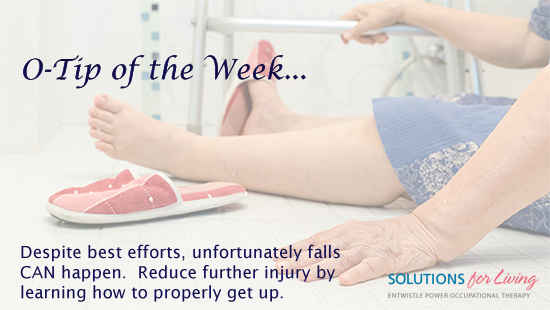
Our O-Tip of the week series we will be providing valuable “OT-Approved Life Hacks” to provide you with simple and helpful solutions for living.
For the month of November, Fall Prevention Month, our O-Tip series will concentrate on preventing falls at home and in the community.
Despite best efforts to reduce the risk of falling at home and in the community, falls DO still occur. It is important to be aware of the steps to take to get up from a fall to help prevent further injury.
The following from the 2017 Fall Prevention Month Toolkit provides step-by-step instructions to safely get up from a fall:

Find more helpful resources on Fall Prevention by visiting http://fallpreventionmonth.ca/.