

Close

Our Blog

by

The Anxiety of Social Media

Julie Entwistle, MBA, BHSc (OT), BSc (Health / Gerontology)
Co-written with Jacquelyn Bonneville, Occupational Therapist

I can only imagine how it must feel to be a teenager in today’s era of technology and social media.  When I was young, our social circles were those we could call, or see at school, in the neighborhood, at camp, or when playing sports.  If we did something wrong, embarrassing, or “bad” it could only ripple so far in the small puddle that surrounded us.  Now, that puddle is an ocean and our activities, photos, thoughts and feelings can not only reach people that we would not otherwise engage with, but can extend across continents.

Over the last decade researchers have been attempting to capture the good, the bad, and the ugly of social media, with mixed results. Social media platforms include websites like Instagram, Facebook, Twitter, and LinkedIn. People of all ages are engaging in social media, as it becomes one of the most predominant forms of communication. Social media has its benefits and risks, and as the rate of anxiety in North America rises it is important to consider how and why you may be using social media, and what it may be doing to your health.

In some ways, social media is not a new concept at its core. Humans have always desired information, gratification, and social exchange to a certain extent – they also require opportunities to de-stress, to socially disengage, or to feel surrounded by others and yet not obliged to interact with them. Social media trends have made it increasingly more difficult to switch off, leading many to feel constantly bombarded by notifications of what others are doing, thinking, saying, feeling (good or bad).

The concept of instant gratification is now more prominent than ever, with instant “likes”, comments, “re-tweets”, or number of “shares” available, and many strive to measure their social success in these numbers. As social media instant gratification is almost a new norm in society, this is likely to transcend into offline world. How will this expectation of instant gratification affect our ability to be patient with life events that typically take a long time to achieve, such as relationships or career development? What is all this pressure to be well-liked (literally) on social media doing to teens who are developing their social identities in the midst of a social, public world? What does online popularity mean for people who are easily influenced, or have low self-esteem and self-concept? These are questions many therapists are now addressing regularly in sessions with teens and adults alike.

You may have heard hot-topic terms like Facebook Addiction Disorder and Social Media Anxiety Disorder; though neither of these are valid diagnoses currently, it points to the notion that a serious shift is happening in our society. Social Media helps us to create a highlight-reel of our lives – either the life we are living, or the life we want to live – and we only post the things we want people to see and this is often enhanced, truth-stretched, fabricated, sepia-toned, and cropped. It leads people to believe that this is what college is supposed to be like, or what my summer is supposed to look like, or how I’m supposed to look as a mother out with my children. Some literature suggests that social media may be holding us up to completely unrealistic expectations, resulting in us feeling less pride for our accomplishments, and more anxious about how we may be measuring up. For more information on this, and an interesting video of youth explaining social media related anxiety, check out these two articles:

The Very Real Anxiety That Comes From Texting, ‘Likes’ And FOMO

Yale psychiatrist has one explanation for why students these days are so anxious

A study published by The New York Times in 2015 reports anxiety is now the #1 mental health diagnosis on college campuses. The constant comparisons, fear of missing out (or ‘FOMO’ as it is often phrased), and misinterpretations of texts are certainly impacting the mental wellness of people of all ages. As a result, anxiety rates are rising exponentially.

Self-reflection is an important tool often encouraged by therapists to help you understand your own behaviour. Occupational Therapists may encourage self-reflection through mindfulness techniques. For instance, why do you use social media? Look at your last status update or picture upload; why did you post that? Maybe the last interaction with social media you had was to write a comment on a co-worker’s LinkedIn profile, and you believe the reason why you did so was to support their competency of certain skills in hopes of maybe boosting their reputation. Now, think deeper than that, to subconscious reasons that may have also motivated you for doing this: Does it make you look like a good coworker or friend for doing that? Does it help spread your name to gain more connections based on who views their profile? Would you be even a little upset if they didn’t return the favour? So, it is important to ask yourself the question: Why am I really posting this? How does it make me feel afterwards? How am I hoping to make others feel?  Do I have a motive deeper than a simple “like”?

It is important to check-in with yourself regarding your thoughts about social media and why you use it, and to respect that the youth of today have entirely different challenges socially than you may have had. To completely withdraw from social media, or to stop your children from using it entirely, may actually be more harmful than good. However, if your urge to use social media becomes so strong that it is negatively affecting your relationships, work, enjoyment in your accomplishments, time-spending, or if it’s making you feel anxious, professionals like Occupational Therapists (especially those with additional training in Psychotherapy) can be an excellent resource to help get you back to functioning in a way that is meaningful and enjoyable for you. OTs are experts and understanding competing life demands, and have a wealth of experience and knowledge helping people to rebalance into productive function.

For other strategies on how to attempt to manage social media related anxiety, check out:

How to Calm Your Social Media Anxiety

In the end, the verdict is still out on the benefits and risks of social media – from a mental health perspective.  Personally, I could not find what I could call “authenticity” on Facebook but still found myself checking this too often.  So I decided to go on a hiatus and have not returned.  I miss the funny videos and seeing photos of my friends’ children, but don’t miss the ads, bothersome images, or personal crusades that people use this platform to promote.  The most important thing here is behavioral regulation – check your screen time, understand your thoughts, feelings and behaviors when engaging in Social Media and make changes if you are not happy with what you find.  And good luck – kicking or changing any habit is not easy!
by

Weekly Mind Bender

Find the hidden bird names in the following sentences:

a.        Jane was speaking French awkwardly

b.       The flea gleefully jumped on the cat

c.       There was a painful throb in his arm

d.       How long to we have to wait for the bus?


a.       Hawk

b.       Eagle

c.       Robin

d.       Owl

by

Let’s Talk About Mental Health

Today is Bell Let’s Talk Day in Canada.  Again this year Bell will be raising funds to support mental health initiatives across Canada and to help put a stop to the stigma surrounding mental health.  Take a look at these 5 great ways to help end the stigma and watch one of this year’s powerful videos.


Remember to tweet using the hashtag #BellLetsTalk and/or share the Bell Let’s Talk Day image to generate a 5 cent donation by Bell!

by

Eating Well Through Tough Financial Times

According to reports from University of Guelph the cost of food in Canada rose 4.1% in 2015 and is excepted to rise at least another 3 % in 2016.  With trips to the local supermarket costing much more, how can you manage to still eat well without breaking the bank?  The following from CTV News provides 5 great tips to maintain healthy eating during these tough financial times.

CTV News:  How to eat healthy amid soaring food prices

by

Accessible Clothing Can Be Fashionable Too!

Julie Entwistle, MBA, BHSc (OT), BSc (Health / Gerontology)
Co-Written with Jacquelyn Bonneville, Occupational Therapist

As occupational therapists, we often see clients experience issues with dressing after an injury or as a result of a disability.  How do you dress when you have one arm?  Or, how can you don pants, socks and shoes when you have not feeling or movement in your lower body?  What about managing zippers and buttons with reduced fine motor control?  Spasms, reduced range of motion, the inability to stand for dressing, or body changes that make clothing options limited?  There are many reasons why dressing can become a problem.

As a society use fashion for several reasons – to manage the weather, for privacy from sensitive parts, and as an expression of ourselves.  Clothing and clothing choices are important.

Business-wear and athletic wear are two areas of fashion that are generally limiting for persons with dressing challenges.  For this blog we wanted to introduce some simple, but still fashionable and functional, adaptations that can help manage the task of dressing if this has become difficult!

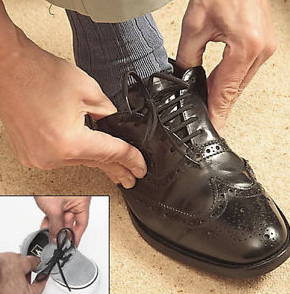
Lock Laces or Elastic Shoe Laces

Untitled-1


Elastic and lock shoelaces are permanently tied, and allow for stretch of the shoe when putting it on or taking it off. This makes it a functional, inexpensive solution for anyone who doesn’t want to worry about their laces coming undone (especially athletes!), or for people who struggle with tying their shoelaces tight enough, or with the intricacies of actually tying the laces.  Note that often these are great in combination with a long handled shoehorn.

Nike Flyease LeBron Sneakers

Nike LeBron Flyease Sneakers (http://store.nike.com/us/en_us/pd/zoom-lebron-soldier-9-flyease-basketball-shoe/pid-10327129/pgid-10327127)

Nike recently announced their release of slip-on ‘wrap-around-fasten’ shoes that are fashionable, basketball style high-top sneakers (designed with basketball superstar LeBron James). Though designed for young adults with Cerebral Palsy initially, this shoe is suitable for anyone who wants some stylish sneakers, without the hassle of laces. See the press release for more information and a video explaining the story behind these sneakers.

Under Armour Magzip

ua


Zippers are often an integral part of our Canadian Fall and Winter attire to help secure our clothing to keep us warm. Zippers can actually be very challenging to co-ordinate for many reasons, and Under Armour tackled “fixing the zipper” in 2014 with their Magzip technology in a variety of unisex athletic-wear styles. The bottom part of the zipper is magnetic, meaning that it is far easier to ‘thread’ and pull up than a standard zipper, without sacrificing athletic hoodie style. See the press release for more information and a video explaining the technology.

One-handed Snap-Belts

belt


Standard business attire (or even picture day at elementary school) often calls for a nice belt, and there are many options available online for snap-belts that do not require the threading of a traditional belt such as the RD Adaptive Apparel Snap-Belt pictured here.

Rollin Wear Jeans

jeans


Jeans are a staple of many wardrobes, but they certainly shift and move when people are sitting or standing. For people who spend a lot of time sitting, including office workers and people who use wheelchairs, jeans can be extremely uncomfortable; jeans regularly have rivets on the back pocket which can cause discomfort while seated, they have the same rise around the waist so when you sit they are either too low or bunch up, and the front button can dig into your waist when you sit down.

Rollinwear has designed a line of jeans designed for wheelchair users that offer an easier ring to work the zipper, a clasp instead of a front button, and are overall designed with the different body position of a person while sitting instead of standing. Be sure to look online for other companies offering similar adaptive jean designs!

Part of the role of Occupational Therapy is to have insight and knowledge about products that will help an individual function independently, without sacrificing style, priorities, or efficiency. For more information about customized products that may work for your individual needs, speak with an Occupational Therapist!

As a last inspiring thought, check out this link to the story of a beautiful athletic-wear teen model with Down Syndrome who is changing perceptions of disability, while being stylish at the same time.


by

Weekly Mind Bender

Five people were eating apples.  Person A finished before person B, but behind person C.   Person D finished before person E, but behind person B.  What order did they finish in?


CABDE.

by

Be There For Someone Who is “Still Here”

According to the Alzheimer Society of Canada in 2011, 747,000 Canadians were living with Alzheimer’s disease and other dementias – which represents 14.9 per cent of Canadians 65 and older.  January is Alzheimer’s Awareness month and the Alzheimer Society has launched a powerful campaign reminding us to be there for those who are “Still Here.”  Check out this campaign and learn about the many ways to be there for someone you care about.

Alzheimer Society of Canada:  Still Here

by

National Non-Smoking Week– Be a Quitter!

Julie Entwistle, MBA, BHSc (OT), BSc (Health / Gerontology)

National Non-Smoking week aside, are you ready to butt out?  According to Smoke Free Ontario, smoking takes approximately 13000 lives in Ontario each and every year.  However, the good news is that the number of smokers continues to decrease yearly, and is currently at 18.1%.  Are you in for reducing this number further?

Apparently, quitting smoking is extremely difficult and many need to try different approaches before finally kicking the habit.  For many smokers it becomes more about the habit and the behavior, than the nicotine itself.  So how can you butt out?  Our team of experienced Occupational Therapists have some great solutions for you to try:

1.    Make Your Intentions Public:  The decision to quit takes a great deal of courage and should be celebrated.  Make your intentions public within your family or friends, or by using social media for a larger reach.  By making your goal to quit public it will help hold you accountable and to draw on those close to you to lean on for support.

2.    Devise a Plan:  Quitting cold turkey can be extremely difficult.  We recommend that you create a monthly or weekly plan to reduce your intake and set you well on your way.  This might be as simple as reducing one cigarette per day for a week or a month, then reducing again etc.

3.    Identify Triggers:  While working through your monthly or weekly plan to reduce the amount of cigarettes you consume, ensure you are keeping track of the amount you smoke each day, the times of day you smoke and what in your environment has triggered you to have a cigarette.  Tracking any behavior is the best way to isolate it and is the first step to making improvements.

4.    Modify your environment to help reduce these triggers:  After conducting your research look closely at the time of day, environment, people, stressors or other triggers that promoted your need or wanting to smoke. Is it possible to change your situation or environment to avoid these triggers moving forward?

5.    Work to reduce stress:  Many smoke as a reaction to stress.  Finding ways to reduce stress, such as meditation and mindfulness practice, taking a hot bath, or breathing exercises can help you to reduce this trigger.

6.    Find a healthier habit:  If it’s the “break” you find is your trigger try finding a different way to take 5 minutes to yourself.  Take a quick walk, try yoga poses, grab a warm beverage, phone a friend or practice breathing exercises instead.

7.    Seek Support:  By making your intentions to quit public you have opened yourself up to a group of family and friends to rely on and assist you in your goal to quit.  If these sources are not available, try phoning the Smokers Hotline or join a support group to speak with someone who can help you through your craving and keep you smoke free.

8.    Seek an Alternative Solution:  There are so many different products in the marketplace to assist you with quitting such as:  gums, e-cigarettes, inhalers, and patches.  Find which one works for you and rely on this to assist you along the way.

9.    Speak to Your Doctor:  Your family doctor is a great resource and will gladly support you in your quest to break the habit.  Speak with your doctor about the alternative solutions and medications that exist that can help you quit.  Your doctor may also connect you to OHIP-funded resources that you can access to support you in your quest.

10.  Celebrate Your Success:  Ensure that along the way you celebrate any milestones you have reached.  If you’ve worked for a week or a month to cut your daily intake by 5 cigarettes, reward yourself and share your news with those you love.  This will help to keep you focussed and lead to further success!

11.   Reword the goal if needed:  Yes “quitting smoking” might be the BIG goal, but under this there are layers of other goals that you can focus on that might seem less intimidating and are more fun to measure.  Maybe your smaller goals include walking upstairs without becoming breathless, having whiter teeth, or not wanting your clothing or home to smell like cigarette smoke.  Perhaps if you relate to a more practical goal that is tangible, measurable, and visible to others, your motivation might be enhanced.

12.   Watch for other bad habits to surface:  Sometimes when trying to move from one bad habit we pick up another.  With any reduction in a negative behavior there will be withdrawal.  Accept this and cope through it for the days it lasts, knowing that those symptoms too shall pass.  But when struggling through withdrawal, try not to adopt another bad habit as a coping mechanism.  Switching from smoking to eating unhealthy food or consuming more alcohol will not help you to achieve the ultimate result you want which is to improve your health.

13.   Don’t just change your behavior, change your LIFESTYLE:  Adopting a new way of living, and talking to others about this, is far more impactful and motivating then talking about a behavior change.  When people say “I am trying to lose weight” it is not nearly as impactful as “I have a sugar-free lifestyle” or “I have changed my lifestyle to achieve my health goals”.  Make a LIFESTYLE change to be healthy and let the behaviors follow.

14.  If at first you don’t succeed… try try again!

For more resources and tips to help you along the way visit www.smokershelpline.ca or www.quitnow.ca.

We wish you the best of luck and encourage you to BE A QUITTER this 2016!


Originally posted, January 2015.