Close

Archive for category: Solutions For Living

by

O-Tip of the Week: Hydrate to Prevent Falls

Our O-Tip of the week series we will be providing valuable “OT-Approved Life Hacks” to provide you with simple and helpful solutions for living. 

For the month of November, Fall Prevention Month, our O-Tip series will concentrate on preventing falls at home and in the community.

This week’s O-Tip of the Week focuses on a simple way to prevent dizziness and balance issues which can lead to falls:  hydration. 

Learn more about how to properly hydrate yourself in the following post from our blog Help with Hydration – How Many Glasses Do You Really Need?

Learn more helpful fall prevention tips from our infographic:  An OT Knows How to Prevent Falls: 

by

When Self-Service is Not an Option – Refueling with a Disability

Julie Entwistle, MBA, BHSc (OT), BSc (Health / Gerontology)

When I was a kid I loved the movie “Back to the Future” with Michael J Fox.  I remember clearly the scene where it shows his parents in the 50’s at a gas station – back then, “full serve” meant windows were cleaned, the car shined, tires pumped, and of course your gas tank refilled.  It was like the pit-stop at a NASCAR race where you would have multiple people at your vehicle getting you on your way quickly.  Fast forward to today where “full-serve” is uncommon, and finding a station where someone can fill your tank while you wait in the car might require you to venture out of your way. 

So, how does this translate for people with disabilities?  Well, firstly, there are many people that can and do drive a car regardless of a mobility impairment.  Cars can be modified to accommodate the specific needs of many people with physical challenges.  Hand controls, left-footed gas pedals, spinner knobs, automatic wipers, voice controls…to name a few.  That is all fine while the vehicle is being operated, but what about when it is time to refuel?  It is possible, but not always efficient or safe, for people with a physical impairment to get out of the vehicle, grab their mobility device, and wait outside the car in the elements to refuel.  Not to mention the safety risks of these tight spaces, other vehicles, and fall / slipping hazards of wet and uneven ground.

Considering the move away from “full-serve”, I wanted to look in detail at the services offered by gas stations to help people to refuel when mobility is a challenge.  I was surprised at what I found – some stations have well listed policies that are clear and supportive, while others have no policy or tell people to “call ahead” before coming to refuel.

Here is what I found about ways to refuel if getting out and around your car at a gas station is not the best choice for you…

I give the following companies a THUMBS UP:

ESSO

(https://www.esso.ca/en/gas-stations)

Drivers with disabilities can use the Esso Fuel Finder to find stations that offer the fueling option that best meets your needs: 

Split serve stations: Both full- and self-service options are available to customers
Full serve only stations: Full service is available to customers
Self-serve only stations: While some of our stations have designated Disability Fueling Assistant hours where more than one attendant is available, often there is only one attendant on duty at self-serve stations.

We recommend you call ahead to see if appropriate staffing arrangements can be made. Contact information is available on the Esso Fuel Finder.

SHELL

(http://www.shell.ca/en_ca/motorists/inside-our-stations/refueling-for-drivers-with-disabilities.html)

Drivers with a disabled parking permit will receive full service at self-serve prices at stations with both full and self-serve pumps. The gas station attendant will fuel your vehicle at the self-service island so that you pay only the self-serve price for fuel. Customers should identify themselves to one of our gas station attendants. Please note this service is available only during full service hours.

At self-serve only stations, staff will make every effort to help customers displaying disabled parking permits with refueling. Please identify yourself to one of our gas station attendants. We also encourage you to contact your local station to discuss your individual needs as some stations have limited staff and payment access.

PETRO CANADA

(http://retail.petro-canada.ca/en/stationsstores/customers-with-accessibility-needs.aspx)

At participating split-service stations, a site which provides self-service and full-service at the islands, drivers with an accessible parking permit will receive full-service at self-serve prices. The full-service attendant will fuel your vehicle at the self-service island so that you pay only the self-serve price for fuel.

Find a Petro-Canada station with full service

At participating self-serve stations, customers with an accessible parking permit can drive up to a two-way call station located at the fuel island and press the button to speak to the attendant inside the store to request assistance with fueling their vehicle.

The following get a THUMBS DOWN:

PIONEER

(http://www.pioneer.ca/Portals/1/Images/About%20Pioneer/Pioneer%20Accessiibility%20Policy.pdf)

Pioneer’s site only speaks to assistive devices, communication, support persons and service animals, but does not address the challenge of people with physical impairments being able to refuel.

CANADIAN TIRE GAS

For non-full serve stations, people are required to schedule an appointment with the retailer for refueling.  ONRoute locations offer full serve to all customers between the hours of 7am and 10pm, 7 days a week.  For service outside of these hours, an appointment is required.  Those using the full serve through the Disability Assistance Program will be charged self-serve prices.

COSTCO and ULTRAMAR:

No information is provided. 

In summary, I was impressed by what I found and applaud Shell, Esso and Petro-Canada for being so progressive and supportive on this issue. For the rest, I presume that the Accessibility for Ontarians with Disability Act (AODA) will require those that are behind in offering disability-friendly refueling options to develop policies and procedures and to post these to be easily found on their websites.   In the meantime, I trust those drivers with mobility issues will use and benefit from what Shell, Esso and Petro-Canada have to offer people in their situation.

by

How to Grow Responsible, Independent Children

When it comes to responsibilities for kids at home many things have changed since I was a kid.  When my generation was growing up most kids learned to cook, clean, tidy up after themselves, manage their own schedules and more.  Today, many kids are living in the “age of entitlement” where very few responsibilities fall on them, and many don’t know how to complete the simplest of household chores.

Teaching responsibility to kids by assigning them age-appropriate chores helps to build independence, a sense of self and prepares them for what lies ahead.

We encourage you to use this great FREE PRINTABLE (available below) to help kids become more responsible at home.

Discuss with your children some tasks they can help with on a daily basis and add these to the chart.  Be sure to review this with the kids, confirm the expectations, and get their commitment.

Here are some age-appropriate tasks or “chores” as suggestions:

Toddler (2-3)

·    Put dirty clothes in laundry basket

·    Help set the table for meals

·    Tidy toys after playing

Ages 4-5

·    Put toys away when finished

·    Make their bed

·    Clear dishes after meals

·    Prepare snacks/drinks

·    Feed pets

Ages 6-7

·    Fold laundry

·    Dust bedroom

·    Help prepare meals (with assistance)

·    Pack school lunches and backpack

·    Yard work (with assistance)

Ages 8-11

·    Load and unload the dishwasher

·    Operate laundry (with assistance)

·    Clean bedroom

·    Help put away groceries

·    Walk and care for pets

·    Make school lunches

Ages 12 +

·    Clean bathrooms

·    Vacuum

·    Prepare a meal

·    Look after younger siblings

·    Clean floors and surfaces

·    Do laundry from start to finish


For more helpful tools for both children and adults visit our Printable Resources page.

by

O-Tip of the Week: Prevent Slips in the Tub or Shower

Our O-Tip of the week series we will be providing valuable “OT-Approved Life Hacks” to provide you with simple and helpful solutions for living.

For the month of November, Fall Prevention Month, our O-Tip series will concentrate on preventing falls at home and in the community.

This week’s O-Tip of the Week focuses on simple ways to keep you safe in the bathroom, one of the most dangerous rooms in the home.

For a simple and inexpensive solution to improve bathroom safety we recommend using adhesive shower or tub strips which are easy to install, and provide added protection from falling when you are getting in and out or standing in the shower or tub with bare feet on a wet surface. Strips are easier to maintain and clean than a standard bath mat and stick better to the bottom of the tub or shower.

Learn more about how to improve safety in your bathroom in this episode from our OT-V series, Bathroom Safety.

by

O-Tip of the Week: Ways to Prevent Sitting Disease

Our O-Tip of the week series we will be providing valuable “OT-Approved Life Hacks” to provide you with simple and helpful solutions for living. 

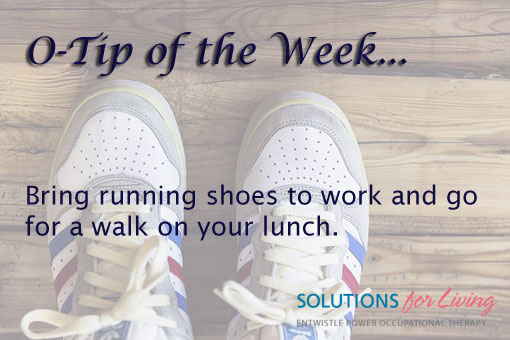
This week’s O-Tip of the Week focuses on ways to get you moving throughout the day in order to keep a healthy lifestyle and prevent sitting disease.

Bring a pair of running shoes with you to work and take a walk on your lunch and/or breaks.  Walking is great for cardiovascular and bone health and will help to prevent the negative effects of sitting all day.

Learn more ways to combat the negative effects of sitting disease in our post, Solutions to Stop Sitting Disease.

by

A Step in the Right Direction — Forward

The Forward Movement, an advocacy group, is working hard to raise awareness and make change in Ontario.  The group is working to have Ontario officially adopt the Dynamic Symbol of Access to replace the currently used International Symbol of Access.  Why?  The dynamic symbol shows action and movement symbolizing differing abilities and can help to change the way society views disability.

It was all about the disability, and not about the person,” says Dylan Itzikowitz, co-founder of The Forward Movement, about the current symbol.

Learn more about The Forward Movement in the following article from CBC News.

CBC News:  Accessibility activists want to ditch iconic symbol highlighting the wheelchair, not the person

How can you support The Forward Movement?  Sign the petition, make a donation, follow The Forward Movement on social media, and/or become a Proud Partner like us.  Learn more about these great ways to get involved by visiting www.theforwardmovement.ca.

by

O-Tip of the Week: A Smart Solution for Printing Success

Our O-Tip of the week series we will be providing valuable “OT-Approved Life Hacks” to provide you with simple and helpful solutions for living. 

This week’s O-Tip of the Week focuses on ways to assist children who are struggling with printing and handwriting.

Using a small pencil or broken crayon is a great way to help kids learn how to properly hold a pencil.  Learn more about how Occupational Therapists help kids with printing and handwriting in our OT-V episode:  Solutions For Printing Success.

by

Occupational Therapy, Social Work, Both or Neither?

Guest Blogger: Carolyn Rocca, Occupational Therapist

When dealing with any form of injury, illness, or life changing event, clients may find themselves being referred to social work (SW) or occupational therapy (OT), or even both. As there can be overlap between the roles of these professionals, it can be helpful to take a closer look at what each profession specializes in, how they differ, and what they can offer you throughout your recovery.

What is similar about both of these health professions is that their role greatly varies depending on which context the professional is working in, making it challenging to define either simply.

Note: While a SW had input into the content of this blog, the objective here is not to fully explain the SW profession, but rather to try and clarify the similarities and differences between SW and OT.  For more information about Social Work, a few Ontario-based resources are listed as follows, and of course more information is available online or by connecting with a SW directly about the services they offer:

Ontario College of Social Workers and Social Service Workers (OCSWSSW) website:  http://www.ocswssw.org/

Ontario Association of Social Workers (OASW) website: https://www.oasw.org/

The Canadian Association of Social Workers (CASW) describes Social work as a profession that aims to help individuals, families, groups, and communities to enhance their individual and collective well-being, by assisting them in developing their skills and abilities to use their personal and community resources to resolve problems (2017). In most provinces across Canada, the minimum educational requirement to become a SW is a 4-year undergraduate bachelor degree in Social Work, while master’s and doctoral degrees are also available (CASW, 2017).

SWs are trained to provide services across many diverse settings including children’s aid agencies, family services agencies, school boards, general and psychiatric hospitals, correctional facilities, welfare administration agencies, federal and provincial departments, as well as private practice. Not surprisingly their roles vary greatly in each of these settings however, some skills and responsibilities are common across practice contexts.

SWs are unique in that they focus on relationships as the basis of their interventions and are experts in providing services not only to the client, but also to their families. In many settings, SWs often play the role of case manager by linking the healthcare team with the client and family, and connecting the client to relevant agencies, services, or programs based on their needs and community resources (i.e. financial assistance, legal aid, social programming, and housing, employment, and education supports, etc.). Certainly, a large difference between OT and SW is that the latter can provide assistance with parent-child relationships, marriage counselling, and mediation services to assist families in resolving disputes. Fundamentally, they are experts in connecting people to one another and to essential resources.

Whereas, the Canadian Association of Occupational Therapists (CAOT) describes OT as the art and science of enabling engagement in everyday living by empowering people to perform the occupations that foster health and well-being in order to participate to their potential in the daily occupations of life (Townsend & Polatajko, 2013, p. 380). Essentially, OTs focus on helping people manage and participate in the day-to-day tasks that are important to them, including their ability to care for themselves, or carry out their role as a spouse, parent, or employee. In most provinces, to become a registered OT, one must complete a 4-year undergraduate degree, and subsequently a 2-year Master’s degree in Occupational Therapy.

Although OTs can provide services in many of the above listed areas of practice, what they offer can be much boarder in scope. While both professions can provide case management services, individual or group-based interventions (i.e. support or psychoeducational groups), and counseling services to assist people in their recovery from an injury, illness, substance use disorder, or major life transition, OTs can also offer a breadth of rehabilitative services. These services can include prescribing and teaching the use of assistive devices and mobility equipment, and providing recommendations, strategies, and education to find solutions to clients’ day-to-day functional challenges and barriers.

Although there are several differences, OTs and SWs have many overlapping roles, meaning they must communicate and collaborate to ensure they are each offering unique services when both working as part of a client’s healthcare team. For example, consider an individual who has sustained physical injuries and secondary mental health challenges as a result of a motor vehicle accident. Throughout their recovery, an OT will be essential in prescribing and training the client in the use of a wheelchair, suggesting environmental modifications so that the client can navigate in their home, and providing recommendations and education about how the client can safely perform daily tasks like showering and meal preparation. Additionally, the OT would provide psychoeducation and coping strategies to support the client in managing with their mental health symptoms, change in daily routine, altered life roles etc. Meanwhile, a SW might focus on providing counselling services to the individual as well as their spouse or children, who would be adjusting to the change in family dynamic considering the accident and resulting challenges of their spouse / parent. Further, a SW would be helpful in terms of assisting the client in accessing disability support services, funding programs, and local peer support groups.

Overall, despite any shared roles, each profession offers unique strengths, skills, and expertise that the other cannot. Their individual areas of specialization make these professionals vital members of multidisciplinary healthcare teams, and together they offer many needed services throughout the rehabilitation process.


Resources and References

Canadian Association of Occupational Therapists (CAOT) website: http://www.caot.ca/default_home.asp?pageid=2412

Canadian Association of Social Workers (CASW) website: https://casw-acts.ca/en

Canadian Association of Social Workers (CASW). (2017). What is social work? Retrieved from https://casw-acts.ca/en/what-social-work

Ontario College of Social Workers and Social Services Workers (OCSWSSW) website: https://www.ocswssw.org/

Townsend, E. A., & Polatajko, H. J. (2013). Enabling occupation II: Advancing an occupational therapy vision for health, well-being, & justice through occupation. Ottawa, ON: CAOT Publications ACE.


by

Stand Up for Good Health

We’ve spoken a lot on our blog about the negative effects of our sedentary lifestyles and sitting disease.  Unfortunately, for many, our jobs require us to spend long hours at a desk, in front of a screen without much movement.  Making time for movement throughout the day is extremely important to help battle these negative effects.  Learn more about the benefits of building movement breaks into your day in the following from Participaction.

Participaction:  This is how standing up more often can change your entire workday

by

O-Tip of the Week: Simple Medication Management

Our O-Tip of the week series we will be providing valuable “OT-Approved Life Hacks” to provide you with simple and helpful solutions for living.   

This week’s O-Tip of the Week focuses on ways to effectively manage your medications, ensuring each dose is taken at the correct time.  There are many effective ways to assist including the use of a dossette, smart phone alarm reminders, printable checklists and more. 

Learn more ways to help you manage multiple medications in our previous post, Medication Management.