Close

Archive for category: Solutions For Living

by

O-Tip of the Week: Life’s too Short to Keep Up with the Jones

Our O-Tip of the week series we will be providing valuable “OT-Approved Life Hacks” to provide you with simple and helpful solutions for living. 

For the month of February, our O-Tip of the week series will talk about Self-Esteem, which is defined as confidence or belief in one’s own worth or abilities.  Self-esteem issues affect more than just teenagers and encompass more than physical insecurities.  Follow along this February to learn more about self-esteem, its importance and some simple ways give your self a boost! 

One way you can harm your self-esteem is through constant comparison of yourself to others.  However, putting a stop to this is, in fact, a difficult ask – magazines, tv shows, movies, social media… all of these things serve as channels to fill your mind with false images of how you “should be.”  Check out this great article care of Psychology Today which provides some great ways to get you to stop comparing yourself to others and see the amazingness within!

Psychology Today:  How to Stop Comparing Yourself to Others

by

How Anxiety and Depression Can Impact Cognition

Julie Entwistle, MBA, BHSc (OT), BSc (Health / Gerontology)
Co-written with Ashley Carnegie, Occupational Therapist

As a student working with an Occupational Therapist in the community, I realized early in my placement that many clients struggle with anxiety and depression in combination with cognitive challenges like decreased attention, concentration and focus, difficulties with memory, and slower information processing abilities. This spiked my interest, as I was unaware of the possible impact anxiety and depression could have on cognition and how these symptoms could be related.  I decided to look into this further, and am sharing my findings below.

Occupational Therapists work in a wide variety of settings including the community. As the hospitals become less and less able to accommodate people long-term, community-based occupational therapy services are becoming more and more common. Working in the community allows occupational therapists to reach a wide variety of clients, and therapists utilize a strength-based approach to build on the client’s current strengths to promote wellness and productivity.

Depression and anxiety are the most common types of mental illness throughout the world, including Canada. From my community placement experience as a student Occupational Therapist, I have found that the majority of the clients I have seen are experiencing depression and/or anxiety, often in combination with other primary diagnoses.

Interestingly, depression and anxiety can negatively impact the way the brain thinks, learns, and processes information and thus how it functions.  However, the relationship is complicated as a decrease in cognition may also lead to an increase in depression and/or anxiety which can then perpetuate the cycle.

Research has highlighted how anxiety and depression can negatively impact several aspects of cognition including:

  • Psychomotor speed
  • Attention
  • Executive functioning
  • Problem-solving
  • Attentional switching
  • Cognitive flexibility
  • Visual learning
  • Memory

The result for most people tends to be poor functional outcomes in their daily lives. Additionally, the brain regions believed to be responsible for these functions have been shown to be abnormal in people that also suffer from anxiety and depression  (e.g. hippocampus, amygdala, temporal lobes, and prefrontal cortex). Decreased memory, slowed information processing, and issues with verbal communication can negatively impact multiple areas of people’s lives. This information demonstrates the importance of the need to detect and treat anxiety and depression as early as possible as well as the need for early cognitive interventions for clients with anxiety and depression.

As a student Occupational Therapist, I wanted to further investigate how Occupational Therapists can help. I found evidence that Occupational Therapists can help clients in reducing functional decline, while also reducing the probability of relapse by treating cognitive deficits. Occupational Therapist’s target these areas by teaching client’s cognitive remediation and compensation strategies during their interventions and treatment monitoring.

Examples of remediation interventions may include:

  • Retraining higher-level cognitive skills (e.g. strategy use, self-monitoring, self-correction, problem-solving, self-evaluation)
  • Education
  • Relaxation and stress management techniques to regain control
  • Divided attention training (e.g. learn tasks separately and then combine tasks)
  • Imagery
  • Rehearsal strategies

Examples of compensatory interventions may include:

  • Modifying the environment (e.g. dim lights, reduce distractions)
  • Altering the task, (e.g. use of rest breaks, breaking the task into smaller components, repetition of instructions)
  • Use of both internal and external cueing/reminders (e.g. use of mnemonics, post-it notes, organizers, applications)

With both, often, a cognitive behavioural approach is taken.  Cognitive behavioural therapy (CBT) works to change clients thought structure to allow positive mood change, enhance coping strategies/problem solving, and help challenge faulty beliefs.

Anxiety and depression are common and are known to negatively impact a person’s cognition.  Worsening cognition then can deteriorate anxiety and depression further.  Early intervention is key to break this cycle and to promote function and wellness.   Occupational therapists play a vital role in providing interventions for those with anxiety and/or depression by implementing interventions for these issues, as well as treating the common resulting cognitive deficits.  Both remediation and compensatory techniques are used, often through cognitive behavioral therapy.  If you, or someone you know, is struggling with anxiety or depression this may present as cognitive difficulty, or if cognitive issues are present, anxiety and depression may also surface.  Consider occupational therapy if you would like support and strategies to improve these symptoms and to reduce their effect on your daily life.


References:

1. Carrier, A., & Raymond, M. H. Community occupational therapy practice in Canada: A diverse and evolving practice.

2. McRae, L., O’Donnell, S., Loukine, L., Rancourt, N., & Pelletier, C. (2016). Report summary-Mood and Anxiety Disorders in Canada, 2016. Health promotion and chronic disease prevention in Canada: research, policy and practice, 36(12), 314.

3. Statistics Canada (2014) Survey on Living with Chronic Diseases in Canada (SLCDC). Retrieved from http://www23.statcan.gc.ca/imdb/p2SV.pl?Function=getSurvey&SDDS=5160

4. Lee, R. S., Hermens, D. F., Porter, M. A., & Redoblado-Hodge, M. A. (2012). A meta-analysis of cognitive deficits in first-episode major depressive disorder. Journal of affective disorders, 140(2), 113-124.

5. Jaeger, J., Berns, S., Uzelac, S., & Davis-Conway, S. (2006). Neurocognitive deficits and disability in major depressive disorder. Psychiatry research, 145(1), 39-48.

6. Bora, E., Fornito, A., Pantelis, C., & Yücel, M. (2012). Gray matter abnormalities in major depressive disorder: a meta-analysis of voxel based morphometry studies. Journal of affective disorders, 138(1), 9-18.

7. Femenía, T., Gómez-Galán, M., Lindskog, M., & Magara, S. (2012). Dysfunctional hippocampal activity affects emotion and cognition in mood disorders. Brain research, 1476, 58-70.

8. Lorenzetti, V., Allen, N. B., Fornito, A., & Yücel, M. (2009). Structural brain abnormalities in major depressive disorder: a selective review of recent MRI studies. Journal of affective disorders, 117(1), 1-17.

9. Fleming, J. (2017). An occupational approach to cognitive rehabilitation. Workshop presented through the Canadian Association of Occupational Therapists, Toronto, ON.

10. Grieve, J. I., & Gnanasekaran, L. (2008). Intervention for Cognitive Impairments. Grieve, JI, & Gnanasekaran, L.(3rd ed. ed.). Neuropsychology for occupational therapists: cognition in occupational performance. Oxford. Malden, Mass.: Blackwell.

11. Haran, D. (2009). Cognitive-behavioral therapy for depression. The Israel journal of psychiatry and related sciences, 46, 269.

12. Knapp, P., & Beck, A. T. (2008). Cognitive therapy: foundations, conceptual models,  applications and research. Revista Brasileira de Psiquiatria, 30, s54-s64.

 

by

Safe Ways for Seniors to Remain Active in the Winter

Winter has fully arrived in Ontario bringing with it freezing cold temperatures, icy surfaces and lots of snow!  If you don’t enjoy any of the these, that’s okay.  Though you may not be able to safely or comfortably enjoy the great outdoors there are still great ways to remain active during the Winter season.  The following care of the McMaster Option Aging Portal discusses some great ways for seniors to stay active without the dangers that can arise when trying to brave the elements.

McMaster Optimal Aging Portal:  Four ways to stay active this winter

by

O-Tip of the Week: Out with the Old and In with the New

Our O-Tip of the week series delivers valuable “OT-Approved Life Hacks” to provide you with simple and helpful solutions for living. 

For the month of January, our O-Tip series will provide you with ways to kick bad habits and establish good ones.

A helpful way to put an end to a bad habit is by replacing it with a good one.  Out with the old habit and in with a new healthier one.  This printable worksheet (below) will help you identify up to 10 healthy things to do more of in place of something you should do less of.  Some examples include:

  • more physical activity, less screen time
  • more taking the stairs at work, less taking the elevator
  • more homecooked meals, less fast food

by

Is the Goal of Achieving Work-Life Balance Stressing You Out?

What is your impression of work-life balance? Is your goal to create this ‘balanced lifestyle’ actually increasing your stress level?  A lot of people find work-life balance a completely unrealistic goal that is impossible to achieve. Many find life demands are simply keeping them too busy to take time to relax.

As we have discussed before, stress can cause heart disease, stroke, high blood pressure, and immunity issues. Statistics Canada says that 1 in 4 adults reported high stress in 2013, and high stress means that your mental and physical health are declining.

The good news is that this is preventable. We simply need to change how we define “work-life balance” and create plans that will help reduce stress based on our individual situations.  The following video from our OT-V (Occupational Therapy Video) series will help shed light on how to create a healthy balance without increasing stress or guilt if this balance is not achieved every day. 


Remember Occupational therapists know the evidence behind de-stressing, and which activities give you the most bang for your buck when you’re low on time.  Contact an OT if you need help de-stressing and creating balance in your life. 

by

Weighted Blankets and Sleep: The Experts Weigh In

Weighted blankets have been used for many purposes, including a source of sensory input for those with Autism Spectrum Disorders and to reduce symptoms of anxiety.  Recently, there has been an increasing trend toward using weighted blankets as a solution for those who struggle with insomnia.  But, do the blankets hold up to the hype when it comes to getting a good night’s sleep?  Take a look at the following from Psychology Today which delves deeper into the use and effectiveness of weighted blankets for sleep.

Psychology Today:  Do Weighted Blankets Really Ease Sleeplessness?

by

O-Tip of the Week: Stay Hydrated with These Helpful Hacks

Our O-Tip of the week series delivers valuable “OT-Approved Life Hacks” to provide you with simple and helpful solutions for living. 

For the month of January, our O-Tip series will provide you with ways to kick bad habits and establish good ones.  This week we talk about hydration and how to get your 8 glasses (or more) each day!

We all have heard of the “eight glasses a day” rule, but is this the right amount for everyone?  The answer is not as simple as you think.  Depending on your age, overall health, and activity level you may actually require more.  At the least, this year, create the habit of ensuring you consume at least 8 glasses of water each day.  Try one or more of the following strategies to see what works for you:

  • Track the habit!  Use our habit tracker to stay accountable to your goal of drinking 8 glasses per day.
  • Set alerts on your phone, fitness tracker, and/or smart home device to remind you to have a glass every 2-3 hours.
  • Always have a glass of water before you eat something.  Thirst can disguise itself as hunger, so try water first!
  • We love the simple hack of using a permanent marker to indicate times of day on your water bottle to remind you how much how much to have and when.  Like the one pictured here care of musthavemom.com.

If you would like to learn more about the importance of hydration and your unique requirements check out our previous post, Help with Hydration – How Many Glasses Do You Really Need?

by

Social Outings Rx

We’ve said this before and we will say it again… being social is good for your health.  Occupational Therapists recognize the importance of social interaction within leisure activities for persons with and without disabilities. We work with clients to explore their interests to help find activities that offer opportunities for social interaction and, if needed, find ways to address the different barriers to engaging in these meaningful past times.

Great news!  Your family doctor can help with this too. There is now a pilot program in Ontario that allows physicians to write prescriptions for social activities and the ROM is assisting with this initiative.  Learn more in the following care of CBC News.

CBC News:  Doctor’s orders: ‘Social prescriptions’ have been shown to improve health

by

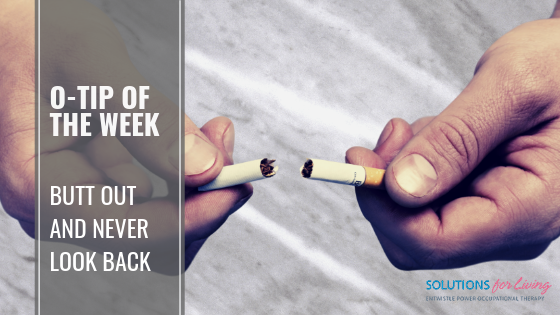
O-Tip of the Week: Butt Out and Never Look Back

Our O-Tip of the week series delivers valuable “OT-Approved Life Hacks” to provide you with simple and helpful solutions for living. 

For the month of January, our O-Tip series will provide you with ways to kick bad habits and establish good ones.  This week we tackle one of the hardest habits to kick – smoking!

According to Smoke Free Ontario, smoking kills approximately 13000 people in Ontario each year.  However, the good news is that the number of smokers continues to decrease yearly.  How can you become one of the quitters? 

A good friend of mine just celebrated her one-year anniversary of being smoke-free after 20+ years as a smoker.  For years she discussed wanting to quit but admits she couldn’t bring herself to do it because of FOMO (fear of missing out).  It wasn’t until she realized that there was nothing to give up and everything to gain that she was able to finally kick the habit. 

Smoking is an addiction and quitting is extremely difficult.  Many need to try different approaches before finally kicking the habit – for my friend, it was the book the “Easy Way to Stop Smoking” by Alan Carr that led to success.  Some other proven ways to butt out are discussed in our post, National Non-Smoking Week– Be a Quitter!

by

O-Tip of the Week: Get in the Habit

Our O-Tip of the week series delivers valuable “OT-Approved Life Hacks” to provide you with simple and helpful solutions for living. 

For the month of January, our O-Tip series will provide you with ways to kick bad habits and establish good ones.  This week we discuss how to create lasting lifestyle changes by forming healthy habits. 

Did you know it can take three weeks or more to develop a new routine or habit?  And following the formation of habits, it can take up to four months to fully change your lifestyle.  Making positive change is a commitment, and with commitment comes accountability.  We recommend using a daily habit tracker, like our free printable below, to help you stay accountable to yourself and your goals.  Ensure you tick the box each and every day and you will be well on your way to creating lasting change!